• Skip to primary navigation
  • Skip to main content
  • Skip to primary sidebar
  • Skip to footer

The Inside Press

Magazines serving the communities of Northern Westchester

  • Home
  • Cover Stories
  • Features
    • Portraits and Profiles
  • Advertorials
    • Lifestyles with our Sponsors
    • Sponsor News!
  • Wellness
  • Happenings
  • Advertise
    • Advertise in One or All of our Magazines–And/Or Subscribe
    • Advertising Payment Form
  • Contact Us
  • Search

Cover Stories

Recognizing Dementia: When it’s Time to Seek Care

December 1, 2017 by Janie Rosman

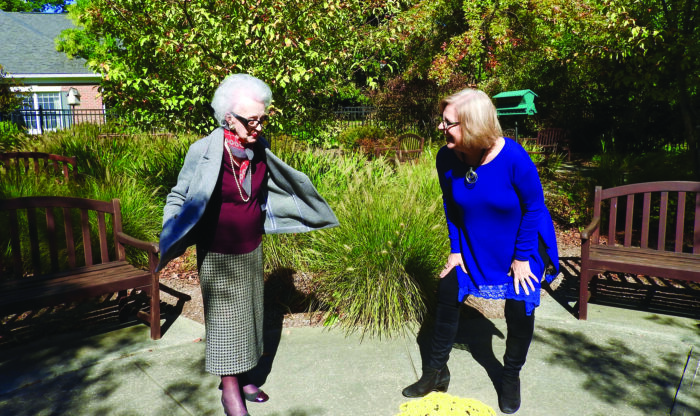
Executive Director Maria Scaros (right) with resident, Virginia, during a Drama Arts Therapy session at The Greens in Greenwich, CT.

Personality changes, difficulty coordinating personal activities and juggling multiple tasks at the same time, getting lost in familiar places–the changes may be gradual when a person develops dementia. As medical professionals learn more about how dementia travels in the brain, they are better able to ascertain how that path affects someone with the disease.
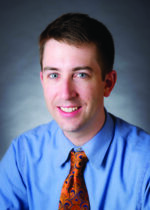
Dr. James Noble
PHOTO COURTESY OF COLUMBIA UNIVERSITY
Dr. James Noble, a neurologist at New York-Presbyterian/Columbia University Medical Center’s Taub Institute for Research on Alzheimer’s Disease and the Aging Brain, said that dementia “is an acquired neurological problem that causes interference with how people live their day-to-day lives.”

Within the umbrella term of dementia, he explained, “Alzheimer’s is the most common form of dementia (other forms are Lewy Body and frontotemporal dementia). In most cases of Alzheimer’s disease, people present with primarily memory loss that may be alongside other cognitive problems.”

Maria Mursch, LMSW, a Care Consultant and Director of Family Education for the Alzheimer’s Association, Hudson Valley Chapter, clarified, “When we talk about the disease, we’re talking about memory loss and about regions of the brain that control functions, judgment, personality/behavior and insight. That’s why we see a multitude of symptoms.”

Noble cited a middle ground called mild cognitive impairment that doesn’t interfere with day-to-day life. “About 50 percent of those with Alzheimer’s are unaware they have a problem, which poses a challenge for diagnoses and delays someone going to the doctor,” he said, unless a caregiver accompanies a patient during a doctor visit.

Often families face a choice between placing their loved one(s) into a home and keeping them in their own home(s) with an aide or additional caregivers. One facility that focuses solely on caring for those with dementia is The Greens At Greenwich, the first assisted living facility in Connecticut designed for people diagnosed with dementia or memory, according to The Greens Executive Director Maria Scaros.

“All our staff is trained in dementia care and engages with residents daily,” said Scaros. Each of its 31 apartments is decorated with residents’ own furniture to give a semblance of familiarity. Outside each door is a glass-enclosed box filled with pictures, tokens and other objects that can spur recognition. “Although age is the biggest single risk factor for Alzheimer’s and other forms of dementia,” Noble explained, “dementia is not part of the normal aging process.” Genetic dementia, while uncommon, presents “in families that have onset under the age of 60, affecting half the family within a generation.”

While families may have expectations and fantasies about the loved one returning to his or her former self, “they are not expected to deal with dementia alone,” Scaros maintained. The facility embraces the entire family, removing the burden of care so they can maintain their roles as spouse, daughter, son and grandchild. “We get to know their family member in the here and now and relate to them as they are in the moment.”

Mursch agreed it’s important to meet the person where he or she is mentally and emotionally. Many patients with Alzheimer’s are first misdiagnosed with depression (the blues), Noble said. “Instead, typical mood changes in Alzheimer’s can be described as ‘get up and go got up and went.’ Addressing this loss of interest in activities can be very challenging. Families may not realize that to engage a loved one in an activity, they need to be proactive.”

A familiar setting will become unfamiliar at some point, Mursch said. “When that starts to happen, we’re looking at someone who progressed in the disease,” she said. “It is important to keep the person comfortable and socializing and active, and there are ways to accommodate the person at home.”

Alzheimer’s Association (https://www.alz.org/) offers support programs and activities and a 24-hour number (1-800-272-3900) that’s answered by the local chapter during work hours and by its national headquarters after hours. Mursch added, “There may be a point when it becomes unsafe to live at home because of the physical environment (i.e. a staircase) or when the caregiver can no longer take care of the person or the situation cannot be resolved by increasing home care.”

Scaros noted The Greens’ biggest competition is home care, which may be the best solution for some. “We need to recognize, however, that when someone says, ‘I want to go home,’ it means, ‘I want to feel safe, secure, loved and engaged.’” Home becomes a feeling rather than a place.

Social activities and cognitive stimulation like hobbies can keep the brain alert. Scaros was trained as a drama therapist and ensures that creative arts therapies are an integral part of The Green’s programs. Lynn Hagerbrant feels the facility goes well beyond the standard of care in sharing, caring and loving for her own parent living there. “They have heart and soul, a caring heartbeat that starts with Maria and flows through all her staff.”

Science continues to research cures for dementia. “New treatments may not be not that far away, and trials to date have helped foresee what next steps to take,” Noble said. For information, visit www.cumc.columbia.edu/dept/taub.

Filed Under: Cover Stories Tagged With: Alzheimer's Association, Alzheimers, Columbia University, Dementia, Disease, Drama Arts Therapy, Genetic Dementia, help, The Greens

Tzahal Shalom Visits Northern Westchester: IDF Soldiers Share Their Stories

December 1, 2017 by Bettina Prober

The Israeli soldiers from the Tzahal Shalom program
PHOTO COURTESTY OF ROBIN GOLDSTEIN

Each October for the past 11 years, Northern Westchester has had some very special visitors, and not just those of the trick-or-treating variety. A delegation of active duty soldiers from the Israeli Defense Forces (IDF) arrives to share their experiences with residents in a variety of formats. The 10-day visit is sponsored by Tzahal Shalom of Northern Westchester, an organization dedicated to creating lasting bonds between many local residents and Israel.

The program, which translates literally to “Welcome IDF to our Northern Westchester community,” was founded by Armonk resident Anita Greenwald and Chappaqua resident Michele Kraushaar in 2006. Its mission is to engage citizens here in the active support of Israel. Given frequent headlines about terrorist attacks and unstable relations with their Palestinian neighbors, many people in the United States are fearful of traveling there, and may have misconceptions about what life is like in Israel. Tzahal Shalom is trying to change that.

Through an assortment of programming aimed at every sector of the community, Tzahal Shalom creates opportunities to meet, interact, and get to know the soldiers. After all, said Anita, “When you care about a person, you care about where they are from. Creating those bonds is what our program is about.”

This year, seven soldiers arrived on October 15 to share their stories and experiences with a diverse set of audiences in Chappaqua and Millwood. They spoke to more than 1,500 people of all ages and religions, as well as local politicians and clergy. The soldiers are all active duty combat officers who have served their required time in the Israeli army and have re-enlisted to further serve their country. Each soldier is recruited and interviewed by the IDF, and, because many of them have never spoken to civilian groups before, prepared for their time here. Though they are not allowed to speak about politics, they are free to speak about anything else. For security reasons, their full identities cannot be disclosed in this article.

Each soldier has a unique perspective they like to share with their audiences. Michal, 21, is an instructions officer in the IDF’s combat engineering corp. Born and raised in Holland by Israeli parents, she is a lone soldier, which means her parents are not currently living in Israel. She decided to enlist in the IDF as a way to reconnect to her Israeli roots. For her, speaking to younger generations has been very meaningful. One of her speaking engagements was at Horace Greeley High School, where she spoke to a senior class.

“[The high schoolers] are at an age where they are old enough to understand what’s going on in the world, and are still developing what they believe in, so they ask very interesting questions,” she said. “I didn’t come to change minds, just to tell my story. They learn something different about another place.”

Omer, 24, is a company lieutenant in the IDF’s reconnaissance unit. Having grandparents who are Holocaust survivors has taught him that “Israel is not something that we can take for granted, so we need to protect it physically … [and we] need support from allies around the world,” he said. “Seventy years ago [many of us] had relatives who were in concentration camps. We have to remember it so we never let that happen again.”

Captain G., a 28-year-old F-16 pilot, is one of the first openly gay pilots in the IDF. “The IDF is inclusive of all different groups of society–LGBT, women, everybody,” he said. Moreover, the IDF is not only tasked with protecting Israel. “Our job is not to make war,” he said, “but to prevent the next war and allow people to prosper.”

The soldiers also spoke of Israel’s many humanitarian missions, which they said, are just as important to the IDF as protecting the country. “People are focused on the military [aspect], but we want people to see all sides and the full complexity of what we do,” Captain G. said. For example, the IDF started a program called Good Neighborhood, which treats injured Syrian refugees. The program was started after an Israeli soldier threw his bandages over a border fence so as to help wounded refugees. The IDF soldiers ensure their safe transportation to and from Israeli hospitals. Since its inception, more than 3,000 Syrian refugees have been treated by both IDF medics and Israeli doctors.

In fact, noted the soldiers, the Israeli government has made a concerted effort to not only aid in disaster relief around the world, but also to, as Omer said, be “the first feet on the ground” after tragedies. After the devastating earthquake in Haiti in 2010, the IDF was able to get one of the first temporary hospitals up and running. Similarly, Israeli troops were deployed to Mexico after the earthquake there this year. “Israel stands for certain values–human rights, women’s rights, and equality,” noted Omer.

During their time here, each soldier is matched with a host family, usually with teenage children at home. During their stay, the families and the soldier often create lasting relationships. The kids in the family usually bond with the soldier like a sister or brother, and the host parents start to view them as one of their own children. It’s not uncommon for soldiers to stay in touch with their host families for years to come. Many families even end up visiting their soldier in Israel. These bonds are paramount to the program, noted co-founder Michele Kraushaar.

That sentiment is echoed by Jackie Moskow, a Millwood resident who hosted a soldier this year. “The best part of this whole experience,” she said, “is watching this relationship develop between our soldier and our kids.” The Moskows are already planning to visit the soldier and his family in Israel this year, and invite him back to the United States for their son’s bar mitzvah next year.   

The soldiers also appreciate the warmth and interest they receive from the community. Though many have been to the United States as tourists, coming as part of the Tzahal Shalom program gives them a deeper understanding of American lives and sentiments toward Israel. “The soldiers leave us with renewed pride and enthusiasm for their service due to the support they feel from us while they are here,” Michele said.

Filed Under: Cover Stories Tagged With: IDF, israel, peace, share, soldier, Tzahal Shalom of Northern Westchester

Grace Bennett and Paul Elliot Honored at HHREC Gala

December 1, 2017 by Stacey Pfeffer

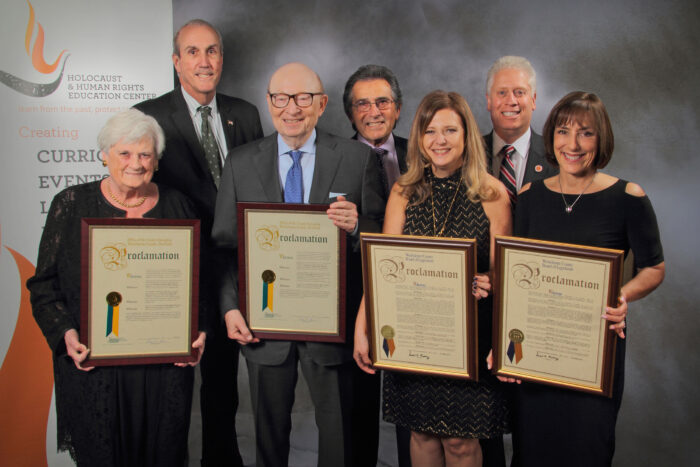
(Left to right): HHREC chair Valerie O’Keeffe; Kevin Plunkett, Deputy County Executive; HHREC honoree Paul Elliot; Mitch Ostrove; Grace; County Legislator Mike Kaplowitz; and HHREC Executive Director Millie Jasper

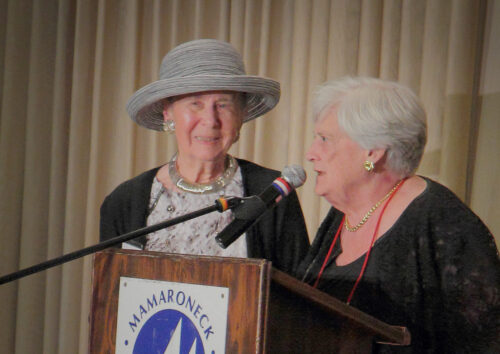
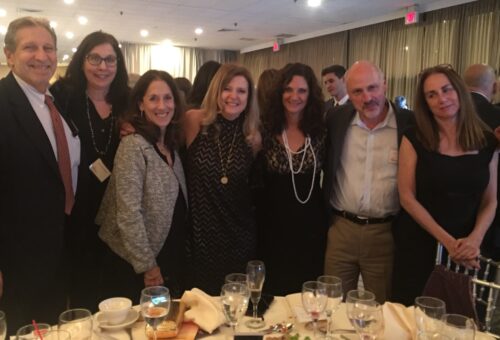
The White Plains-based Holocaust and Human Rights Education Center (HHREC) held their annual gala on October 26th. The room at the Mamaroneck Beach and Yacht Club was packed with supporters dedicated to the HHREC’s mission of “learning from the past, protecting the future.” Grace Bennett, publisher of both Inside Chappaqua and Inside Armonk magazines and Paul Elliot, the Founder & CEO of ELCO Management, a portfolio management company were the evening’s honorees. Also in attendance at the event were Congresswoman Nita Lowey, Westchester County Legislator Michael B. Kaplowitz, Deputy County Executive Kevin J. Plunkett, County Clerk Tim Idoni and New Castle Town Supervisor Rob Greenstein.

Bennett first became involved with HHREC after writing about her father, Jacob Breitstein, a Holocaust survivor in her “Just Between Us” editor’s column in Inside Chappaqua. A reader of the magazine introduced her to the non-profit and she has been an active leader in the organization ever since.

Grace received the Bernard J. Rosenshein Courage to Care Award. She joined HHREC’s Advisory Board in 2004. For the past 13 years, she has made innumerable contributions in her roles on the Board of Directors, the Advisory Board and GenerationsForward.  As the daughter of two Holocaust survivors, Grace has a passion for Holocaust remembrance and has been instrumental in guiding our educational programs,” noted Millie Jasper, HHREC’s Executive Director. She has frequently profiled and highlighted HHREC’s achievements and programming through her magazines and via social media.

Elliot, who is a Chartered Financial Analyst (CFA) has used his business acumen to help several non-profits including the Rabbinical Pension Fund, the Community Synagogue in Rye and the Neuberger Museum of Art in Purchase. He joined the Board of HHREC almost two decades ago.

“Paul was awarded the Eugene M. & Emily Grant Spirit of Humanity Award. He has been an active member of the Board of Directors for 19 years and has shown unwavering support for our programs and events. Most recently he spearheaded the creation of the Endowment Fund, which has seen considerable growth since its inception,” commented Japser.

The HHREC offers several workshops, traveling exhibits and subsidized trips for educators. The Holocaust Survivor Legacy Education Project, an interactive database of the oral history of Westchester survivors is used by teachers to educate their students about the Holocaust. The organization also created a Human Rights Institute (involving approximately 30 schools each year), which helps shape student leaders to fight hate and bigotry in all its forms by introducing the concept of being an ‘upstander’. In addition, the HHREC’s Speakers Bureau helps put a human face on the Holocaust by having survivors and/or liberators tell their stories. Each year the speakers reach more than 25,000 students and adults.

The evening concluded with a moving speech by Ellen Kaidanow, a GenerationsForward member who told the story of her mother-in-law also named Ellen Kaidanow, who was only 5-years-old when her mother, father and two sisters were all forced to move from their beautiful home in the Ukraine to a walled Jewish ghetto. Ellen tells the story of her mother-in-law’s life as a young girl in the ghetto and her miraculous tale of becoming the sole survivor of her family at age six. The GenerationsForward program consists of children and grandchildren of Holocaust survivors recounting their family’s stories as the number of Holocaust survivors is dwindling every day.

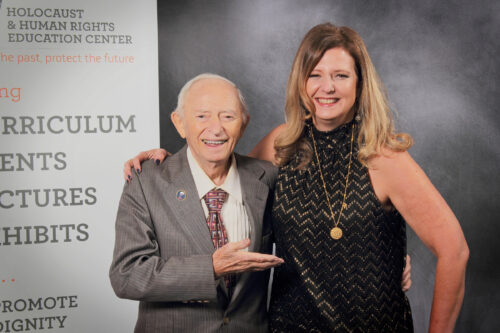
Grace with her father Jacob Breitstein
PHOTO BY WILLIAM LANDIN
Ellen Kaidanow, keynote speaker with Ellen Kaidanow, her mother-in-law.
PHOTO BY WILLIAM LANDIN
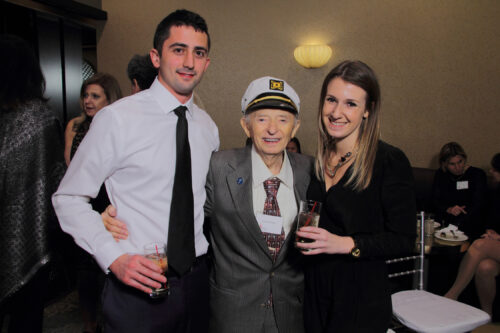
Chris Lane, Jacob Breitstein (Grace’s dad) and Anna Bennett (Grace’s daughter)
PHOTO BY WILLIAM LANDIN
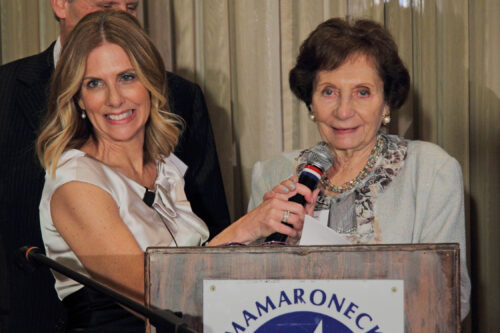
Grace and HHREC Executive Director Millie Jasper
PHOTO BY WILLIAM LANDIN
HHREC honoree Lee Katz and Chair Valerie O’Keeffe
PHOTO BY WILLIAM LANDIN
Hal Levine, Nancy Huehnergarth, Jodi Levine, Grace, Dawn Dankner Rosen, New Castle Town Supervisor Robert Greenstein and Suzanna Hyler
PHOTO BY JANINE CROWLEY HAYNES

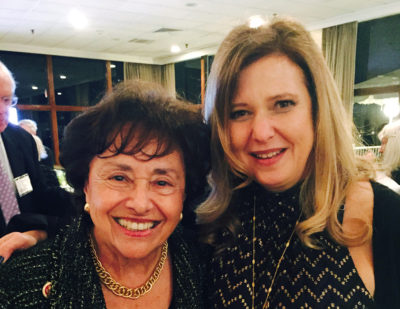
Grace and Congresswoman Nita Lowey

Filed Under: Cover Stories Tagged With: Annual Benefit, Bernard Rosenshein Courage to Care, Courage to Care Award, Ellen Kaidanow, GenerationsForward, Grace Bennett, Holocaust and Human Rights Education Center, Lee Katz, Paul Elliot, Spirit of Humanity Award

Christine Ackerman on Being Open & Engaged

October 22, 2017 by The Inside Press

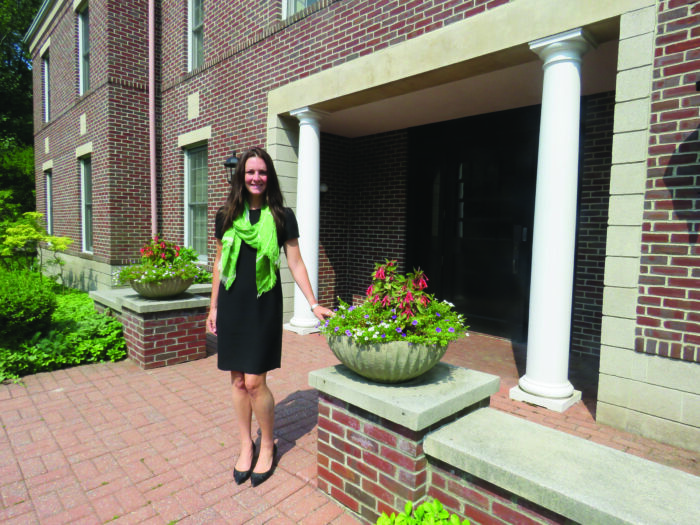
An Avid Runner, the CCSD’s New Superintendent also Goes the Extra Mile to Emphasize Communication, Transparency and Supporting District Wide Initiatives in STEM, Health – and Social Justice, too.

PHOTO BY GRACE BENNETT

BY GRACE BENNETT

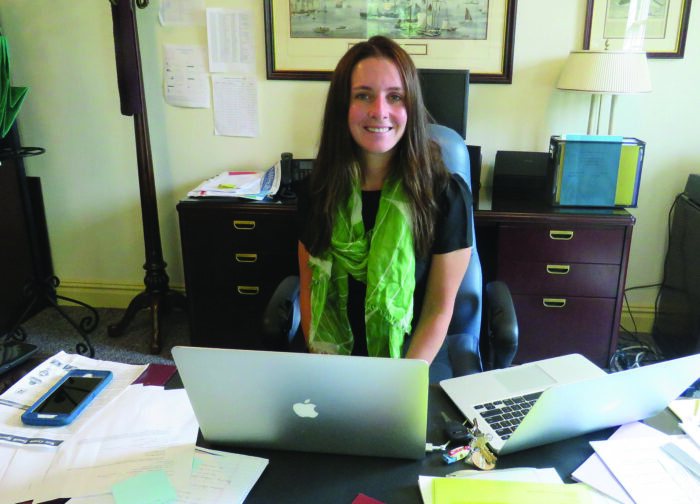
Maybe I’m just getting older, but upon meeting new Chappaqua school district Superintendent Christine Ackerman this past summer, I could not help but marvel at how youthful she seemed; I was certain she was young enough to be my daughter. Ok, well almost! And so I asked her how her youth might lend a reinvigoration of sorts and fresh perspective to our schools while taking on 21st century challenges.

First, some background: Ackerman, only 39 years old, comes to Chappaqua after three years as Superintendent of the Greenwood Lake Union Free School District, following four years as Assistant Superintendent for Curriculum, Instruction and Pupil Personnel Services with the Millbrook Central School District, where she had served as its high school principal for a year and a half. Prior to that, she was Assistant Principal & Director of Social Services at Valhalla Middle/High School, Dean of Students at John Jay High School in Katonah, and a teacher and Dean of Students in the New York City school system.

A native of Vernon, New Jersey and one of four children, she credits her decision to take an unorthodox route for an educator – going directly from college to graduate school to receiving her PhD – as the reason that doors opened very quickly and enable her to compile such an impressive and varied resume for someone so young.

A New and Broader Outlook

“I think I have a fresh perspective. I’ve had a lot of different experiences in various roles within a school district,” Ackerman explained when asked what she brings to Chappaqua. “I’ve been a teacher, an assistant principal, a principal, an assistant superintendent for special ed, for curriculum and instruction, and superintendent, so I think I have a large frame of reference, which I am able to use when I’m looking at different issues, whether they’re instructional or social/emotional.” She elaborated that she will be able to draw from her experiences in diverse districts, “from high-performing districts to the inner-city,” enabling her to work with different constituent groups on a wide range of issues.

She also stressed the value of having her own children (a third grader at Westorchard and a fifth grader at Seven Bridges) enrolled in Chappaqua schools. “I can’t underscore the importance of having my own kids here: it’s very, very important,” said Ackerman, a single mom in the district. “I want people to have confidence in the fact that I feel that this is the best place for my kids to receive an education. I think it speaks volumes, it speaks more than anything I could ever say to have my own children to be able to experience what I feel is one of the best educational experiences they could have in the state, if not the country.”

“When you have children that go through the district, it gives a different perspective, not only as an administrator, but as a mom,” Ackerman continued. “You get real time experience when you’re a mom – the homework, the assessments – you have a different lens because you’re not only looking at it in terms of how the structure and the education and social program are operating, but you’re looking at it in terms of how your own child is experiencing it.” She added that “it lends a different credibility” when people know that decisions she makes as an instructional leader will directly impact her own children too.

As an example, Ackerman described transitioning one of her prior district’s anthology reading program to a writing workshop program – what currently exists in Chappaqua – as the literacy instructional base. Not surprisingly, there were many questions, and she was able to “very clearly say it benefits [the children, including my own] and why these are the practices I’ll be doing with my own children at home to support what’s happening in the classroom.”

Ackerman does not sense any real discomfort of her kids or their teachers in her dual position as Superintendent and classroom mom. “I think [my kids] are proud of their mom, and they see me because I’m very present in the buildings with the kids. For them it’s normal to have their mom walking around the building and going in and out of their classes,” she said. She added that in her prior Superintendent position, if “any initial unfamiliarity with me existed, as time went on and the frequency of my interactions with the people increased, I think that any kind of trepidation dissipated. It would be my goal, though, that people would feel comfortable interacting with me as a colleague, not necessarily as a supervisor, because I think that’s where the best collaboration happens for kids.”

Ackerman’s children, like their mom, however, are most excited about the opportunities available to them in Chappaqua. “The facilities and the extracurricular program in Chappaqua is unbelievable; when it’s all you’ve experienced, you don’t really have a broader perspective of what else is out there for kids,” she said, noting the difference in other schools her children have attended. “When we pulled up to Seven Bridges and my son saw where he was going to school, he was amazed, and so was I,” she added.

“All of our facilities are so thoughtful and designed in a way to really support instruction differently. The opportunities here are endless for our kids, and I am just so privileged that my kids are going to be able to have that same opportunity as other students.”

Full STEAM Ahead: Collaboration and Technology

Emphasizing the high level of instruction in our district schools, Ackerman hopes to even further enhance technological and collaborative tools to even better prepare our students for college and beyond.

“I’m extremely passionate about educational technology, because I feel that we need to prepare students to leave here ready to interact and integrate into a society that is focused on web-based interactions,” she said. “And I also feel that, if you look at college and career readiness standards, we exceed many of the academic standards, but one of the things that businesses really focus on is the ability of kids/employees to work collaboratively to solve real-world problems.”

Ackerman has been very impressed with CCSD’s work with collaborative spaces.

“I think one of the smart, visionary decisions that the previous Superintendent had was the concept of these maker-spaces, because they really have kids applying content in real-life application.” She points to the district’s redesign of school spaces to support STEAM work.

“We have our iLab in the high school, and we’re beginning to think differently in our elementary schools by incorporating some of the practices in our high school. We’re looking at spaces differently.” She described a pilot project at Westorchard “where we’re really looking at our classroom design in a way that supports student collaboration.”

Challenges Ahead

As Superintendent, Ackerman is an integral part of the CCSD Board of Education. “It’s a partnership, so every meeting I’m there with them, preparing the agenda, preparing reports for the community, for the Board of Education on our progress and what we’ve been focused on. We have a very dedicated group of individuals from all sorts of constituencies. I feel so fortunate to be able to work for this Board of Education. They’re really focused on the kids.”

Upon arriving in Chappaqua, Ackerman has had numerous “entrance meetings” with different constituent groups, all confirming the CCSD’s strength. “The faculty, staff, and administrative team are extremely strong, very professional, and devoted to our kids in a way that’s probably unique compared to other districts,” she said. “You have some of the top people in their profession working in this district with our students. This is where you want to teach: the professional development, the commitment of the community towards providing the best education for the children here, is unparalleled.”

One of the biggest challenges facing the district that she has been asked to focus on is communication and transparency. “Some of the things that we’re already in the process of engaging in will be re-designing our website, thinking about how we’re structuring our board meetings, talking about what can we share versus what can’t we share, and just being really cognizant of making sure that people feel comfortable with the processes that we have in place,” Ackerman explained.

“We have a lot of committees – including communications – that look at a lot of many different aspects of our program,” she continued. “I look forward to leveraging some of those committees to talk about what I heard in entrance meetings. One of the things that we’ve been talking about in terms of communication is our social media presence – we really don’t have one. Can we have a voice on social media? These are all things that are important but they’re a process and they take time,” she added.

Ackerman thinks that the team in place is up to the challenge, brushing aside the idea that a consultant or public relations firm might be needed. “I just think we need to work with the people that we have and work with our parents to all be comfortable, because I think, in terms of people feeling like they want more communication from the district that can get that feedback from our community and use that to figure out how we’re going to move forward.” Ackerman is on it.

She noted that she has already engaged in some outreach with local publications, this one included. “I think we need to look at that,” she said. “I’ve already made some contact with our local media providers, I’ve tried to build relationships with our newspaper, because I think there’s a lot going on here that we can highlight as well. I feel like it’s an opportunity for us.”

Ackerman also recognizes that there is work to be done as far as instilling strong values in students of an affluent district. She recalled that one of the focus areas of this past summer’s administrative retreat was the social and emotional growth of students, which she described as an integral piece of the academic program and “one of our responsibilities.”

“I know that there’s been a lot of work done in individual buildings around this particular issue with staff members and under the leadership of the administration, so one of the areas that I know we’re going to look at collaboratively as a district K-12 is how we’re all working collectively on that important component of the academic program,” she said.

She also noted the need to help the student body appreciate diversity and build tolerance. “I support social justice [and was] trained by the Social Justice Institute,” Ackerman said. “I find that it has to be embedded in the curriculum and that it’s something that happens on a regular basis in the classrooms through teachers interactions with kids, but I also know there’s value in having teacher-student connections and individual conversations that focus on these issues specifically.” She is working on figuring out how to structure the school day around promoting “common values that we all value as humans and that we need to partner on and complement each other from home to school.”

Shown here with Christine Ackerman (L-R): Georgia Rappaport, Sara Albert, School Board member Vicki Tipp, Luke Leopold and Jared Saiontz

Nutrition and Fitness

Ackerman, an avid runner (five to seven miles every morning before going to work), is an advocate in fitness and healthy eating, for herself, her children and the students in the district. “I think it’s important for my own kids to see me valuing my health and to be healthy, so I am committed to making sure that our kids [do the same],” she said. She also notes the evidence that supports how nutrition affects school performance; “there’s so much research that supports how students come to school, and what happens in the morning, particularly around what they’re eating in terms of preparing them for instruction, so I think how our kids spend their lunch breaks and what they eat during their lunch breaks are important, absolutely.”

First Impressions

One of Ackerman’s early experiences as the CCSD Superintendent was marching in the town’s Memorial Day Parade and meeting Hillary and Bill Clinton and Governor Andrew Cuomo. “It was amazing for me to be able to be in the presence of the former President and the Secretary of State. They took time with me to find out where I was from, and offered their assistance with any support that I would need. They affirmed to me how great the community was. I was honored,” she said. However, what impressed her even more was that the Board of Education immediately followed these illustrious residents in the parade. “What I found most telling though about that experience, and this really for me put in perspective how much this community values education, was the parade order was the President, Secretary of State, the Governor, and the Chappaqua Board of Education. That was amazing to me.

To see that level of commitment that this community has toward its schools and respect,” Ackerman recalled.

The school year got off to an exciting start, too, with a packed-house September 8 community event celebrating the new Greeley track and field under the newly-installed lights. “This community event was designed to foster a sense of togetherness amongst our K-12 students and community,” she said. “We also wanted to take a moment to truly celebrate our new facility that will be used by all facets of our community.” Indeed, the event was attended even by Chappaqua’s youngest residents and enjoyed by all.

An emotional and inspiring event on that same field followed several weeks later, as the Greeley boys’ varsity soccer team dedicated a home game to one of its own who tragically passed away this summer. “One of my most memorable moments so far was watching the boys’ soccer team honor Casey Taub [who had worn uniform number 22] by leading the crowd in a standing ovation as they played during the 22nd minute of a recent home game,” Ackerman recalled. “The senior captain even scored a goal at 22:22 – it was such a moving tribute to this young man. I continue to be impressed by the quality of instruction and the caliber of students who are members of the Chappaqua Central School District community.”

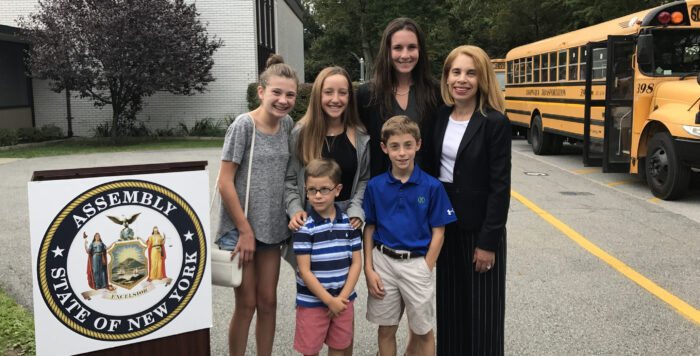
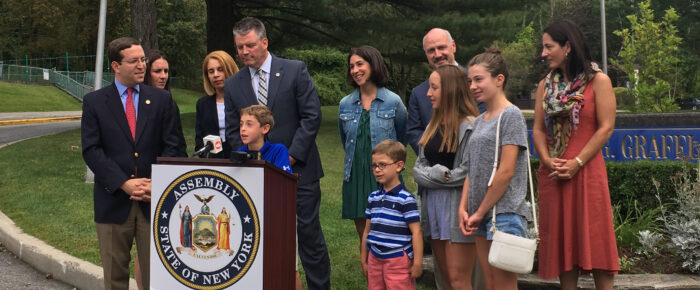
PHOTO BELOW (Left to Right): State Assemblyman David Buchwald, Superintendent Christine Ackerman, CCSD Board Member Vicki Tipp, Senator Terrence Murphy, Jared Saiontz at the mic, Stacey Saiontz, Town Supervisor Rob Greenstein, Liz Rappaport, Luke Leopold, Sara Albert, Georgia Rappaport (holding white bag). Additional people who have helped advocate for the bills and traveled to Albany who are not pictured are: Patty Albert (mom), Elliott Saiontz (older brother of food allergic child); Heather Brown (mom) and Spencer Brown (food allergic child); Jill Mindlin (mom) and Maya Mindlin (food allergic child); and Jon Terrry (advocate whose sister passed from allergic reaction to a bee sting).

She is also impressed with the philanthropy and advocacy of student and parent groups. For example, “our students and parents worked together to advocate for legislation that would allow bus drivers who are not employees of the District to administer EpiPens.” She added that “we are currently working to develop a Board of Ed policy in conjunction with Chappaqua Transportation to support our students in this way.”

To that end, Ackerman wanted the community to be aware that the District will be engaging in “a strategic cohesive planning process to identify long and short term goals in relation to the Board of Education’s strategic questions over the course of this school year.” And most importantly, Ackerman stressed that she is available to talk with anyone about any issue.

“I am available and people can feel free to contact me if they need help, if they want to talk to me, they have ideas, I’m open. They can email me at chackerman@ccsd.ws or they could set up a meeting. I’m here, I’m open, and I’m here to be their partner. I’m really looking forward to those experiences with people here.”


Bus Drivers Get Green Light to Administer EpiPens

At her first press conference for the district at Douglas Grafflin Elementary School, Christine Ackerman joined parents and students and Westchester sponsors of a new law passed to protect and save the lives of students who suffer from severe allergies. Assemblyman David Buchwald and State Senator Terrence Murphy co-sponsored the legislation which now allows school bus drivers and others employed by firms providing services to schools to administer epinephrine when a child suffers anaphylaxis shock.

Christine Ackerman: “Our students and parents worked together to advocate for legislation that would allow bus drivers who are not employees of the District to administer EpiPens.”

David Buchwald: “The New York State Department of Health will need to move quickly to issue the regulations necessary for the timely implementation of this act.”

Terrence Murphy: “When a child experiences anaphylaxis, there is little time to wait for emergency personnel to arrive. Every second is crucial.”

Advocate Stacey Saiontz: “Recently, a school bus driver in Massachusetts saved a student’s life when emergency personnel could not arrive on the scene in time. I am so pleased New York school bus drivers will be able to do the same.”


Grace Bennett is Publisher and Editor-in-Chief of Inside Chappaqua Magazine. This interview was edited by long time Inside Press contributor Debra Hand. Special thanks as well to intern Amanda Kraus for transcribing.

Filed Under: Cover Stories Tagged With: Administration, Bus Drivers, CCSD Superintendent, Chappaqua Central School District, Christine Ackerman, EpiPen, health, nutrition, school

Helping New Castle Voters Make Well-Informed Decisions

October 22, 2017 by Lindsay Hand

The New Castle League of Women Voters works hard to educate locals on the issues.

These days it is nearly impossible to discuss anything related to politics and not be biased, opinionated, and usually also argumentative. However, organizations such as the League of Women Voters are working to do the exact opposite. The League educates voters in a comprehensive, non-partisan way, allowing voters to get a full and all-inclusive understanding of the major issues so that they can make well informed voting decisions.

Looking Back: League History

The League does not back particular candidates or parties but instead presents the issues and the facts. It might sound crazy, but it’s true! In its almost 100-year existence, the League has maintained its nonpartisanship. “It is important for us to remain unbiased, to be trusted to allow both sides of a story and all candidates to present themselves,” says New Castle Voter Service Director Mary Kirsch, who was a member of the New York City League in the 1970s and has been involved since 2011.

The League of Women Voters, founded in 1920, stemmed from the women’s suffrage movement. The League was originally set to assist these new voters in taking on the new responsibility of voting. The League continues to do this, encouraging women to actively participate in making crucial decisions pertaining to their lives and their counties and states, as well as the nation as a whole. (Fun fact: Some decades ago, the National League voted to include men as members!) The New Castle League, founded in 1950, continues the tradition put forth by the original League and today has 120 members.

Meeting the Contenders: Candidates’ Nights

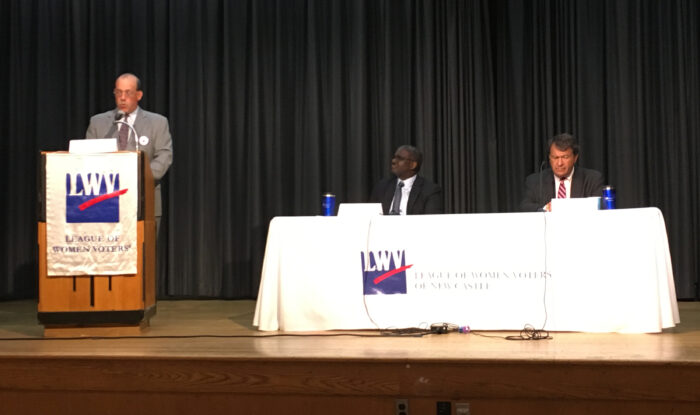
The New Castle League, currently headed by co-Presidents Sheila Bernson and Jennifer Mebes Flagg, is very active, and works hard to make sure all local voters are informed about what the issues are and where the candidates stand. The most notable way this is done is through ‘Candidates’ Nights,’ which have long been a staple of League activities throughout the country. “We have heard from residents how much they appreciate our Candidates’ Nights,” Flagg says, “and how it was the deciding factor in their selection of a particular candidate.”

Typically held at the Chappaqua Library for the New Castle League, these events allow candidates for certain positions and institutions (for example, the Board of Education and Library Board) to appear in public and answer questions so that voters can get a clearer idea of where the candidates stand on the issues in an open, fair, and respectful environment. The League is currently planning for a Candidates Night on October 25th for the Town Board positions. Representatives from Team New Castle and Stronger New Castle will be the featured.

Now planned by Kirsch, the Candidates’ Nights are presented as a forum in a format similar to a debate, with questions coming from both moderators from the Westchester League as well as audience members interested in learning more about where the candidates stand. With recordings and livestreams, Candidates’ Nights have become widely accessible for all local voters, including many younger residents. “Many young residents of New Castle want to be involved and informed about the pressing issues facing our community and country,” explains Kirsch. “The League is a very good, reliable and trustworthy source of information and conversation.”

The moderated forums follow the same basic structure, following guidelines that have been in place for years, each time: candidates have up to two minutes for an opening statement, then the moderator poses a question from the League, and finally the floor is opened for attendees to ask questions. These events are a well-organized and a civil way for both the New Castle League to help inform local voters of the issues and for the candidates themselves to have a chance to speak with their constituents, face-to-face. “There is nothing like seeing people in person, interacting with their peers and opponents. I feel more comfortable choosing someone based on that kind of presentation,” adds Kirsch. “What can you tell from glossy brochures?”

The New Castle League has established itself as an important part of our community. From events like Candidates’ Nights and educational forums to luncheons and philanthropy work, the New Castle League is present throughout the community and works hard to bring people together and educate local voters before they go make decisions that have real, tangible effects on themselves and others.

The League sets an excellent example for nonpartisan politics and informing voters of the basic issues, without the other noise that often comes along with anything in the political sphere. With the New Castle League of Women Voters providing so many local opportunities, New Castle residents can head into the voting booths feeling confident they understand the issues and know they are voting for a candidate who espouses similar political beliefs.

Filed Under: Cover Stories Tagged With: League of Women Voters of New Castle, LWV, vote, women

  • « Go to Previous Page
  • Page 1
  • Interim pages omitted …
  • Page 93
  • Page 94
  • Page 95
  • Page 96
  • Page 97
  • Interim pages omitted …
  • Page 149
  • Go to Next Page »

Primary Sidebar

Please Visit

White Plains Hospital
William Raveis – Armonk
William Raveis – Chappaqua
Northwell Hospital
Houlihan Lawrence – Chappaqua
Houlihan Lawrence – Armonk
Houlihan Lawrence – Briarcliff
NYOMIS – Dr. Andrew Horowitz
Westchester Table Tennis Center
Spavia
Compass: Miller Goldenberg Harris Team
Lipari & Mangiameli Dentistry
Raveis: Lisa Koh and Allison Coviello
Bristal Assisted Living
Maid Brigade
Kevin Roberts Painting & Design
Zwilling J. A. Henckels
Meagher & Meagher Attorneys at Law
Compass: Aurora Banaszek
Dr. Briones Medical Weight Loss Center
EyeGallery
Elliman: Pam Akin
OuterBoundaries travel
Houlihan: Kile Boga-Ibric
Donna Mueller
New Castle Physical Therapy
Beascakes Bakery
Joseph Richard Florals

Follow our Social Media

The Inside Press

Our Latest Issues

For a full reading of our current edition, or to obtain a copy or subscription, please contact us.

Inside Pleasantville and Briarcliff Manor Inside Chappaqua and Millwood Inside Armonk

Join Our Mailing List


Search Inside Press

Links

  • Advertise
  • Contact Us
  • Digital Subscription
  • Print Subscription

Publisher’s Note Regarding Our Valued Sponsors

Inside Press is not responsible for and does not necessarily endorse or not endorse any advertisers, products or resources referenced in either sponsor-driven stories or in advertisements appearing in this publication. The Inside Press shall not be liable to any party as a result of any information, services or resources made available through this publication.The Inside Press is published in good faith and cannot be held responsible for any inaccuracies in advertising or sponsor driven stories that appear in this publication. The views of advertisers and contributors are not necessarily those of the publisher’s.

Opinions and information presented in all Inside Press articles, such as in the arena of health and medicine, strictly reflect the experiences, expertise and/or views of those interviewed, and are not necessarily recommended or endorsed by the Inside Press. Please consult your own doctor for diagnosis and/or treatment.

Footer

Support The Inside Press

Advertising

Print Subscription

Digital Subscription

Categories

Archives

Subscribe

Did you know you can subscribe anytime to our print editions?

Voluntary subscriptions are most welcome, if you've moved outside the area, or a subscription is a great present idea for an elderly parent, for a neighbor who is moving or for your graduating high school student or any college student who may enjoy keeping up with hometown stories.

Subscribe Today

Copyright © 2026 The Inside Press, Inc. · Log in