• Skip to primary navigation
  • Skip to main content
  • Skip to primary sidebar
  • Skip to footer

The Inside Press

Magazines serving the communities of Northern Westchester

  • Home
  • Cover Stories
  • Features
    • Portraits and Profiles
  • Advertorials
    • Lifestyles with our Sponsors
    • Sponsor News!
  • Wellness
  • Happenings
  • Advertise
    • Advertise in One or All of our Magazines–And/Or Subscribe
    • Advertising Payment Form
  • Contact Us
  • Search

Cover Stories

Bearing Witness at the 75th Anniversary of the Liberation of Auschwitz

March 22, 2020 by Stacey Saiontz

Train tracks leading into Auschwitz – prisoners were transported in cattle cars

Elie Wiesel stated “To hear a witness is to be a witness.”  I am a witness. On January 27th 2020, I traveled to Auschwitz for the 75th Anniversary of the liberation of Auschwitz with 105 Auschwitz Survivors from around the world and 50 world leaders to commemorate the victims and honor the Survivors.

The memorial service took place on the grounds of the death camp where

1.1 million, mostly Jews, were murdered. We sat under a large heated tent that straddled the train tracks that had dragged prisoners into Birkenau, often to their death in the gas chambers. As Ronald Lauder, president of the World Jewish Congress, stated “I am here, simply, as a Jew. And, like all Jews everywhere, this place, this terrible place called Auschwitz has sadly become an inseparable part of us. Auschwitz is like a scar from a terrible trauma.  It never goes away and the pain never stops.”

Walking into the camp I quietly reflected on my grandparents stories of survival. I took in the remains of the barracks, including the barrack where my grandfather spent his youth being tortured against his will. The weather was cold but I was well bundled and couldn’t help but think about my grandfather who was forced to spend his time in Auschwitz without a warm jacket or hat or gloves.

I listened to each Survivor as they shared intimate details about their own personal stories, details that humanized the unfathomable atrocities of Auschwitz. Details that I will shout out to the world and share with future generations so they know the Holocaust happened to men and women and children with personalities and stories, like all of us, not to abstract numbers.

The Survivors all related stories about how upon their arrival at Auschwitz over 75 years ago, they were stripped of their dignity, forced to strip down to nothing in front of all, have their heads shaved, their possessions stolen and arms permanently tattooed with a number.  94- year-old Auschwitz Survivor Batsheva Dagan spoke about her arrival and subsequent assignment of being forced to sort belongings of those sent to the gas chambers.  She cried to the crowd,  “Where was everybody? Where was the world who could see that, hear that and yet did nothing to save all those thousands?”

Turning A Blind Eye on the Jewish Refugee Crisis

In his speech Lauder explained “And when European Jews begged the world for a safe harbor, someplace to go, the entire world turned its back on them. Even my own country–the beacon of freedom–turned out its light on the Jewish people when they needed it most. The US organized a conference in Evian, France in July of 1938 to discuss the Jewish refugee crisis. There were a lot of lovely speeches but the US did not let any additional Jewish refugees in and every other country in attendance followed their lead. There were 32 countries and none of them, except for the tiny Dominican Republic wanted any more Jews.  Hitler saw this. Four months later came Kristallnacht. And again, there was no world reaction. Hitler tested the world. And at every step he saw the truth–the world did not care. That’s when he knew he could build this factory of death. Evian led to Auschwitz. Kristallnacht led to Auschwitz.  World anti-Semitism led to Auschwitz.”

Survivor Josef Kreitenberg commented “I don’t know how I survived but I just kept on believing because that’s all you could do.”

Survivors are Dwindling

As the years pass and the eye witnesses who can say “I was in Auschwitz” dwindle in numbers, these Survivors made it their duty to return to ensure the world does not forget! Polish President Andrzej Duda vocalized “We have with us the last living Survivors, the last among those who saw the Holocaust with their own eyes. The magnitude of the crime perpetrated in this place is terrifying, but we must not look away from it and we must never forget it.”

For some of the Survivors it was their first trip back since that day 75 years ago when they were finally free from their terror. However, for most it will be their last. But to all the Survivors who returned the memories of what occurred inside the infamous gate bearing the words “Arbeit Macht Frei” (translation: work sets you free) are no less haunting today. Survivors continue to have nightmares as their memories are still fresh. However, Survivors feel the need to share these painful memories with future generations so the world will never forget, especially today when we witness the ominous growth of anti-Semitic attacks and hatred around the world.
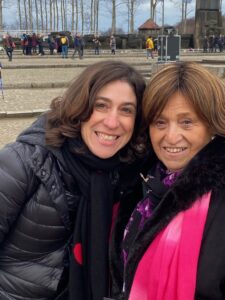
The author with Survivor Angela (Angi) Orosz Richt. Angi was born in Auschwitz on December 21 one month prior to the camp’s liberation.

No Graves to Visit

Some of the Survivors returned to Auschwitz to memorialize their family members murdered there. These Survivors whose family members went up in flames in the gas chambers and crematorium do not have a grave to visit.  To them, Auschwitz is a cemetery. Survivor Tova Friedman said “My going back is my telling them, I remember you.”

Survivor Ben Lesser explained: “People would love to forget the hard truths and that’s why we need to keep coming back here to refresh our memories and keep the world from acquiring amnesia. Unfortunately, we can’t live forever. What happens after we are gone, I don’t know.”

  93-year-old Survivor Marian Turski declared “Auschwitz did not fall from the skies.” He urged the next generation to be vigilant.  “Do not be indifferent when you hear lies, historical lies. Do not be indifferent when you see the past is stretched to fit the current political needs. Do not be indifferent when any minority is discriminated against.”

Survivor Marian Turski

The 11th Commandment

He explained that the 11th commandment should be “Thou shall not be indifferent.”  He warned that if you “don’t heed the 11th commandment you cannot be surprised when you see (another) Auschwitz fall from the sky.” He explained that if people are indifferent when incremental steps of discrimination are implemented, then another Holocaust could happen. Turksi reminded the room that what allowed the Holocaust to happen was not just the evil of the Nazi’s but also the indifference of the world.

Lauder emphasized “We will never eradicate Anti-Semitism. It’s a deadly virus that has been with us for over 2,000 years. But we cannot look the other way and pretend it isn’t happening. That’s what people did throughout the 1930’s and that is what led to Auschwitz.”

The Nazis tried to dehumanize and obliterate all Jews of Europe. But the 75th Commemoration attended by over 200 survivors proved that Nazi’s did not win. These Survivors signify that the Jewish people won. They survived and were resilient. “There is one more part of the Auschwitz story that no one ever talks about.  When the Survivors were liberated from this Nazi nightmare, they never sought revenge.  They lost their mothers and fathers. Sisters and brothers… After everything that happened to them, these Jewish Survivors just walked out of these gates and went on to build new lives, raise new families, work hard and create,” said Lauder.

After the long day of memorializing in Auschwitz, we arrived back at the hotel for a late dinner. By 11 p.m., Auschwitz Survivor David Wisnia asked for a microphone and explained that he wrote a song while in Auschwitz–a parody about life in the death camp. On January 27, 2020, 75 years after the liberation, David Wisnia, a man full of life, sang this song proudly from his wheelchair to a room full of witnesses who will NEVER FORGET.

All the Survivors agree that they do not want their past to be their grandchildren’s future. The Survivors on this journey did not talk about anger or revenge, but rather their love for their new life and family.   I felt embraced by love on the trip by Survivors who ironically were treated with the worst type of hate, and whose lives were torn apart by hate. Through conversations with the Survivors on my journey and with my grandparents throughout my life, I have learned that the Holocaust is not just a story of hate. It is also a story of resilience, humanity, love and kindness. People who are taught to put others before themselves; people who are taught to love, those people do not hate–rather, they choose life.
Filed Under: Cover Stories Tagged With: 75th Anniversary, Auschwitz, Auschwitz Survivors, holocaust, Memorial Service, refugee, Stacey Saiontz, survivors

Update On Redistricting Downtown Chappaqua

March 22, 2020 by Amy Kelley

Several merchants are in favor of a change in zoning but note that many customers still travel by car so ample parking is a necessity

People like to live in places that have walkable downtowns. But the reality is that online shopping has impacted many local merchants significantly, and if the hamlet of Chappaqua is going to thrive, town planning must ensure the area is kept vibrant as it faces modern pressures.

The Town of New Castle has had a new comprehensive plan since 2017, and many of the action items provided for in the plan are now underway. One of these is the adoption of a new type of zoning code, which may happen this fall. The code, Sabrina D. Charney Hull, director of planning for the Town of New Castle, said, aims to provide a framework for making many positive changes to the hamlet of Chappaqua that residents have requested.

“I’ve been working for the town for seven years and part of my job is to update the town’s comprehensive plan,” Charney Hull said. The last comprehensive plan New Castle had was completed in 1989 but was never formally adopted. It’s a tremendous undertaking, and the time had come to move forward with creating a new one.”

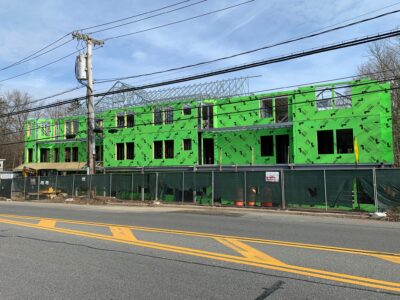
Merchants hope these apartments on Bedford Road will bring in more foot traffic to downtown

“My responsibility was to update the Comprehensive Plan in an efficient and timely manner,” Charney Hull said. In 2014, New Castle contracted with the Pace Land Use Law Center to canvass the community with a survey, to find out what residents wanted for their town. There were also public meetings and other means of outreach. “You name it, we did it,” Charney Hull said.

Diverse Housing Stock Needed

Overall the feedback indicated, besides other things, that New Castle residents wanted a revitalization of the town’s hamlets, including a walkable, livable, eco-sustainable downtown Chappaqua. Residents indicated that while they highly valued open spaces and their single-family neighborhoods, they also wanted a greater diversity of housing stock to provide more options for residents to downsize once they had raised their families, and to enable more young people to live in Chappaqua. This is particularly important for town services dependent on volunteers, like the fire department and ambulance corps. “There’s a record low in volunteering because there’s no population to volunteer,” Charney Hull explained.

These responses and more were incorporated into the town’s 2017 comprehensive plan, which aims to recognize and respond to the many changes that have taken place that impact the town since the last plan. Among these are the internet, which has changed shopping habits drastically. Merchants need more foot traffic to overcome online competition.

Additionally, “as millenials’ (the younger generation’s) economic self-sufficiency increased and the baby boomers (older generation’s) age, these populations are becoming more interested in amenities, housing, services and entertainment options that are accessible without a personal vehicle or through public transit. Also, there is a trend to introduce “healthy living” and “active lifestyles” into everyday actions” (plannewcastle.us/abouttheplan). New Castle residents want to create a “diversity of housing,” Charney Hull said.

The plan also recognizes modern post-9/11 security and disaster/emergency preparedness concerns, as well as modern concerns for environmental stewardship. When the town board adopted the comprehensive plan, the town hall held a full house of supportive residents, Charney Hull said.

Foot Traffic Needed Downtown

When looking to create opportunities for more diverse housing stock, it made sense to look at downtown Chappaqua–it has a train station, it’s connected to town sewer and water. The infrastructure is there, and that’s where merchants need foot traffic.

In neighboring Mount Kisco, efforts are also underway to revitalize the downtown, but there, the village has decided to work with a master developer, while Chappaqua has decided to approach change by considering moving to form-based zoning.

One of “active actions” provided for in the plan is a revision of the zoning code. “Right now we have zoning that’s called Euclidean zoning,” Charney Hull explained. “You zone by use–houses in one area, businesses in another, industrial uses in another area.” That’s how it has been since the 1920s, when that type of zoning was needed for health and safety reasons. However, the kind of zoning now proposed is called form-based zoning.

“We know the existing zoning isn’t conducive to today’s commercial market and we also know we don’t have enough feet on the street,” Charney Hull said. “When creating a walkable, livable environment, the first step is to look at your zoning.”

Defining a Form-Based Code

A form-based code is “a land-development regulation that fosters predictable built results and a high-quality public realm by using physical form (rather than separation of uses) as the organizing principle for the code,” according to the Form-Based Codes Institute. That means that residential and commercial uses may coexist in the same area, while attention is paid to the architectural harmony of the buildings, and how they relate to public spaces such as sidewalks, no matter what they contain. (Of course, Charney Hull pointed out that in downtown Chappaqua, there will be allowable uses–not all uses will be allowed.) Charney Hull said that anyone developing a property in the Chappaqua downtown area will have seven or eight architectural templates they can draw from, which will describe how the detailing on windows, trim boards and so on, should be.

Charney Hull said response from business and property owners in the hamlet has been “very positive.” That’s because “right now it’s not economically viable to re-develop,” Charney Hull explained. “Our existing code at 2-3 stories is not developable.” An expert hired by the town determined that the numbers don’t work–developers won’t be motivated under the existing code. If the proposed new zoning code is adopted in the fall, buildings on Greeley Avenue and lower King Street can be built to four stories.

Merchants Weigh In

Of course, one major part of this plan of action is that there be no net loss of existing parking. “It would be good for the businesses,” Angelo Tradito, owner of the Old Stone Trattoria on King Street, said of the proposed zoning code. “I think it’s better for the town to have more mixed-use… it’ll bring new people to Chappaqua.” While Tradito’s business is on the west side of King Street, farther from the train station and Greeley Avenue, he said he does get some foot traffic currently.

“Not a lot, but some,” Tradito said. There are apartments behind the building housing his restaurant, and a new building going up across the street that Tradito said may bring more pedestrians to his place in the future. However, currently most of his patrons come by car.

Trish Kallman, owner of hip-kid in the heart of downtown Chappaqua, notes that she is in favor of changing the zoning. “I’m for it as long as it’s respectful of the look and feel of the town. I get that people want the beautiful bucolic downtown feel. But it’s not very vibrant right now.”

Kallman said that a change in zoning would benefit people who live in Chappaqua as well as the merchants. “As long as certain things are protected,” she said. “You don’t want it to look like a city.” Patrons of hip-kid generally come by car at this point, although Kallman said it would be nice if new zoning resulted in more downtown residents who could shop there.

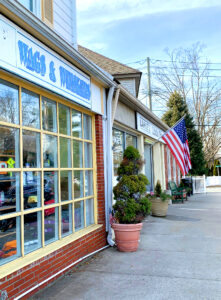
Christine Meyer, owner of Wags & Whiskers, is less optimistic about potential future foot traffic if the zoning changes. Meyer’s business is located on the west end of King St, across from Walgreens. Most of her customers come by car. But Meyer did say more foot traffic would “absolutely” be a good thing for the hamlet.

“It’s up to the individual property owners,” Charney Hull said, to determine when existing properties are re-developed under a new code, should it be adopted. It will likely be up for a vote by the town board as soon as the fall. “The community is spearheading this,” Charney Hull pointed out. “It’s what they have asked for, and the town board has been supportive of this process throughout.”

Filed Under: Cover Stories Tagged With: Chappaqua, Comprehensive Plan, diversity, Downtown Chappaqua, hamlet, lifestyles, merchants, public transert, Redistricting, Town Planning, walkable downtowns

Our Volunteer Firefighters – Tradition, Sacrifice, and Rewards

February 22, 2020 by Ella Ilan

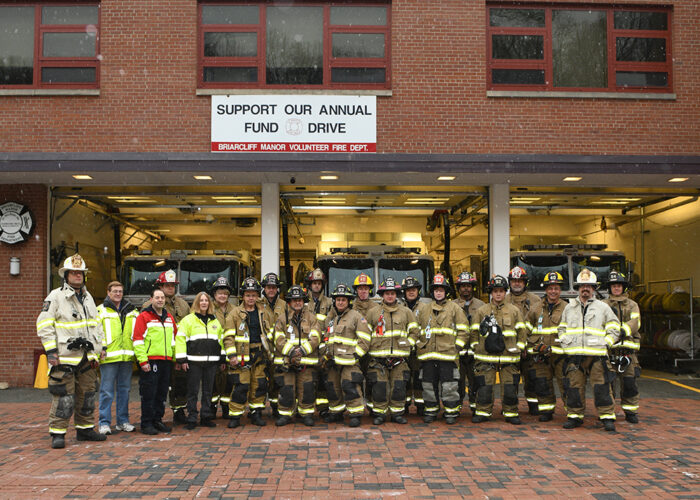
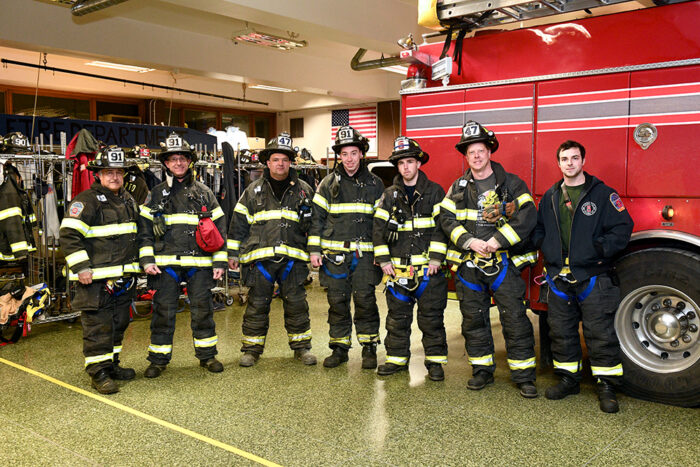
PHOTOS BY DONNA MUELLER

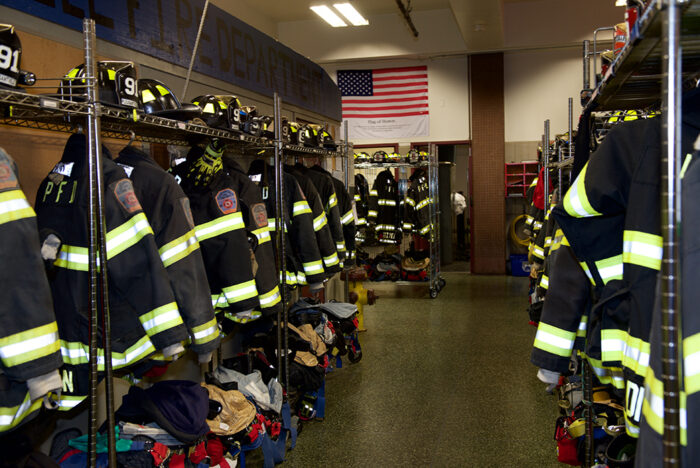
While we sleep soundly in the night, pagers go off and rouse the best and bravest amongst us. Answering the call of the horn, whether at 3 a.m. or 3 p.m., our volunteer firefighters step away from their daily lives to help their fellow citizens.

“I don’t think I’ve ever encountered someone on an emergency call that wasn’t happy to see us,” says Briarcliff Volunteer Fire Department First Assistant Chief Vincent Caruso, a 13-year member of the Briarcliff Fire Department. “It’s a great feeling when people see you and feel that help is here.”

Driven to Serve the Community

The Briarcliff Fire Department, The Ossining Fire Department, and The Pleasantville Fire Department are all 100% volunteer.

For some members, it’s in their blood and they are following in the footsteps of fathers and grandfathers.

“It’s our family tradition,” says Ossining Firefighter Rob Reaman of Rescue 14. “My grandfather was an ex-captain out of Chappaqua out of The J.I.D. [Bristol Engine Company], my uncle was an ex-captain out of Columbia Hose [Company] in Sleepy Hollow, my mom was president of Rescue 14 in Ossining, my father pretty much served everything and was in Cataract Hose [Company] for 28 years on Waller Avenue and then came back to Rescue 14 for about seven years now.”

Pleasantville Fire Chief Stephane Zapletal always had an interest in the fire department and joined as a teenager 19 years ago. “I’m a first generation firefighter but my wife’s family has four generations of firefighters and she’s the captain of the Pleasantville Ambulance Corps.”

Some members join after serving in a junior firefighter program during high school and others decide later in life that they want to give back to the community in this way.

Briarcliff’s Chief Caruso began his career working on the Volunteer Ambulance in high school. Finding it to be both noble and exciting work, he joined the Briarcliff Fire Department ambulance in 2006. “I planned on just riding as an EMT but soon found that I can be a fireman too. I did the training, got bit by the fire bug, worked my way up and it’s been a pleasure leading the group.”

Briarcliff’s Second Assistant Chief Arie Uyterlinde joined eleven years ago. After participating in a new employee orientation at Montefiore Medical Center geared towards caregivers, he was struck by the value of what these caregivers were delivering to patients. “As a corporate employee, this appealed to me and I wanted to contribute and have a positive impact on people’s lives. I saw signs up for volunteers just at the right time and decided to join. It’s really been a life changing experience.”

Pleasantville Fire Commissioner Dan Cultice joined in his forties. “I have a business in town and I wanted to give back to the community. It’s been very rewarding.”

The Challenge of Recruitment

All three departments struggle with the need for more volunteers. These departments were started when this area consisted of a primarily blue-collar population. This meant people stayed locally for work and were thus far more available to respond to calls than they are today. “With a good deal of our residents commuting to work in the city and not getting back until the evening, it can take double the number of members to cover the same amount of calls as it took when residents worked locally,” says Uyterlinde. “We need more members to ensure adequate coverage.”

“Anyone, no matter where you are, if you’re interested, go out and find your local fire department or EMS,” implores Caruso. “I don’t care where you live–I guarantee they need volunteers.”

“We will welcome and train anybody,” says Cultice. “I’m proud of our diversity. It’s a real melting pot. We have financial analysts from Wall Street, creative directors, architects, and blue-collar workers. We have men and women. It doesn’t matter if you don’t traditionally work with your hands.”

What It Takes

Interested candidates must be 18 years of age, have a clean record, and live or work in or near the town for which they volunteer. Recruits are trained in-house in the ways their particular department functions. Westchester County provides more substantial training that is required of all interior firefighters through the “Firefighter 1” training program at the Fire Training Center located in Valhalla. Interior firefighters can go into a burning building to extinguish fires or rescue victims. Some volunteers choose to help out as exterior firefighters whereas they can help out at the scene of an event but not go inside a burning building.

Firefighters undergo annual health screenings and occasionally physicians will limit someone’s active ability.

“Generally, people understand their own limitations and may dial back their functions on their own, if necessary,” says Uyterlinde. “Older members sometimes grow into more of a mentor role as opposed to a doer themselves. There’s a real tradition of having a lot of respect for your senior members because of the experience they bring to the table.”

“We have more than a handful of guys, each with 50 plus years of experience, and I regularly go to them for advice,” says Pleasantville’s Chief Zapletal.

Fearless Firefighters

All of the firefighters interviewed explained that they generally felt excited, rather than scared, upon getting a call. “You definitely get an adrenaline rush because it’s your job to start thinking ahead about what could be happening, what tools you’ll need, and what team you have that showed up at the fire house,” says Cultice. “We have a short amount of time to make the right decisions but we’re not scared because we’re well-trained and you know the firefighter next to you is going to have your back.”

Unforgettable Moments

Many of the departments’ calls leave indelible images in the firefighters’ minds that they cannot reveal to the public, because sharing them would be insensitive to the victims involved.

The interesting ones, however, are fun to share. Uyterlinde recalls a Christmas eve call where the police and fire department were called to investigate a self-combusting package. A package that had been received a week earlier and had been sitting on a living room floor started smoking. The homeowner brought it outside where it proceeded to catch fire. Although firefighters expected to find a battery or explosive within the package, it merely contained a purse. The Cause and Origin team reconstructed the scene and determined that sunlight coming through a window was concentrated by a snow globe that had been moved near the package onto a small piece of the box. This burned a hole through the box, caught the paper packaging inside the box on fire, and then proceeded to burn from inside the box out.

Zapletal recalls a fire where the hose supplying water was laid across the road and a car ran over it, bursting the hose and causing the water pressure to rip the hood off the car.
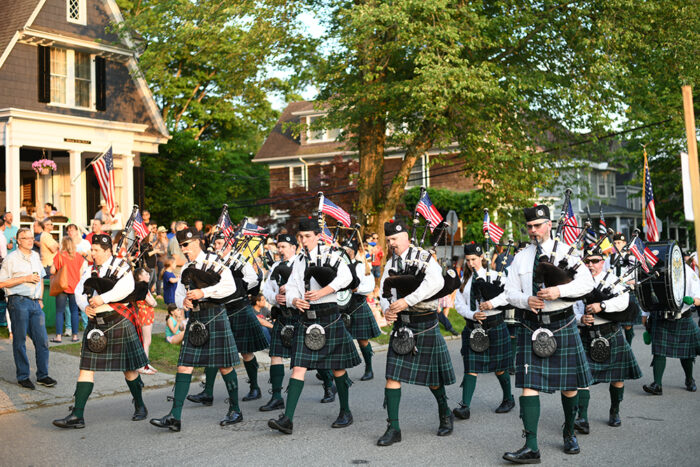
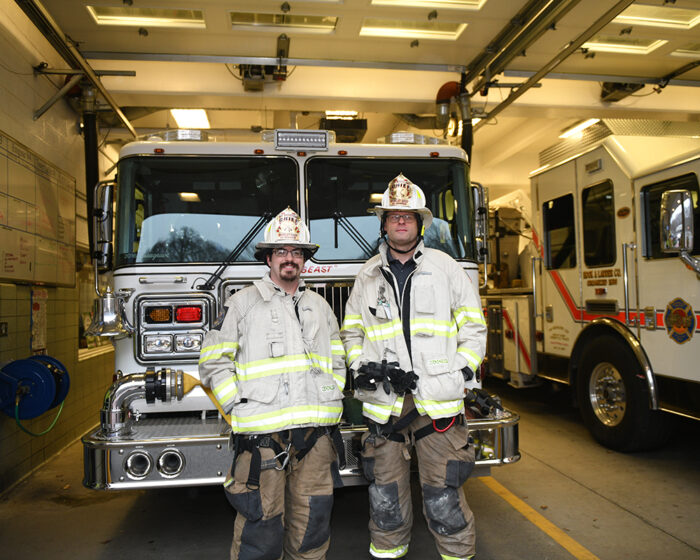
Relating some of his more enjoyable memories, Cultice recounts what it’s like to be one of the moms and dads running into the high school as a firefighter when an alarm goes off in one of the chemistry classes. “It’s always memorable when you see people in the community,” he says.

A Continuing Legacy

Each of the fire departments has a true appreciation for its history.

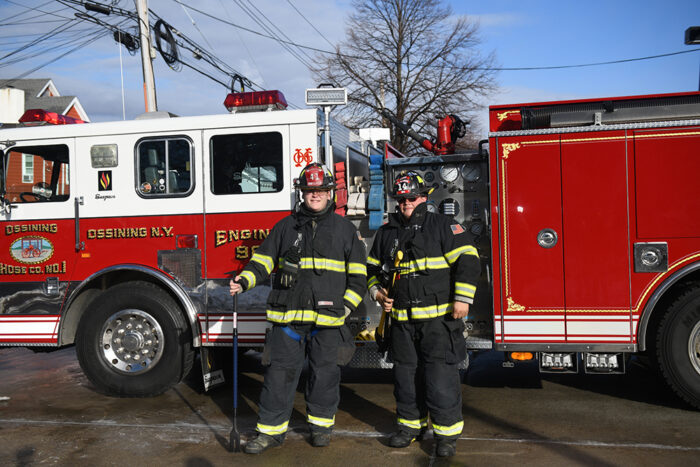
The Ossining Fire Department’s history stretches back farthest. As Westchester County’s first volunteer fire company, Washington Engine company was organized in Sing Sing in 1812. They purchased a gooseneck hand engine originally owned by the first organized fire company of New York City known as Engine No. 1. Today, the department boasts nine companies that operate six Engines, two Ladders, one Rescue Truck, one R.I.T. Truck, and one Spill Response Trailer. These nine companies were gradually added over the years to keep up with the growing population.

The Pleasantville Fire Department celebrated their 125th anniversary last year with a big party. When William H. Jahne organized the Pleasantville fire department in 1894, there were no streets, paved roads, municipal water, or sewer. The members used buckets of water to extinguish fires. Today, Pleasantville has four senior companies, a junior corps, and an auxiliary.

Just a few years later, in 1901, Frederick Messinger and a group of 13 other local men founded Briarcliff Steamer Company No.1. Briarcliff Steamer Company is no longer in existence, but there are currently three active companies; Briarcliff Fire Engine Company, Briarcliff Fire Hook and Ladder Company, and Scarborough Engine Company, which was formed to improve fire protection in the west part of the village.

As a nod to their storied history, Briarcliff is one of the only departments in the area that runs white apparatus, as opposed to red. The trucks are white to memorialize the white horse-drawn dairy carts donated by Walter Law, the “Laird of Briarcliff Manor,” who owned a large portion of this area, to be used as fire apparatus.

Proudly affixed to the Briarcliff fire trucks are the antique bells that are handed down from truck to truck. Ensuring that the legacy lives on, every time they buy a new truck, the department makes sure to specify a custom mount to hold a 100-year old bell.

Neighboring Departments Support Each Other

“We have a great relationship with our surrounding volunteer departments,” says Cultice. “If there is a large incident, we will ask other departments to join us. We will provide back up to our neighboring departments at a fire or go to their firehouse in case they get another call. We work together, train together and invite them to our firehouse for large events. I’m very proud of that kind of organization and camaraderie.”

For more information or to volunteer, please head to the fire department’s websites. For Briarcliff, go to www.bmfd.org. For Ossining, go to www.ossiningfire.org. For Pleasantville, go to www.pleasantvillefire.org.

Filed Under: Cover Stories Tagged With: 100% Volunteer, Answering the Call, Briarcliff Fire Department, courage, diversity, Fellow Citizens, help, Ossining Fire Department, Pleasantville Fire Department, Tradition, Volunteer Firefighters

Pollinator Pathway Gardens: Gaining Local Support

February 22, 2020 by The Inside Press

Pollinator pathway garden in downtown Chappaqua. Prior to this, the area was full of weeds.

Article and Photos by Missy Fabel

Just last year at a meeting of the Earthwatch Institute, a prominent environmental non-profit, scientists declared the bee to be the most important living being on the planet. This notion was shared by Albert Einstein more than a century ago who boldly stated that “if bees disappear, humans would have four years to live.” Yet bees are at risk of extinction. In fact, in some regions of the world, they have disappeared up to 90 percent.

While that news is sobering, local residents and county-wide initiatives are doing their part to keep bees and other pollinators happily buzzing in the communities of Northern Westchester.

Bees, butterflies, birds and even bats are all pollinators that play a vital role in the transfer of pollen from one plant to another, enabling fertilization and the production of fruit and seeds. More than 30% of our food grows as a result of pollinators. Yet, the habitat loss of native plants and widespread use of pesticides and herbicides are causing worldwide decline of pollinators.

The History Behind the First Pollinator Pathway

Sarah Bergman started the very first Pollinator Pathway in Seattle more than a decade ago as part of a social and ecological project to combat the decline in pollinators. In an effort to connect two green spaces more than a mile apart, Ms. Bergman went door to door to the homeowners in-between to create a mile long 12-foot-wide corridor of pollinator friendly gardens, a literal “pathway” to sustain pollinators with pesticide-free habitat and nutrition.

With increasing public awareness of the decline of pollinators, particularly native bees, Bergman’s idea caught on. In 2018, Norwalk, Wilton and Ridgefield together with Hudson to Housatonic Regional Conservation Partnership (H2H) set up the first Pollinator Pathways in Connecticut. Westchester followed their lead and New Castle Pollinator Pathway Coalition (NCPPC) is among the more than 16 municipalities, organizations and hundreds of individuals joining Pollinator Pathways in Westchester.

Pollinator Pathway sign on Route 120 

Pollinator Pathways in New Castle

The New Castle Pollinator Pathway Coalition (NCPPC) is a volunteer effort consisting of individuals and organizations that support pollinators by connecting properties and green spaces to create a more hospitable environment for bees, butterflies, birds and other wildlife.

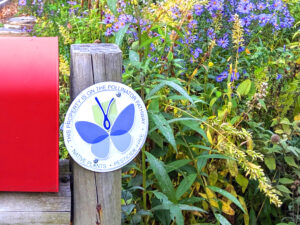
Pollinator Pathway signs have been popping up in New Castle on resident’s mailboxes and downtown near the train station in recent months. These signs mark just some of the properties that are part of the NCCPC.

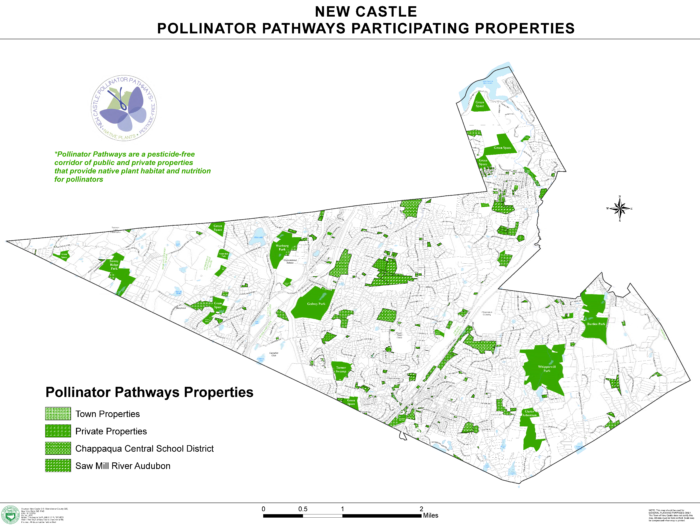
According to New Castle resident Victoria Alzapiedi, founder of New Castle Healthy Yards and co-chair of NCCPC, more than 130 public and private properties are already on the Pathway and the list is growing. “I’m so excited that there are so many property owners in our community signing on to the New Castle Pollinator Pathway. Not using pesticides and other lawn chemicals and adding native plants–including specific host and nectar plants for each species of butterfly, moth, and bee–will attract these important insects to your yard and provide a haven for them to live and to thrive,” Alzapiedi explained.

Pollinator Friendly Gardens Gain Traction in Other Towns

Garden clubs and other organizations in Pleasantville, Bedford, North Castle and other towns in Westchester are also spreading the word, through education, outreach and the creation of pollinator friendly gardens.

“Our mission includes educating people about ways to help the planet,” says Phina Geiger, president of the Pleasantville Garden Club, whose members planted a demonstration garden next to a playground in Mt. Pleasant this past spring. “Many of the plants we used were ones from our yards, tried and true locally sourced native plants that people may not know about, but can come and see and be inspired to use in their own yards. The Pleasantville Garden club is also partnering with their Parks & Recreation department to promote Pollinator Pathways in other areas of town, she added.

Plans to add native and pollinator friendly plants are also in the works in Armonk. This spring, the North Castle Public Library is adding native trees, shrubs and perennials to its foundation planting as part of the New York Library Association (NYLA) state-wide Sustainable Library Certification Program. “We wanted to enhance the landscaping in front of our library,” says Edie Martimucci, Director of North Castle Public Library, “and using native plants just makes sense from an environmental and sustainability standpoint.”

Tips for Creating a Pollinator Friendly Garden

Whether you live in an apartment with a balcony, a typical suburban home, a large estate or are a commercial business in town, everyone can participate in Pollinator Pathway by avoiding the use of pesticides and choosing native plants. Nature preserves, such as Glazier Arboretum in New Castle, Eugene and Agnes Meyer Preserve in North Castle, town and county parks, schools, typical backyards and front yards, even window boxes can help support pollinators.

“It’s simple, really,” declares Filipine de Hoogland of Westchester Pollinators. “Many people already have native trees and shrubs in their yards with natural pesticide free areas. If we connect our pollinator friendly yards, we can construct pathways. Pathways create safe territory for our pollinators and other wildlife to survive.” She also suggests informing your landscaping company about the steps you are planning to take to create a pollinator friendly yard, so they can help you achieve your goals.

A bee on wild sweet William 

Year-Round Needs for Pollinators

Pollinators need nectar and pollen in all seasons. Native spring flowering trees and shrubs are an important nectar and pollen source early in the season as well as common native plants often considered “weeds,” such as the common violet. Violets provide nectar as well as leafy greens for the recently hatched butterfly larvae of the Great Spangled Fritillary. Consider leaving violets and other wildflowers in your lawn in spring.

Aster and goldenrod are vital sources of both nectar and pollen in the fall. White wood aster naturally colonizes the woodland edges common in suburban landscapes and can easily be encouraged to spread. Leaving some leaf litter in your garden or natural area also helps support pollinators by providing cover for overwintering insects.

Local Pollinator Events On the Horizon

Look for NCPPC and Westchester Pollinator events this spring and summer, including activities to celebrate the 50th anniversary of Earth Day as well as national Pollinator Week, June 22-28. In addition, mark your calendar for The Chappaqua Garden Club’s Mother’s Day weekend plant sale from May 7-10. The sale offers hundreds of native plants including specific pollinator friendly plant combination kits for sun, shade, wet and dry areas, according to Chappaqua Garden Club co-president Melanie Smith. For more information, visit chappaquagardenclub.com

Missy is a native plant landscape designer and consultant, teacher, writer and  naturalist in Chappaqua. She is a Steering Committee member of the Native Plant Center at Westchester Community College, a member of the Town of New Castle Conservation Board and co-chair of the NCPPC.

For more information on Pollinator Pathways and how to start one in your town, visit: https://www.pollinator-pathway.org

How to Join the Pollinator Pathway Initiative

  • Include native plants on your property for all seasons
  • Avoid using pesticides and herbicides
  • Consider leaving some bare ground for nesting native bees and leaving some autumn leaves for overwintering eggs and pupae of pollinating insects

If you reside in New Castle, register at: pollinator-pathway.org/new-castle


Why are Pollinators Under Threat?

  • Habitat loss due to urban development and agriculture
  • Widespread application of pesticides
  • Climate change

Filed Under: Cover Stories Tagged With: Bees, Butterfles, Downtown Chappaqua, Earthwatch Insititute, environment, Fertilization, garden, Habitat Loss, Hudson to Housatonic Regional Conservation Partnership, landscaping, Moths, Native Plants, NCPPC, New Castle, New Castle Healthy Yards, New Castle Pollinator Pathway Coalition, non-profit, North Castle Public Library, parks, Pesticide Dangers, Pleasantville Garden CLub, Pollinator Pathways, Pollinator Week, private properties, schools, Westchester

Town Board Inauguration Welcomes Incumbents & Newcomers

February 22, 2020 by Kiran Sheth

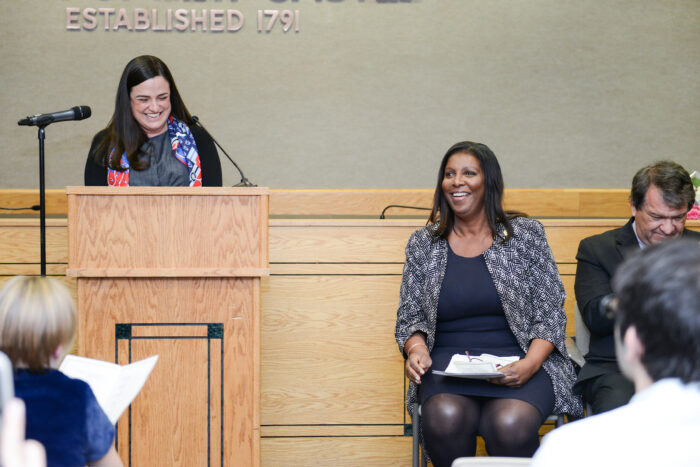
L to R: Town Supervisor Ivy Pool, NY State Attorney General Letitia James and County Executive George Latimer

PHOTOS By Carolyn Simpson

On January 27th and before a packed Town Hall, New Castle inaugurated a new Supervisor and three Council Members, two of whom are newcomers to the Town Board. The ceremonies opened with the presentation of colors by various town first responders including the New Castle Police Department, fire departments from Chappaqua and Millwood and the Chappaqua Volunteer Ambulance. In an audience that included New York State Attorney General, Letitia James, and Westchester County Executive, George Latimer, the elected officials were administered their oaths of office.

The inauguration was the culmination of the hotly contested November 5th election between candidates from two slates–New Castle Democrats and the Republican-sponsored Team New Castle. In addition to the Town Supervisor, there were three Town Board positions that were up for election.

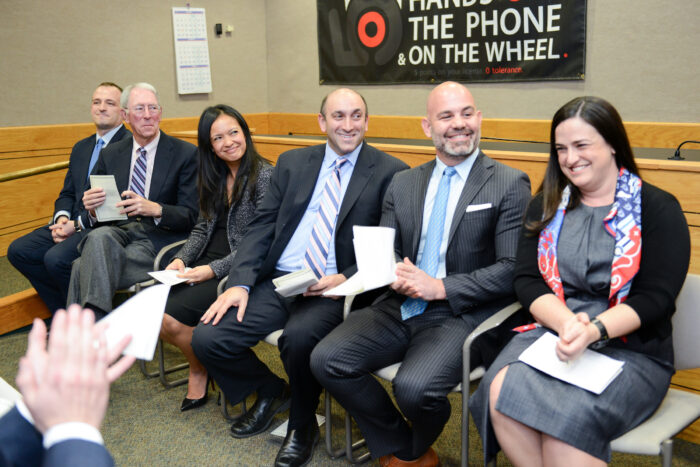
L to R: County Legislator Vedat Gashi, Town Justice Douglas Kraus, Town Board member Lauren Levin, Town Council member Jason Lichtenthal, Deputy Town Supervisor Jeremy Saland and Town Supervisor Ivy Pool

Ivy Pool was elected from the New Castle Democrats and succeeds Robert Greenstein as Town Supervisor and will serve a two-year term. Pool was first elected as a Council Member in 2017. Jeremy Saland, having assumed his position on the Town Board in 2015, was re-elected and will also serve as Deputy Town Supervisor. Jason Lichtenthal, who ran with Pool and Saland as part of the New Castle Democrats ticket, was also elected as a Council Member. Lichtenthal has served as a Commissioner in the Millwood Fire District. Lauren Levin joins Lichtenthal as the other first-time Town Board member. Levin ran on the Team New Castle slate and has served on the Chappaqua-Millwood Chamber of Commerce board and Streetscape Committee. Saland, Lichtenthal, and Levin will join the existing member, Lisa Katz, on the four-person Town Board.

Town resident and member of the Chappaqua Ambulance Volunteer Corps, Reese Highbloom commented on what he expects the new Town Board will accomplish. “I hope that the new board members can be a great face for the New Castle community, get to know each and every one of us and really hear what we want and what we have to say.”

Pool stated that the Town Board has an ambitious agenda and has prioritized certain initiatives including creating thriving hamlets, modernizing infrastructure, thoughtful capital planning and improving recreation and community spirit. “There are a lot of different goals and objectives that the Town Board has put together for what we hope to accomplish,” Pool affirmed. “The most immediate thing that we are working on right now is a rezoning initiative for downtown Chappaqua. We have done a great deal of work replacing infrastructure, but now we are ready to take that to the next step.”

Deputy Supervisor Saland emphasized Pool’s determination for the rezoning of the hamlet. “We are working on the form-based code to revitalize the hamlet. It is what the community wants and is consistent with the comprehensive plan.” Saland stated that the Town Board is eager to get to work for the people of New Castle. “I am excited to work with everybody on the Town Board; everybody is very eager, very hungry, very smart and very dedicated.”

Lichtenthal holds the belief that the town needs to come together in order to initiate progress and change. “We are in a time where we need to work together a little bit more than the past and we must come together with new ideas to move our town forward,” Lichtenthal passionately explained. He encourages the community to bring forth and share their ideas with the new Town Board. “Unless people come out and tell us how things are going and how they see New Castle, we are not going to be able to move forward as a community.”

Also sworn in during the evening’s events was Douglas Kraus for Town Justice. The incumbent Kraus was re-elected to his 7th term having served in the position since 1994. Vedat Gashi was also administered the oath of office for County Legislator representing District 4. Gashi, a Democrat, will represent New Castle and portions of Somers and Yorktown on the Westchester County Board of Legislators.

At the end of the ceremony, Pool concluded with how she anticipates the new Town Board will serve the people of New Castle. “Here in New Castle, we can and will do better. The only way that we are going to get things done is to forge partnerships and engage all voices.”

Filed Under: Cover Stories Tagged With: Douglas Kraus, George Latimer, inauguration, Ivy Pool, Jason Lichtenthal, Jeremy Saland, Lauren Levin, Letitia James, Lisa Katz, New Castle, Town Board, town supervisor, Vedat Gashi

  • « Go to Previous Page
  • Page 1
  • Interim pages omitted …
  • Page 75
  • Page 76
  • Page 77
  • Page 78
  • Page 79
  • Interim pages omitted …
  • Page 149
  • Go to Next Page »

Primary Sidebar

Please Visit

White Plains Hospital
William Raveis – Armonk
William Raveis – Chappaqua
Northwell Hospital
Houlihan Lawrence – Chappaqua
Houlihan Lawrence – Armonk
Houlihan Lawrence – Briarcliff
NYOMIS – Dr. Andrew Horowitz
Westchester Table Tennis Center
Spavia
Compass: Miller Goldenberg Harris Team
Lipari & Mangiameli Dentistry
Raveis: Lisa Koh and Allison Coviello
Bristal Assisted Living
Maid Brigade
Kevin Roberts Painting & Design
Zwilling J. A. Henckels
Meagher & Meagher Attorneys at Law
Compass: Aurora Banaszek
Dr. Briones Medical Weight Loss Center
CPW Vein & Aesthetic Center
Decicco and Sons
Houlihan: Kile Boga-Ibric
Terra Tile & Marble
New Castle Physical Therapy
Pinsky Studio
Houlihan: Tara Siegel
Beascakes Bakery

Follow our Social Media

The Inside Press

Our Latest Issues

For a full reading of our current edition, or to obtain a copy or subscription, please contact us.

Inside Pleasantville and Briarcliff Manor Inside Chappaqua and Millwood Inside Armonk

Join Our Mailing List


Search Inside Press

Links

  • Advertise
  • Contact Us
  • Digital Subscription
  • Print Subscription

Publisher’s Note Regarding Our Valued Sponsors

Inside Press is not responsible for and does not necessarily endorse or not endorse any advertisers, products or resources referenced in either sponsor-driven stories or in advertisements appearing in this publication. The Inside Press shall not be liable to any party as a result of any information, services or resources made available through this publication.The Inside Press is published in good faith and cannot be held responsible for any inaccuracies in advertising or sponsor driven stories that appear in this publication. The views of advertisers and contributors are not necessarily those of the publisher’s.

Opinions and information presented in all Inside Press articles, such as in the arena of health and medicine, strictly reflect the experiences, expertise and/or views of those interviewed, and are not necessarily recommended or endorsed by the Inside Press. Please consult your own doctor for diagnosis and/or treatment.

Footer

Support The Inside Press

Advertising

Print Subscription

Digital Subscription

Categories

Archives

Subscribe

Did you know you can subscribe anytime to our print editions?

Voluntary subscriptions are most welcome, if you've moved outside the area, or a subscription is a great present idea for an elderly parent, for a neighbor who is moving or for your graduating high school student or any college student who may enjoy keeping up with hometown stories.

Subscribe Today

Copyright © 2026 The Inside Press, Inc. · Log in