• Skip to primary navigation
  • Skip to main content
  • Skip to primary sidebar
  • Skip to footer

The Inside Press

Magazines serving the communities of Northern Westchester

  • Home
  • Cover Stories
  • Features
    • Portraits and Profiles
  • Advertorials
    • Lifestyles with our Sponsors
    • Sponsor News!
  • Wellness
  • Happenings
  • Advertise
    • Advertise in One or All of our Magazines–And/Or Subscribe
    • Advertising Payment Form
  • Contact Us
  • Search

Armonk Cover Stories

Local Author Tackles Tough Topic in Latest Children’s Book: Repeating Kindergarten

August 29, 2018 by Julia Bialek

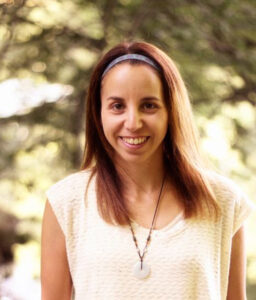
Becca Eisenberg, book author

It is always inspiring to meet people who are guided by their passion, especially when that passion is helping others. Rebecca Eisenberg who goes by “Becca,” a speech language pathologist, author, instructor, parent, and Armonk resident epitomizes that sentiment. A proponent of children’s literature, Eisenberg recently self-published a children’s book entitled My Second Year of Kindergarten aimed at providing parents and teachers with a resource on the topic of repeating kindergarten. The inspiration for the book? Her own experience.

They say necessity is the mother of invention and Eisenberg can attest to that. When she and her husband made the difficult decision to have their son repeat kindergarten, she searched for a children’s book to help explain the transition to her son; disappointed to have found no such publication, Eisenberg decided to write her own. “As a speech pathologist and mother, I have always looked for children’s literature to help explain difficult transitions or complex issues, and when I was looking for a book about repeating a grade, there was no book at all! I decided I was going to write my own. I tend to create my own work when I can’t find it. I read the draft to my son, and he loved it. The more I thought about it, the more I was devoted to putting it out there,” says Eisenberg.

Inspiring a Growth Mindset

For over two years Eisenberg worked hard to create a book with which all children and parents could identify. My Second Year of Kindergarten is about a boy named Peter, named for a student she worked with who defied all odds and learned to spell, write, and communicate beyond expectations, who is repeating kindergarten. The book follows Peter’s progress from “last year” to “this year,” highlighting the skills Peter gains from repeating the grade. With this book, and the reading guide for educators and parents she created to accompany it, Eisenberg hopes to inspire a growth mindset for children by changing the default attitude from “I can’t do it,” to “I’m learning how to do it.”

Eisenberg draws from her own personal experience to offer advice to parents who are considering having their child repeat kindergarten. Tips such as, “Be honest! Explain the reasons why you have made the decision to have your child repeat kindergarten,” and “Connect with other parents whose children already repeated kindergarten” are compiled in the back of her book. Although Eisenberg had what she described as an “ideal experience” with repeating kindergarten (due to a supportive school and family), Eisenberg knows that some people still treat the topic as something shameful and not to be discussed. Through her book, she hopes to change that. By starting meaningful and honest conversations through literature, she is well on her way.
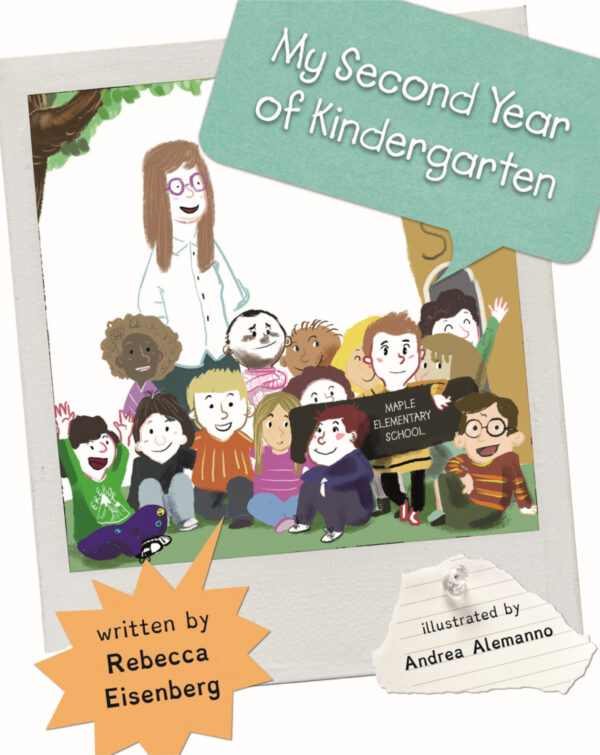
Although Eisenberg believes that repeating kindergarten does indeed have benefits, she does not advocate it for every child. “If a child is repeating kindergarten, there is a reason for it; either social or academic delays,” explains Eisenberg. “When parents and their ‘team’(their school and other individuals involved in the decision) make the decision to repeat kindergarten, it is about making the best decision for the child.” Eisenberg stressed that she did not write the book to promote the idea of repeating kindergarten for all children, but rather to provide a resource for the families who decide that their child will benefit from it. Some benefits she cites of repeating the grade include social closeness with peers and more time to understand information, which can increase a child’s confidence and happiness at school.

Web Resources for Parents, Children and Educators

As a web savvy author, she also created a website www.mysecondyearofkindergarten.com to serve as a resource. With downloadable worksheets for children and podcasts it offers valuable information so that children repeating a grade can view it as an empowering and positive experience. In addition to the website for the book, she writes an impressive blog called www.gravitybread.com that forms the foundation for all of her work and emphasizes learning during mealtimes. Since 2012, she has updated her blog with language tips, special needs resources, book and app reviews, her interpretations of research articles, and other information with the goal of sharing her passion of connecting with children through storytelling with other parents.

Hearing her talk about her book, her blog, and the other resources she has created with such pride, Eisenberg’s profound commitment to others shines through.

“I have always been passionate about helping other people, for work and in my life. Ever since I was little I have felt the desire to help people with different abilities and needs. It is just a part of who I am.” She truly embodies what it means to put your heart into your work.

Kindergarten Skills

Deciding whether or not to repeat kindergarten can be a very hard decision for families. Dawn Lorenz, a kindergarten teacher at World Cup Nursery School in Chappaqua for 24 years, notes that children entering kindergarten should have the following skills:

  • The ability to listen attentively
  • Follow multi-step directions
  • Stay on task for increasing periods of time
  • Work cooperatively
  • Resolve conflicts socially
  • Function independently (put on shoes, use bathroom independently, etc.)
  • Transition between tasks or locations
  • Follow classroom rules
  • Ask for help when needed

Lorenz warns parents against having their child repeat kindergarten so they can gain an advantage in academics or sports. “There needs to be a clear reason to repeat the grade. It isn’t about being the oldest, fastest, best, or smartest, it is about that individual child and how they will feel during that kindergarten year. Childhood is a journey, not a race; the social-emotional skills are a foundation for academics, now and in the future, so we should not rush our kids to attain skills. We need to respect that five-year-old year and how important it is to a child’s life and development,” she explains.

Potential Reasons to Repeat Kindergarten

  • Social or emotional immaturity
  • A slower developmental timeline
  • Any reason that leads you to suspect that your child may need just a bit of extra time

Lorenz says that she has never had parents who came back to her regretting their decision to have their child repeat kindergarten, but there are many parents who wish they did make that decision because their child just was not ready yet. “We have to make the decision based on our individual children after taking into consideration advice from the “experts” in our lives (whether that be teachers, school districts, preschool directors, etc.).”

“There should not be any embarrassment or stigma at all if you are making the decision for the appropriate reasons for your individual child. You want to set the stage for the rest of their career in education–you want them to be happy and love learning!” sums up Lorenz.

Filed Under: Armonk Cover Stories Tagged With: book, Kindergarten, kindergarten readiness, Learning, Repeating Kindergaren

Byram Hills Teacher Travels to Japan on Study Tour and Incorporates Highlights into Curriculum

August 29, 2018 by Ella Ilan

PHOTO COURTESY OF MARTIN GILBERT

Byram Hills High School teacher Martin Gilbert, who teaches both global history and economics recently traveled to Japan on a two week immersion experience for history teachers sponsored by the Foreign Policy Research Institute and the Center for East Asian Studies. The study tour took the twenty participating American teachers, chosen through a selective application process, to various sites in Tokyo and the northern island of Hokkaido handpicked for their cultural, political and economic significance.

“Every day was a highlight,” says Mr. Gilbert. He particularly enjoyed interacting with the diverse mix of young teachers on his trip. As the oldest teacher on the tour, he filled the role of a mentor to them. Some of his favorite experiences included attending a very lively baseball game, traveling around Hokkaido and soaking in its natural beauty, visiting a school and working in small groups with students learning English, visiting the site of the 1972 Winter Olympics in Sapporo, and riding the high speed bullet train, the Shinkansen. He really enjoyed visiting the “onsens,” Japanese hot springs, and partaking in the public bath ritual.  Mr. Gilbert was pleasantly surprised to discover that the hotel owned a “yukata,” traditional bathrobe for the onsen, that fit his tall 6-foot-7-inch frame.

Other highlights of the trip included visiting and spending time with staff at the United States Embassy and meeting a Japanese diplomat at the Ministry of Foreign Affairs who was an expert on Chinese-Japanese relations. The diplomat discussed the tension over islands in the South China Sea.

“For me, as someone who is very interested in current affairs, it was fascinating to hear about trade relations between China and Japan, the second and third largest economies in the world.” Mr. Gilbert said. “I like to discuss current events in my classes. This year I will certainly talk more about Japan and the United States and the current trade war.”

Visiting the Shrines

Mr. Gilbert has always longed to visit Japan since the country holds special meaning for him. He has told many Byram Hills students this story when talking about shrines in eastern religions in his global history class.  When he and his wife were newlyweds, she traveled to Japan on a fellowship. While there, she prayed for a baby at a shrine.  After returning from her trip, she was soon pregnant with the couple’s first son. Ever since then, Mr. Gilbert wanted to travel there.

In his class, Mr. Gilbert teaches about Shintoism and Buddhism. After visiting many shrines in Japan, he can now relay his first hand experiences to his students. Like his wife, Mr. Gilbert had his own opportunity to pray for a wish at a Shinto shrine. The process involved buying a small thin wooden plaque for the equivalent of ten dollars, writing your wish on the plaque, and hanging it on the rack of wishes in the hope that the deity housed at that shrine will make your wish a reality. He took pictures of the plaques that he plans to share with his students to allow them to visualize this ritual that they may have only read about in a textbook. His personal experience gave him perspective to share with students who might be familiar with the custom of placing prayer notes in the Wailing Wall in Israel.

Incorporating the Trip into Classroom Lessons

Between his first hand account of customs observed and the videos he recorded of his experiences that he will incorporate into his curriculum, he will be able to offer a glimpse into Japanese culture to his students.  Visiting in person allowed Mr. Gilbert to gain deeper insight into customs he may never have read about in a textbook. He learned that people are prohibited from walking through the center of a “torii” gate into a shrine because the center is reserved for the gods. He learned that people entering a shrine must follow a purification ritual with very specific steps with regard to washing your hands and face.

Even after teaching at Byram Hills for twenty-seven years, Mr. Gilbert is continually seeking educational and cultural enrichment for himself and his students. This was his fourth trip to Asia. On previous study tours, Mr. Gilbert has traveled to Korea twice and China once. He has also been to Israel on a Fulbright Scholarship and to Nicaragua through the Byram Hills Education Foundation.

“I really want to give back to the kids by sharing my experiences. I hang pictures of my trips up in the classroom and I let my students know that there is a world outside Armonk. I hope that some of my students get the travel bug,” says Mr. Gilbert. Opening himself up to new learning experiences as a teacher, he is a great example to his students of how one can always continue to learn in life.

Filed Under: Armonk Cover Stories Tagged With: Byram Hills, Customs, Hokkaido, japan, Shrines, teaching, Travel, trip, yukata

A Music-Ability Minded Program: Rock On Music School

August 29, 2018 by Shauna Levy

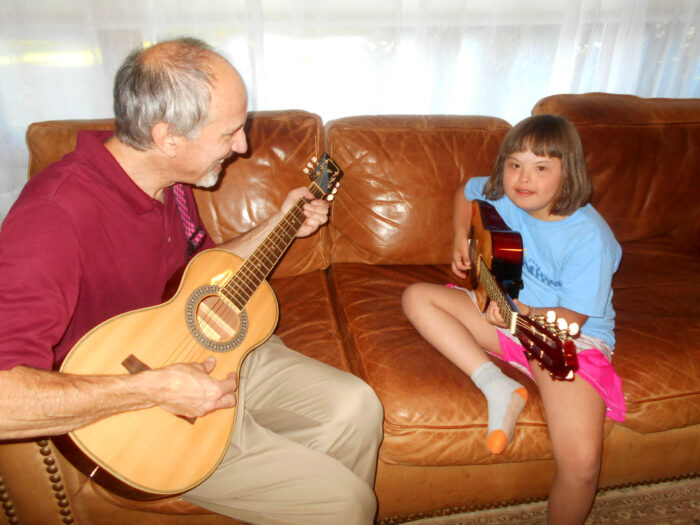
(L-R) David Meyers and Sophia Tuohy, a music student from Armonk
PHOTO COURTESY OF DAVID MEYERS

David Meyers found his passion for teaching music to children with disabilities quite accidentally. Having spent most of his career in real estate, music was relegated to a side pursuit that he relished when afforded the time. In 2008, however, that all changed when he began teaching a youth music program at New York’s Patterson Recreation Center. Playing and writing music moved to the forefront of his focus as his career took an unanticipated turn.

A New Beat

As Meyers became acquainted with the learning style of today’s children, he saw that to resonate with his audience, he would need to devise his own curriculum. He explains, “I quickly found that kids no longer absorb music in the same way as when I was a student. Modern music is heavily electronic and lyrics are oftentimes not age appropriate.” As a result, Meyer’s unique “RockOnMusicSchool” technique was born. He created original music and developed a learning method that began with simple lyrics, accompanied by the most basic guitar string work that gradually advanced to intricate songs with chords requiring increasingly complex finger work.

Serving the Underserved

In teaching, Meyers found a renewed sense of gratification, saying, “It’s the first job I’ve had that isn’t just about the dollar and that is so personally fulfilling.” The role soon became even more meaningful when a friend approached him to give lessons to his son who has autism. Meyers adapted his mainstream curriculum and within a few months saw his new student develop confidence through music. That experience shaped Meyers’ music school. He says, “I made a personal commitment to cater to this audience. These children have a tremendous need for recreational opportunities and are such an underserved community. Music provides them with a creative and social outlet, while building self-esteem, fine motor and language skills.”

Meyers now teaches music lessons through organizations such as SPARC (Special Programs and Resources Connections) of Westchester County as well as through his RockOnMusicSchool, providing one-on-one sessions at students’ homes. “Conducting lessons in a child’s home is so beneficial to those with physical disabilities that may make it challenging to get out or those who thrive within the comforts of their own environment,” Meyers says. Lessons are fine-tuned based on each child’s unique abilities. As Meyers points out, “Depending on the child’s circumstances, we might select strings, drums or keyboard.”  He also modifies lessons by focusing on specific skills such as developing eye contact, sounds or social cues. To engage the kids, he often writes “silly, personalized songs” to get them excited and motivated for playing music.

Marilyn Tuohy of Armonk has become accustomed to hearing Meyers’ fun lyrics throughout the hallways of her home. “My daughter Sophia has Down Syndrome and loves music, which led a friend to recommend David to us. He really knows how to interact with her and gets her engaged no matter what her mood. He brings all instruments including drums, shakes, the keyboard and guitar and always comes up with new songs that are so alive and appealing to kids. They learn the lyrics right away. After David leaves, Sophia as well as my two sons and even my husband are still singing! I’ve seen my daughter’s speech and fine motor skills develop as a result. She speaks slower and clearer and is always singing in the house.”

Music is known to have therapeutic qualities and Meyers agrees, explaining, “Music has a natural timing and rhythm that serves to encourage children to use their voice in response to appropriate cues. Songs have a built-in conversational script that is valuable for children who have social challenges. Students learn to manage frustration, gaining the understanding that it’s okay to mess up and that they will eventually advance. It’s all in their control. These are skills they will take with them into adulthood.”

A Satisfying Crescendo

Today, that first client that inspired RockOnMusicSchool’s mission is now proficient in keyboards, bass, drums and guitar and has developed a love of The Beatles. Meyers proudly reports that this student has also integrated into a mainstream music class. “Each child already feels the music inside of them–some just need guidance to get it out,” he adds as we wrap up our conversation. And, it seems that Meyers has mapped the path as he continues to encourage all children to find a love of music in their own unique way.

Filed Under: Armonk Cover Stories Tagged With: music, Music Therapy, school, Special Needs, The Beatles, therapy

Safeguarding Your Child’s Health at School

August 29, 2018 by Amy Kelley

As summer comes to a close, local parents can be found buying notebooks, pencils and clothes and getting ready for the changes in routines and activities that a new school year brings. But what about safeguarding the health of children returning to school?
Along with new challenges and commitments can come new exposure to all kinds of viruses, not to mention that plague of camps and classrooms alike: lice. According to Dr. Ellen Lestz, a pediatrician with White Plains Hospital Physicians Associates in Armonk, weather changes such as those experienced in our area in the fall cause viruses to be more prevalent, and “your standard communicable things” are the most common at back-to-school time: Viruses that cause maladies such as colds, coughs and gastrointestinal problems.

Handwashing Is Key

Dr. Lestz said handwashing is the “most important” defense. Noting that many classrooms have hand sanitizer available, she stressed that children should clean their hands before lunch or a snack. “It’s good when teachers reinforce this at the beginning of the year,” she said, “and when they teach children how to cough and sneeze appropriately.”

Kids and adults alike should sneeze or cough into their elbows, not their hands, and if a hand is accidentally used to stifle a cough or a sneeze, handwashing should follow right away.

Lestz also pointed out that students need a nutritious diet and enough sleep to remain healthy, and she recommended that parents work on changing sleep schedules about a week in advance of the school year, back to school-year timeframes.

“I think that will kind of prime their immune systems,” she said.

Keeping Lice at Bay

As far as lice goes, Lestz said that while probably more common at camp, it can be a problem at school as well. Besides the usual admonitions not to share hats or combs and to keep long hair back, Lestz said there’s not a lot of evidence that over-the-counter products advertised to repel lice actually work.

But when a kid does have lice, Lestz said it can be a good idea to call on a lice professional. Besides great combouts, these lice-eradication experts are good at communicating to parents and children the steps they need to take in order to prevent recurrence. “They’re so, so thorough,” Lestz said.

The National Association of School Nurses (NASN) also recommends that parents review proper hygiene to prevent the spread of infections before school starts, and parents should know their school’s policy regarding when to keep sick kids home.

Parents should also have child care plans for sick children if needed, and in addition to required up-to-date vaccines, the NASN Back-to-School family checklist also recommends flu vaccinations. Of course, parents should communicate any health concerns or issues their children have with school nurses.

Other ways of preparing for optimal mental and emotional health may include getting youngsters back in touch with school friends after a summer apart. Lestz suggested arranging a few playdates. And to avoid anxiety, make sure all summer assignments are completed, if possible, with time to spare. “If your child’s nervous, understand their feelings and have open communication with them,” Lestz added.

Filed Under: Armonk Cover Stories Tagged With: Armonk, Back to School, handwashing, health, kids, lice, viruses, White Plains Hospital Physicians Associates

Malcolm Pray Achievement Center Inspires Youth

August 29, 2018 by Ella Ilan

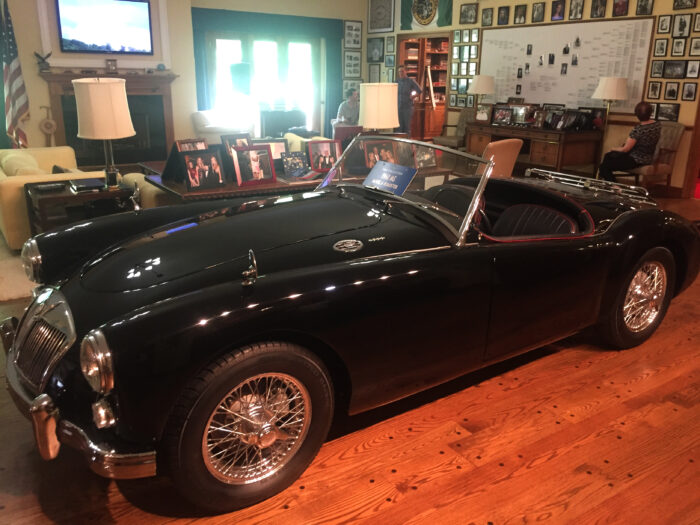
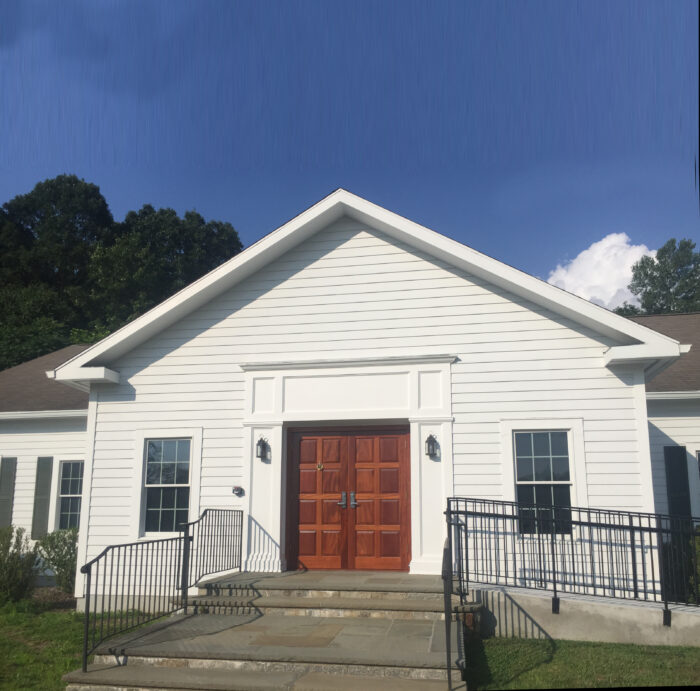
Housed within three nondescript white clapboard buildings resembling an old country church at the end of a long driveway at 16 Bedford Banksville Road is a magnificent collection of vintage cars at the Malcolm Pray Achievement Center. This is more than a car museum and serves a greater purpose that was both envisioned and executed by its entrepreneurial founder Malcolm Pray. It is both a celebration of success and an opportunity to visualize oneself reaching one’s dreams.

The Malcolm Pray Achievement Center is a non-profit organization that offers programs that inspire visitors towards success through a tour of an impressive automobile collection and the story of Malcolm Pray.

Malcolm Pray was an entrepreneur in automotive sales. He started as a car salesman in 1955 in Greenwich, Connecticut and eventually bought his own dealership and grew the business to six dealerships. After an amazing career, he sold his business in 1999 and conceptualized a place to showcase his collection to motivate kids to work hard just as he was motivated as a child when he first saw his dream car at the 1939 World’s Fair, a 1937 Delahaye, a car he later purchased. He passed away in 2013. The Pray Family Foundation continues running the center.

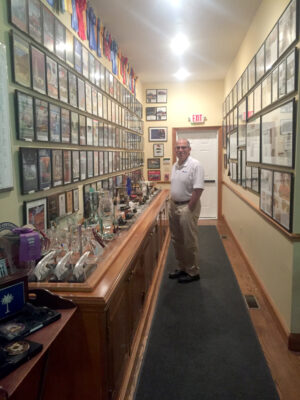
Inside the main building, besides the 1960 MG Model A Roadster just beyond the entryway, it feels as if you have stepped into someone’s grand living room. There are couches, a fireplace, a library off to the right, console tables and walls adorned with civic and humanitarian honors, “Best in Class” awards from car shows such as Concours d’Elegance, photos of Mr. Pray with ex-US presidents and well-known politicians, and framed family photos.

The Armonk Chamber’s Neal Schwartz inside the Malcolm Pray Achievment Center which recently hosted a Chamber meeting and included a fun tour.

Owning Your Handshake

Over seven thousand visitors have come to the center and each is personally greeted at the door with a handshake. As a former car salesman, Mr. Pray recognized the importance of a welcoming handshake and this was his first lesson to his guests. He taught them to own their handshake so that they would be treated seriously.

After visitors are welcomed into the center, they watch a two-minute video about Mr. Pray that talks about his passion for cars, his imperfect school record, and about his road to success after serving in the Air Force.

“My message is clear,” he says in the video, “There is nothing in life that you cannot achieve. No matter what you do you will be in the people business…and never forget–your reputation is the greatest asset that you have.”

That message is just one of the different steps to success that Mr. Pray hoped to teach his visitors. Some other steps include consider a career, educate yourself, respect your body, learn the value of money, and be organized.

Success Despite Struggles

The circumstances of his life lend special weight to his tips for success. A child of the Great Depression, he struggled in school and had a mild dyslexia, undiagnosed in his youth. Most tragically, he lost one of his four children, his 17-year old son, in a car accident in 1986. Achieving success despite these challenges makes an impression on young visitors, particularly those with their own struggles.

Executive Director Marikay Satryano tells visiting teens that have trouble relating to Mr. Pray’s ultimate success and wealth that his life only appears to look linear if you look at him working his way up from being a car salesman. “What you don’t see between those milestones are tough decisions, hard work, personal tragedy, and struggles. Not every path is linear. You have to make the moment and take that first step,” she says.

While Mr. Pray’s original intent was to inspire youngsters, his achievement center has hosted families, senior citizens and veterans. The life principles offered are relevant to anyone going through transition.  Seniors grappling with what they will do in retirement, veterans trying to find their way after active duty, and adults seeking good advice to pass on to their children can benefit from a visit here.

After spending time in the main building, watching the video and discussing the steps to success, guests are led into the first garage where they experience their “aha” moment. In that first garage, they are met with some of the most significant American, British and German cars ever built. Ms. Satryano takes visitors through a fascinating twentieth century history lesson intertwined with a history of cars. Her props just happen to be rare world class automobiles.

Visits to the Malcolm Pray Achievement Center are free and by appointment only.  “It’s a resource,” says Ms. Satryano, “and we want the community to know that we are here for them.”

Filed Under: Armonk Cover Stories Tagged With: Achiement, cars, Classic Cars, hidden gem, history, Malcolm Pray, Malcolm Pray Achievment Center, showcase

  • « Go to Previous Page
  • Page 1
  • Interim pages omitted …
  • Page 8
  • Page 9
  • Page 10
  • Page 11
  • Page 12
  • Interim pages omitted …
  • Page 41
  • Go to Next Page »

Primary Sidebar

Please Visit

White Plains Hospital
William Raveis – Armonk
William Raveis – Chappaqua
Northwell Hospital
Houlihan Lawrence – Chappaqua
Houlihan Lawrence – Armonk
Houlihan Lawrence – Briarcliff
NYOMIS – Dr. Andrew Horowitz
Westchester Table Tennis Center
Spavia
Compass: Miller Goldenberg Harris Team
Lipari & Mangiameli Dentistry
Raveis: Lisa Koh and Allison Coviello
Bristal Assisted Living
Maid Brigade
Kevin Roberts Painting & Design
Zwilling J. A. Henckels
Meagher & Meagher Attorneys at Law
Compass: Aurora Banaszek
Dr. Briones Medical Weight Loss Center
Roamfurther Athletics
Houlihan: Kile Boga-Ibric
Fleetwood Pastry Shop
Chocolate Chalet
Saltbox Sash
Wags & Whiskers Dog Grooming
Donna Mueller
New Castle Physical Therapy

Follow our Social Media

The Inside Press

Our Latest Issues

For a full reading of our current edition, or to obtain a copy or subscription, please contact us.

Inside Pleasantville and Briarcliff Manor Inside Chappaqua and Millwood Inside Armonk

Join Our Mailing List


Search Inside Press

Links

  • Advertise
  • Contact Us
  • Digital Subscription
  • Print Subscription

Publisher’s Note Regarding Our Valued Sponsors

Inside Press is not responsible for and does not necessarily endorse or not endorse any advertisers, products or resources referenced in either sponsor-driven stories or in advertisements appearing in this publication. The Inside Press shall not be liable to any party as a result of any information, services or resources made available through this publication.The Inside Press is published in good faith and cannot be held responsible for any inaccuracies in advertising or sponsor driven stories that appear in this publication. The views of advertisers and contributors are not necessarily those of the publisher’s.

Opinions and information presented in all Inside Press articles, such as in the arena of health and medicine, strictly reflect the experiences, expertise and/or views of those interviewed, and are not necessarily recommended or endorsed by the Inside Press. Please consult your own doctor for diagnosis and/or treatment.

Footer

Support The Inside Press

Advertising

Print Subscription

Digital Subscription

Categories

Archives

Subscribe

Did you know you can subscribe anytime to our print editions?

Voluntary subscriptions are most welcome, if you've moved outside the area, or a subscription is a great present idea for an elderly parent, for a neighbor who is moving or for your graduating high school student or any college student who may enjoy keeping up with hometown stories.

Subscribe Today

Copyright © 2026 The Inside Press, Inc. · Log in