• Skip to primary navigation
  • Skip to main content
  • Skip to primary sidebar
  • Skip to footer

The Inside Press

Magazines serving the communities of Northern Westchester

  • Home
  • Cover Stories
  • Features
    • Portraits and Profiles
  • Advertorials
    • Lifestyles with our Sponsors
    • Sponsor News!
  • Wellness
  • Happenings
  • Advertise
    • Advertise in One or All of our Magazines–And/Or Subscribe
    • Advertising Payment Form
  • Contact Us
  • Search

Inside Thoughts

Why Mandatory Voting Would Work in Democratic Nations

November 28, 2016 by Inside Press

Voters would be more adequately informed about the decisions they are asked to make.

BY ARI BENNETT

The United States and other democratic countries should implement mandatory voting. 

Perhaps the strongest argument against mandatory voting is that every individual has a right to simply not express his or her opinion.  If a person does not want to contribute to the political process and is okay with others doing that for him or her, then why should the government interfere?  But people should not be shocked by the suggestion to impose requirements on our citizens.  There is some precedent for this, with the ultimate good of a working society. 

usa-mapIt seems ironic that many people who do not vote still feel they have a right to complain about policies undertaken by the government.  I see nothing wrong with requiring this slight but very meaningful investment into the political process.  Mandatory voting, having the whole of the public’s voice heard, would be good for the health and progress of a nation.

Mandatory voting is a rather liberal idea that many Republicans and Democrats in America might reject.  However, we should not be offended to be required to do something when it will improve our society.  It is often forgotten that the United States government already requires its citizens to contribute to America in various ways.  From filling out the census to paying taxes to registering for the draft to mandatory education, the United States has in many ways forced citizens to be active participants in the betterment of America.

In the United States, citizens are legally required to fill out the census form every ten years.  Someone not filling out the census is subject to a fine of $5,000.  The primary purpose of the census, written in the Constitution, is so that every ten years we can adjust how many members of Congress each state receives so that each state is properly represented.  Knowing the population of each state helps maintain our democracy, and lets us know how the government should allocate its funding.

In addition, every state requires that all people are in school until at least the age of 16.  While perhaps parents might want to raise their children differently, without a formal education, the government requires one to learn certain material so that he or she can become an educated citizen who can be more capable of contributing to society.

While these comparisons are not perfectly analogous, each asks citizens to do something in exchange for what the government provides them.  Ideally, we would like universal voting among citizens, but we would also like to see those voters to be adequately informed about the decisions they are asked to make. 

I would suggest that the requirement to vote be coupled with programs that increase the knowledge of all voters, particularly new voters who may have felt ill-informed in the past.  This can be accomplished by widespread informational sessions held at public places such as libraries prior to major elections.  Further, candidates could be required to send out mass mailings with a set of bullet points outlining their stance on important issues of the day.

I have heard, from many people my age, that they do not vote because they do not feel educated or informed enough to make such decisions.  Certain groups are less likely to vote than others, and two of those groups include the less educated and younger people.  It is true that the government can still function without a large voter turnout, but it creates an environment in which the government does not work for all people in mind.  The groups who tend to have lower voter turnout will lose out in influencing the adoption of policies that might help them.  I believe all citizens should have a moral obligation to actively inform themselves. 

Additionally, campaigns spend a lot of money on issues directed towards people who intend to vote, and this has created a polarized political atmosphere that is unhealthy for democracy in America.  The benefits include a higher level of discourse and understanding. 

By requiring Americans to vote and educate themselves, we foster a more informed electorate.

Ari Bennett is a junior at Union College studying Studio Arts and Statistics.
Filed Under: Inside Thoughts Tagged With: Democracy, Democrats, Informed electorate, Mandatory Voting, Republicans

What are we Teaching our Children About Winning & Losing?

October 21, 2016 by Danika Altman, Ph.D.

fullsizerender

By Danika Altman, Ph.D.

Most of us believe our message to our children is: “Do your best.” But the implicit message may be: “You need to be the best.” We are a community of achievers with high expectations for our children. We want our children to replicate our success. We employ coaches and tutors to help, but by doing so we may also be conveying “You must do well.” The problem is that this message may be causing anxiety and win-at-all-costs attitudes in our children.

An overemphasis on winning neglects the valuable lessons that are learned from losing. It is painful and humbling. In order for our children to cope with losing, they must feel compassion for themselves. When we face our failures, compassion and support gives us a chance to rebound. Compassion for ourselves despite our flaws and mistakes is the way we endure criticism and grow. Alternatively, judgment and negativity after a failure often leads to anxiety, depression, aggression, quitting or poor performance.

In the U.S. Open Tennis final, Novak Djokovic gave us a good example of his need to win-at-all-costs. He called for a medic just before Stan Wawrinka’s turn to serve rather than before his own, and a game short of the changeover. The announcers alluded to this being poor sportsmanship. Wawrinka had momentum, and the six-minute hiatus could have caused him to lose focus but–despite it–he won the title. What makes this interesting is Djokovic and Wawrinka are friends, but will Wawrinka ever trust Djokovic again?

We have fortunately many opportunities to teach our children about sportsmanship and friendship. We have likely overheard children posturing, saying things like: “I’m the best at soccer and so and so is next.” If children brag to feel powerful by inducing envy in their friends, they will not likely have many successful friendships. We should teach our children that everyone has strengths and weaknesses. We should help them focus on their strengths and improving their weaknesses rather than on other children’s weaknesses to feel good about themselves. An excellent exercise in self-esteem building for children is to have them compliment someone who needs improvement in a particular skill. It creates positive feeling and connection rather than “power” at another child’s expense.

When we face our failures, compassion and support gives us a chance to rebound.

Children are experts at reading their parent’s reactions. If we express anger that our children have made the B team instead of the A team, they feel that they have failed, when in fact they have an opportunity to grow.

If we point out the number of children our children have to beat to get to the top of the tennis ladder, we are sending the message: “I will not be satisfied until you get there.” If we express disappointment when our children receive a poor grade on an exam, the message is “only an A makes you acceptable to me.”

Parents who criticize their children, their children’s teammates or coaches, create anxiety. They are teaching their children that their weaknesses will be seen and judged by others. When children feel shamed, they feel resentment toward their parents, rather than a desire to improve. Instead, empathic statements about how hard it is to be on the playing field or score As on tests are very valuable. Our children want to know that we support them and their friends despite setbacks. Empathy for their struggles empowers them to be resilient and self-confident. It enables them to work through their own disappointments without quitting or doubting themselves.

We abhor losing because it makes us feel pain and vulnerability but it also gives us  opportunity to build self-esteem. If we help our children to see that we have been there and pushed through, we become role models for how to rebound. If we help our children view failures as something that happen to all of us but do not define who we are, they might even accept a bit of advice. If our children see our confidence in their ability to work hard and our compassion for their pain, we give them the strength and determination to try again.

In a Ted Talk, Julie Lythcott Haims reports the Harvard Grant Study shows that the best predictor of success in adulthood is not athletic ability or grades. It is the number of chores one did in childhood.  A greater number of chores is correlated with taking initiative and contributing to the greater good at work. We all know that working with colleagues is equally as important for success as surpassing them.

If our implicit message to our children is that they have to win, they may not be developing confidence, compassion, humility and resilience in the process of growing up.

If instead, we help our children reach their goals by supporting their strengths while having compassion for their weaknesses, they will hopefully have the self-esteem to do their best.

Danika Altman, Ph.D., is a clinical psychologist in private practice with adolescents, adults and couples. She specializes in adolescent anxiety, depression, and identity development. She also works as a coach for students on college and employment interviews. She has offices in Pleasantville and Manhattan.

Filed Under: Inside Thoughts Tagged With: children, Danika Altman, parenting, success, Winning and Losing

Field Hockey: Greeley’s Hidden GEM

August 25, 2016 by The Inside Press

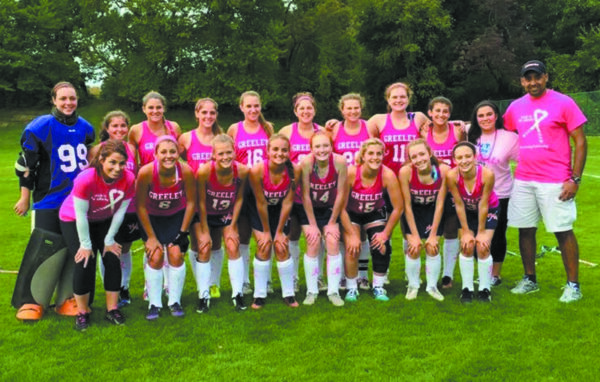
Greeley Field Hockey team wearing special pink jerseys in order to raise money for Breast Cancer research.

By Lauren Neff

My heart had never beat so fast. As I watched attentively to the orange ball on the end of my teammate Megan Graham’s stick, I squeezed the hands of my teammates so tightly that my knuckles turned white. We had fought Scarsdale to a 1-1 overtime draw in the Sectional Semifinals. It was time for the shootout–1 on 1, player vs. goalie. Tensions were high. Nikki Potter and Fiona Grant both managed to score on Scarsdale’s goalie. Our goalkeeper, Willa Kuhn, magically stopped three of four attempts.

It was Graham’s turn to shoot. Graham carried the ball towards the opposing goalie and with her speed, went around her and scored, clinching our win. Tears began to stream down my face. We jumped on Kuhn, then joined together in a group hug. We were going to the Sectional Finals, the first time Greeley field hockey had ever done so.

I could not have been a part of this wonderful program if I had not made the fateful decision to play field hockey in seventh grade. Like every other female athlete in town, I had played soccer since kindergarten. I had moved from the C team to the B team and eventually to the A team. One day, my friend told our group about how much fun the field hockey team is, that her sister had played and said it was a great way to fool around with friends after school. I called my dad asking if it would be alright for me to play. He responded, “as long as it doesn’t interfere with soccer practice.”

Little did we know at the time, it would cause me to quit soccer altogether. Most girls had never played a sport before, so I had a big advantage–field hockey is a lot like soccer, yet with a stick. I fell in love with the sport. Our team was terrible. We won once that year but it was FUN. As the girls mulled their high school options, I wanted to play field hockey, not soccer, and I had a much greater chance at doing so.

Unfortunately, in two years, Horace Greeley High School’s field hockey team may be extinct. This upcoming season, Greeley’s team is comprised of only juniors and four sophomores. There is a whole JV team to fill. Also, there are no cuts. Right now, besides swimming and boys tennis, field hockey is the most successful sport at Greeley. We were league champions in 2014 and made the Sectional Finals last season. With eight returning Varsity players this season plus good JV players, we expect a successful season and an even better one next year.

“When I became the Head Coach,” said Coach Sukhi Sukhwinder Singh, “ we finished 13th in the Section. The next year, we were 17th. It went to 11th, fifth, third and second…The first year, we won two awards at the Awards Dinner. I am happiest about this past year. We won 19.” Coach Sukhi was named Westchester/Putnam Coach of the Year in 2013.

Here’s the issue: Some 60 8th grade girls played for CYSC and club teams. There are three girls soccer teams at Greeley–Varsity, JV A & JV B. Each team is comprised of around 20 girls. Unfortunately, only three to four spots are open on Varsity this year. Around 15 sophomore girls will likely remain on the JV A and B teams.

So when freshmen girls try out for soccer this August, some will make a team and some will not. However, the real question is, how long will they remain on a team? Many girls will end up playing on JV for two years, then not making Varsity. History has shown that about eight to ten in a class will play on Varsity.

It is so difficult to make the Varsity soccer team here that great athletes will end up being cut from the program because of a lack of space. So what can these girls do? The answer is simple: pick up a stick. One of our Varsity players, Cat Brennan, left soccer for field hockey in ninth grade and started many games as a sophomore.

Field hockey allows every girl who plays it to succeed in some way and grow as an athlete and as a person. Whether that is scoring a goal, giving an assist, winning an award or just being there to support the team and have fun, everyone takes something away from this experience. I would have maybe lasted two years on JV soccer teams if I were lucky. In field hockey, I was called up to Varsity as a freshman. This past year, I started each game, scored 11 goals and received several postseason awards. If I can do it, so can anyone. Please join us.

Lauren Neff is a rising junior at Horace Greeley High School. She enjoys field hockey, basketball, and singing in an A Capella group.

Filed Under: Inside Thoughts Tagged With: Field Hockey, Girls Field Hockey, Greeley, Horace Greeley High School

Mindfulness in a Crazy World

August 24, 2016 by The Inside Press

image001-2By Jodi Baretz, LCSW, CHHC

Lately, it seems like on a weekly basis we are hearing about some awful terrorist attack, or act of gun violence. Our flags are constantly at half mast, and we barely mourn one tragedy before another one hits. This is a constant reminder of how intolerance, hate and racism are still present around the world. This unrest adds to the chronic anxiety many of us already feel on a daily basis.

The tragedies we hear about are real, but we have to be mindful of the stories we tell ourselves. It is easy to get carried away with doomsday scenarios, because our hyperactive brains are programmed for survival.

The 24-hour media coverage of shootings, killings and terrorist events perpetuates worry, and creates anxiety. The media often seems to thrive on fear because they know you will tune in. The reality is that “we didn’t start the fire, it was always burning since the world’s been turning.” It just seems that the Armageddon is closer now than ever before.

“If every eight year old in the world is taught meditation, we will eliminate violence from the world within one generation.” –Dalai Lama

While we are so down on the events of the day, we must remember that our current society is much better off than in the past. For example, look at the changes in the LGBT community. It is much safer now for teens and adults alike to be proud and embrace who they are, without tremendous fear of persecution. Additionally, in the past, children with Down’s Syndrome would be institutionalized, and now they are often mainstreamed and have become valued members of society. Remarkably, there is a black President in the White House, which had been unthinkable just a short time ago. We certainly have come a long way, and hopefully can continue along this path.

Nonetheless, the recent awful news has an effect on us, especially those of us with children. We worry about them growing up in a world that is volatile. We worry when they travel overseas. We worry about them being exposed to hate and violence at such a young age. How do we cope with the weight of the world on our shoulders?

Mindfulness practices are not only ways that we can improve focus and be present, but also ways to cultivate love, compassion and bring peace to ourselves and others. When we practice meditation and mindfulness, we open our hearts and realize that although we have different beliefs, races, and religions, we all share a common thing–humanity. We can begin to notice our judgments and biases. Look at your own life and be curious if there are others you have unfairly judged or rejected because they are different than you.

Listen to your self-talk, and notice without judging yourself how your biases and beliefs have affected you. We each have to do our part to be more understanding of others and accept those who are different than ourselves.

A story I heard at a seminar about a soldier returning from Iraq can speak to compassion and non-judgment. He was having difficulty managing his stress and anger, and enrolled in a Mindfulness Based Stress Reduction class. He was at a supermarket behind a woman that was handing over her baby to the cashier and delaying his check out. He would normally have said something, but waited and felt the frustration course through his body. When he got to the front of the line, he asked the cashier about the baby, and she revealed that her husband was killed in Iraq, that was her baby, and her mother was watching her because she couldn’t afford child care.

So, what can we do to protect ourselves from sadness, depression and anxiety that the world puts on our shoulders? Shutting off the news every so often, as well as turning off social media, can give our minds a break from the onslaught of negativity. Noticing when your mind races and when you are creating stories that are not facts, help to work with the brains negativity bias. Learning to sit with sadness and grief, without letting it take over our whole beings can be a helpful practice for coping. When compassion and kindness win out we have less hate, anger and intolerance. In addition, being good role models for our children is crucial, because they are watching us all the time. What we say matters. When we engage in these behaviors daily, hopefully, person-by-person, we can change the world, and make a difference.

Jodi Baretz, LCSW, CHHC is a psychotherapist, mindfulness and holistic health coach at The Center for Health and Healing in Mount Kisco. She is the founder of the program and upcoming book, “Mindful is the New Skinny.”

Visit jodibaretz.com for more info or FB group @mindful moms.


Filed Under: Inside Thoughts Tagged With: healing, inside thoughts, Jodi Baretz, Mindfulness, Society

Why the Worst?

August 4, 2016 by The Inside Press

By Michael Levin

Michael-Levin11Okay, I’m out.

I won’t lie.

I’d hoped Donald Trump, once the Republican nomination was secured, would awaken from his macho fulminations and realize that he was just a heartbeat from the Oval Office.

That he would pivot from dog whistles and bluster and Mexican walls and Muslim bans and recognize that the leadership of the free world was his for the taking.

But he didn’t.

Because he couldn’t.

I’m old enough to recall the 1970s Donald Trump, the one who deserves much of the credit for saving midtown Manhattan.

Remember the Daily News headline, “Ford to New York: Drop Dead”?

New York City was dying economically.

The city was dangerous.

Commuters went home at night and left Midtown’s streets empty.

Tourists went elsewhere.

It was Cleveland on the Hudson.

And then the renaissance began, when a young Donald Trump – admittedly abetted by his father’s political connections – put together a deal to transform the failed Commodore Hotel.

It had been a giant massage parlor hard by Grand Central Station, and Trump turned it into the Grand Hyatt.

That deal triggered the resurgence of midtown Manhattan and sparked a building boom that continues to this day.

But then the brilliant builder became the bloated ego.

Then came all the bad deals – the casinos, the failed airline, the schlock, the broken marriages, the failed multilevel marketing scheme, Trump University, and, of course, “You’re fired.”

The one thing Trump possessed as the 2016 Presidential campaign began was an ear attuned to the populist desire for an outsider.

An outsized outsider, one who could restore pride to a nation made Lilliputian by the incumbent.

A man with a can-do spirit, a disregard for the rules, and Teflon skin.

Just right for the times, as he vanquished 16 Republican contenders any of whom might have had a shot at the White House in a normal year.

But he couldn’t grow up.

Instead of letting Hillary’s email scandals dominate the headlines, he had to go after a judge of Mexican heritage.

And he put on a clown car of a Republican convention, where no one took five minutes to vet his wife’s speech, and where his biggest opponent, Ted Cruz, demonstrated a selfishness that rivaled
only that of Trump’s.

And now, our Republican nominee proves to have the thinnest skin in all of politics, applying his “hit me once, I’ll hit you ten times” to the parents of a young Marine killed in battle.

I hoped for more.

We didn’t get it.

Now, it’s been said that “Hillary is to secrecy as Bill was to bimbos.”

No one less than FBI director James Comey, a universally respected man, branded her a compulsive liar.

And yet, for Republicans and conservatives, suddenly she’s Plan B.

Don’t ask me if I’m going to vote for her.

But I’ll tell you whom I can’t vote for.

The worst political candidate in America in my lifetime.

Worse than Wallace.

Worse than Goldwater.

Maybe even tied for worst with David Duke.

Are you sure there isn’t a legitimate third party candidate somewhere in the wings?

Jimmy Carter named his autobiography, Why Not The Best?

Well, my fellow conservatives.

We could write a book.

It’ll be called, Why The Worst?

Because he didn’t pivot from immaturity to maturity, from narcissist to President.

Because he can’t.

And the damned thing is, he still might win.

A registered Republican, Michael Levin is one of the most established ghostwriters in the nation. A New York Times best-selling author, Levin has written, co-written or ghostwritten more than 100 books, of which eleven are national best sellers. Visit www.businessghost.com


Filed Under: Inside Thoughts

  • « Go to Previous Page
  • Page 1
  • Interim pages omitted …
  • Page 13
  • Page 14
  • Page 15
  • Page 16
  • Page 17
  • Interim pages omitted …
  • Page 24
  • Go to Next Page »

Primary Sidebar

Please Visit

White Plains Hospital
William Raveis – Armonk
William Raveis – Chappaqua
Northwell Hospital
Houlihan Lawrence – Chappaqua
Houlihan Lawrence – Armonk
Houlihan Lawrence – Briarcliff
NYOMIS – Dr. Andrew Horowitz
Westchester Table Tennis Center
Spavia
Compass: Miller Goldenberg Harris Team
Lipari & Mangiameli Dentistry
Raveis: Lisa Koh and Allison Coviello
Bristal Assisted Living
Maid Brigade
Kevin Roberts Painting & Design
Zwilling J. A. Henckels
Meagher & Meagher Attorneys at Law
Compass: Aurora Banaszek
Dr. Briones Medical Weight Loss Center
OuterBoundaries travel
Fleetwood Pastry Shop
Whitaker’s Garage Door Store
Chocolate Chalet
Donna Mueller
Joseph Richard Florals
Houlihan: Tara Siegel
King Street Creatives

Follow our Social Media

The Inside Press

Our Latest Issues

For a full reading of our current edition, or to obtain a copy or subscription, please contact us.

Inside Pleasantville and Briarcliff Manor Inside Chappaqua and Millwood Inside Armonk

Join Our Mailing List


Search Inside Press

Links

  • Advertise
  • Contact Us
  • Digital Subscription
  • Print Subscription

Publisher’s Note Regarding Our Valued Sponsors

Inside Press is not responsible for and does not necessarily endorse or not endorse any advertisers, products or resources referenced in either sponsor-driven stories or in advertisements appearing in this publication. The Inside Press shall not be liable to any party as a result of any information, services or resources made available through this publication.The Inside Press is published in good faith and cannot be held responsible for any inaccuracies in advertising or sponsor driven stories that appear in this publication. The views of advertisers and contributors are not necessarily those of the publisher’s.

Opinions and information presented in all Inside Press articles, such as in the arena of health and medicine, strictly reflect the experiences, expertise and/or views of those interviewed, and are not necessarily recommended or endorsed by the Inside Press. Please consult your own doctor for diagnosis and/or treatment.

Footer

Support The Inside Press

Advertising

Print Subscription

Digital Subscription

Categories

Archives

Subscribe

Did you know you can subscribe anytime to our print editions?

Voluntary subscriptions are most welcome, if you've moved outside the area, or a subscription is a great present idea for an elderly parent, for a neighbor who is moving or for your graduating high school student or any college student who may enjoy keeping up with hometown stories.

Subscribe Today

Copyright © 2026 The Inside Press, Inc. · Log in