• Skip to primary navigation
  • Skip to main content
  • Skip to primary sidebar
  • Skip to footer

The Inside Press

Magazines serving the communities of Northern Westchester

  • Home
  • Cover Stories
  • Features
    • Portraits and Profiles
  • Advertorials
    • Lifestyles with our Sponsors
    • Sponsor News!
  • Wellness
  • Happenings
  • Advertise
    • Advertise in One or All of our Magazines–And/Or Subscribe
    • Advertising Payment Form
  • Contact Us
  • Search

Cover Stories

Getting to Know Harriet Schleifer: A Soulful and Courageous New President for the American Jewish Committee

August 24, 2019 by Grace Bennett

I knew I was going to like Harriet Schleifer–the newly appointed 66-year-old president of the venerable American Jewish Committee (AJC)–upon noticing a large coffee table book about singer/songwriter Leonard Cohen. She immediately commented on the impact of Cohen’s singing and his songs in her life, “the sensory experiences,” and shared impressions of the current exhibit (‘A Crack in Everything’ at the Jewish Museum in New York City (she loved it). “I discovered him as a teenager,” said Schleifer. “That voice. He was so soulful…”
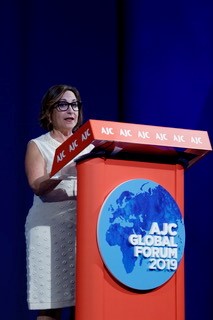
Schleifer described the AJC mission as vital during this painful period of history in which we are witnessing a surge in antisemitism here and around the globe. From 2017 to 2018, the number of antisemitic incidents was up 74% in France and 16% in the UK. In 2018, 58% of all religious bias hate crimes in the U.S. targeted Jews.  AJC Paris worked closely with the French government on developing a plan to combat antisemitism. One outcome was the creation of a senior government position-the Interministerial Delegate to Combat Racism and Antisemitism.

To get a sense of what drives Schleifer, we also delved into her multiple other roles over the years such as a Student Advocacy attorney in Elmsford, her assorted philanthropic efforts and leadership roles, and her ultimate challenges (and rewards, too) as a mom to a special-needs son. More on that, later.

Harriet Schleifer at home. Photo By Grace Bennett

We shared our stories of tragedy… being children of survivors. Schleifer’s parents survived Hasag, a forced labor camp. Her parent’s families were sent to their deaths in Treblinka; many in my own family perished in Auschwitz. The near two-hour interview took place in the living room of Schleifer’s beautiful and spacious home in Chappaqua. Schleifer is an empty nester living with her husband, Len, the love of her life who she met in junior high school, and the co-founder of a Tarrytown-based bio tech company. She speaks lovingly of Len and of her two sons, a 38-year-old federal prosecutor in California, and of a 33-year old son with developmental disabilities.

I asked Schleifer for her interpretation of how the upward spike has happened, what it means here in the States, and where do we go from here.

She noted wistfully that the AJC had tracked a particularly alarming surge in France 17 years ago. “We asked the French government if they were aware. The French are tolerant and don’t like to identify by demographics so whenever any hate crimes or bias crimes they had no stats going back that many years–there are no IDs of perpetrators or victims. There is now an organization, The European Union Agency for Fundamental Rights, that is focused on antisemitism and has issued ground-breaking surveys of Jews in European countries.

“This is very important information: we’re seeing a spike of acceptance to racist words and actions that we haven’t seen before. It’s becoming more common; people are desensitized. It’s a slippery slope. We need to be vigilant. And definitely define when a hate crime is also antisemitism.”

She emphasized that the International Holocaust Remembrance Alliance definition of antisemitism has been adopted by several countries in Europe and in Canada. “We need to understand what antisemitism looks like so we can use that information as a tool to train anyone (such as police or teachers); we each have a civic responsibility to stand up to it.”

Meanwhile, the AJC views itself as “fiercely bi partisan” as they work on “securing the safety and well-being of Jews around the world, the security of Israel, and to enhance and ensure democratic values for all globally.” Schleifer also said the AJC’s work is influenced by Elie Wiesel, who had said, “What hurts the victim most is not the cruelty of the oppressor but the silence of the bystander.”

Antisemitic Tropes: “Back in Vogue”

I asked Schleifer to define the ‘slippery slope’ she mentioned; in true bipartisan fashion, she brought up antisemitic offenses across the political spectrum. She suggested that both extremes have employed the antisemitic trope that raises the specter of Jews as possessed of great power and controlling institutions. “It is back in vogue,” she said, whether it was being used in the language of the ‘Unite the Right’ marchers in Charlottesville or in other arenas.

“Jews will not replace us” is a fascist Nazi trope, and there were many who chanted it,” said Schleifer.

The use of terms like ‘Benjamins’–even though it came from a hip-hop song–it still recalls an old trope…There is a lack of education. But words are important. You may also not realize that you are using a term that is offensive to another culture.  So, let’s sit down and learn from each other!… And that includes people of all stripes!”

New Black/Jewish Caucus — AJC’s Role

From here, Schleifer expressed her pride in the AJC’s instrumental role in aiding and encouraging a Black Jewish caucus in Congress that was launched by four Congressional reps and has already expanded. AJC hopes this will launch into a reconnection to the concerns we shared during the civil rights movement. For whatever reason over time, these ties have dissipated. We want to encourage people coming together to recognize what they have in common.”

Schleifer said she will be rooting for the Caucus. “The announcement was made at our AJC Global Forum in June in DC. We take great pride in being there at the outset. It’s very important to me. Our Atlanta office is taking the lead, with their wonderful history of Black-Jewish relationships.”

On Bridge Building

Another AJC initiative bringing people together, said Schleifer, is a Muslim Jewish Advisory Council launched in 2016. “It is a semi-autonomous group comprised of very impressive business, civil and religious leaders who have seen their efforts result in the passage of anti-hate legislation. But we work very closely to support and facilitate it.”

The AJC, contends Schleifer, is all about “inter-religious bridge building, not only domestically, but also internationally.” She said that the AJC is not only bi partisan, but non-partisan. “We work both sides of the aisle. There’s no room for partisanship. We work toward values that everyone should be on board with. We write Amicus briefs. We submitted one against political gerrymandering and another, in favor of immigration reform.”

It was time to ask: Who is Harriet Schleifer? Over the interview’s course, her intense connection to her Jewish roots were visible–from both the lovely Judaica art in her home and the Magen David pendant she says she has worn proudly in nearly the 35 countries she has traveled to representing the AJC.

We began with a conversation about the Holocaust, and frankly, we both held back tears as we exchanged information.

“I was made aware from the time I had any receptive language, during my toddler years, what my parents went through. My father worked very long hours doing jobs he had to teach himself. In his later years, he spoke to my sister and me. My mother never held back. I learned that she had a fiancé who got killed, then a husband who got killed, and then she married my dad. I learned most of my mother’s family was sent to Treblinka save for one brother. The last time she saw her mother, they squeezed hands on the selection line and went in different directions…

“These are very traumatic things to hear as a baby. My father was the sole survivor of his family. His two-year older brother and father were all on a line together; they sent his father and brother in the other direction.”

Growing up with this history, first in the Bronx and then in Rego Park, Queens, Schleifer gradually gained a sense of responsibility that she would need to tell this story to future generations. “Why should all those people have died in vain? They cannot. It is up to us. If you feel the responsibility, you must also act on it.  Everything I do is with an eye to Jewish values and culture and history.”

Her advocacy and activism within the AJC, in the meantime, requires patience, persistence and considerable courage to reach far across political positions and world views. In ‘Project Interchange,’ for example, AJC brings non-Jews in academia, media, religious, civic and diplomatic life to authentically experience reality on the ground.  Delegates meet with Israeli Arabs and usually travel to Ramallah to meet with PA representatives and other key Palestinians in the West Bank.

The Emerging Leader

Schleifer’s advocacy for Jewish communities gradually grew and then surged after moving to Chappaqua in 1988. She joined Bet Torah Synagogue and ultimately became its President. Her ascent to the AJC presidency followed active involvement with the Jewish organizations ORT, UJA, and, also, the Westchester Jewish Council.  “One day, a Chappaqua resident and then another asked me if I knew anything about AJC. I’d never hear of it. A couple years went by and I was asked to help sponsor a Jewish Film Festival at the Jacob Burns Film Center. “That appealed to me, and it’s now in its 17th year!” AJC was, fortuitously for Schleifer, a co-sponsor.

At the time, Schleifer was working as an attorney for Student Advocacy. “A lot of my clients were Latino, and so I got involved in the interfaith work of AJC–Hispanic Heritage Day–and other committees. This led to becoming president of the Westchester office in White Plains, and then joining its national board of governors, bringing Schleifer eventually to her present position.  AJC, headquartered in NYC, has 22 regional offices in the U.S., 12 international posts and 37 international partnerships with Jewish communities around the world, and hundreds of thousands of supporters and followers globally.

Her earlier volunteerism with ORT and UJA came more naturally, as her “heart was pulled toward human services.” Schleifer’s father’s brother was trained by ORT in Poland. “Those personal relationships speak to me. Then, after that, I had a child born with significant special needs, who at 33 happily resides at the Chapel Haven Schleifer Center community in New Haven.

“I don’t think it was coincidental.  I always had an eye for those who needed a voice or who needed to be brought in–and then I had my child. My natural bent has been to help.” Eventually, however, something felt ‘missing.’  The introduction to AJC offered new horizons for Schleifer “that continue to excite me every single day.”

“I still appreciate and contribute to the human service organizations, that will never go away, but the thrust of my energy now is on bridge building. I feel that’s where I can be most effective… and on “moving the needle to changing hearts and minds.”

Schleifer is certainly well educated for the task. She is a Cornell University graduate, holds two graduate degrees in higher education from the University of Virginia and a law degree from St. John’s University in New York City. And, she is clear that she has solid support at home.

Schleifer met her husband when they were in junior high school. “We started dating when I was 16 and he was 17. I followed him to Cornell. She described Len as “simpatico. Over the years, having a special needs son introduced stress, and it was hard.

But we are like minded and we support our son in every which way.”  Their immense partnership and bond, she said, makes her activism possible.

Adoption of IHRA

At this point, the conversation turned back to AJC’s distinct role “as the number one global Jewish advocacy organization. One goal today is its work to see the IHRA definition of antisemitism adopted around the world. She said the US State Department has adopted and used the definition. “There’s bipartisan acceptance. It can get complicated responding to antisemitic speech given first amendment rights of free speech, at least outside of special environments such as the classroom or the workplace. And another question: How far can you go before speech tilts to incitement of violence?  You have the right to criticize Israel but there comes a point where anti-Zionism masks anti-Semitism and that calls for a response to ensure that this form of antisemitism does not become normal.

“We see that in the BDS movement… If you bar an Israeli academic from coming, that is a total subversion of academic freedom. It turns freedom of expression upside down. Many states have passed legislation that prohibits businesses contracting with the state from boycotting Israel. So we already have protections in the commercial sphere.”

Addressing the BDS Movement on College Campuses

“BDS proponents stifling Jewish organizations and programs on campus is absolutely unproductive. AJC’s goal is to build bridges, not tear them down. There’s a lot of miseducation and lack of education that we need to address. A lot of BDS supporters haven’t even been to Israel.”

As for the gains BDS has made on college campuses, Schleifer said “younger people are too removed from what happened in Europe so they’re trying to figure out how to respond to the rise.

“But now we have to wake up… and educate young people. People talk about Israel and the occupation; the word ‘occupation’ is anathema to young people here. I’ve testified in the Knesset regarding the connection between American Jews and Israeli Jews. We are relatives who don’t know each other. Israeli priorities are security and economics. We U.S. Jews are not running into shelters with 15 seconds to take cover before a rocket hits…”

American Jews, living in relative comfort, have trouble relating to the fears Israelis live with, Schleifer explained. “We don’t understand why some Israelis have a hard time giving up settlements–not that I’m in favor, I don’t think they’re helpful at all–but we don’t really have the visceral understanding of fear of giving up land. We don’t know each other’s realities the way we think we do.”

Even among Israel’s most strident critics, Schleifer said, a trip there can profoundly change one’s perspective. “When we take non-Jews to Israel, we not only expose them to their counterparts, we also invite Arab Israelis to meet with them. We go into Ramallah.”

The AJC delegations are intended to be “an authentic look at what’s happening on the street, even if it’s critical of Israel. If you understand the reality on the ground, if you come back after an educated experience, then you can come back and talk. I don’t want to hear voices that are uni-dimensional.”

Key to AJC’s mission too is to make sure Israel is treated as a normal country along with the other 192 countries in the world. AJC regularly addresses some very real bias against Israel at the United Nations, such as with human rights votes that target Israel, and only Israel. They monitor anti-Israel bias in other institutions as well.

“When UNESCO officially refers to various historic sites in Jerusalem with only their Arabic names–that’s a problem. Because that denies the connection of Jews to the land of Israel. The fact that someone would deny the historic continuity of Jews in that part of the world and question the legitimacy of a Jewish state–that is what we advocate against. We want every country to recognize and accept the legitimacy of the Jewish state of Israel. And as our only democracy in the region.”

Schleifer cited a successful campaign encouraging U.S. mayors and governors to officially fight against anti-Semitism. The Mayor’s campaign against antisemitism, which drew more than 350 U.S. mayors and municipal leaders from all 50 states and the District of Columbia (plus more than 200 European mayors in 31 countries) signed the agreement. This campaign was entirely an AJC initiative.

The interview began to wind down with Schleifer encouraging my own interest fighting anti-Semitism:

“I have a philosophy: if you’re able, you must… If you have the time, then get involved in something that will make the world better,” she said. “If you’re able to help somebody, just do it. If I can speak out for Jews around the world… I can’t think of a better use of my time.”

After I left, I thought back to our initial discussion of the Cohen songbook. “He was receptive to different religious views,” Schleifer had noted.

In the song Hallelujah, Cohen evokes his Jewish roots.

“What would Cohen be doing if he were alive today about the spike in anti-Semitism?” I had asked.

“He was such a sensitive person. He would be writing about it, of course,” Schleifer said. “It goes to the core of decency.”


Filed Under: Cover Stories Tagged With: AJC, American Jewish Committee, Antisemitism, Black Jewish Caucus, Building Bridges, Courageous, Democratic values, Harriet Schleifer, IHRA, Leonard Cohen, Project Interchange, Soulful

At Burke Neurological Institute: How Robots are Helping Persons with Spinal Cord Injuries

August 24, 2019 by Stacey Pfeffer

PHOTOS COURTESY OF Jamie Petrone

When you first meet Jamie Petrone, it is impossible not to notice her engaging smile and friendly personality. The 42-year-old has an optimistic outlook on life which is a bit surprising given her diagnosis of transverse myelopathy (TM), a type of spinal cord injury that has caused her to use a wheelchair for much of her life. But instead of focusing on her disability, Petrone has broken through barriers and is changing people’s perception of what it means to be disabled.

Petrone was a 19-year-old student studying musical theater at Shenandoah Conservatory and one day was not able to get out of bed. She had suffered a stomach ache at the time and was taking a prescription medication which resulted in a severe allergic reaction and a nearly fatal illness called Stevens-Johnson syndrome. Doctors believe that this syndrome triggered her to have TM which ultimately led to paralysis in her lower extremities but it took almost ten years before she was definitively diagnosed with TM.

The Mission of BNI

Despite this, Petrone is amazingly engaged in studies to get her to walk again with the help of a team of clinicians and scientists at the White Plains-based Burke Neurological Institute (BNI). BNI is a leading, nonprofit, research institute devoted to curing neurological diseases and injuries. Sixteen laboratories and more than 100 people in the Institute focus on identifying and testing novel strategies to repair the brain and the spinal cord. Strategies include drugs to unlock repair in the damaged spinal cord as well as training devices using the latest robotic technology.  BNI is based at Burke Rehabilitation Center and works in conjunction with Weill Cornell Medical.

BNI occupies a unique space for those with neurological impairments including patients suffering from a host of health problems such as stroke, spinal cord or traumatic brain injuries, cerebral palsy, neurodegenerative and retinal degenerative diseases. “The institute is focusing on chronic neurological disability and neurorestoration or repairing the nervous system,” explains Christine E. Hughes, the Vice President of Institutional Advancement at BNI. “We don’t want to teach people how to use a wheelchair or crutches. We want to repair the patient’s nervous system so they can walk again.”

Petrone was lucky enough to be participant in a clinical trial at BNI in the Lower Limb Robotics Program with Amy Bialek, a physical therapist and Chappaqua resident conducting research on the use of robotics for spinal cord injury.

Petrone on the Today Show
PHOTOS COURTESY OF Jamie Petrone

Limited Options for Petrone

The clinical trial which Petrone enrolled in had strict criteria and Bialek screen hundreds of patients before she found a small subset of patients that met the criteria. Currently, for those that do not qualify, BNI is developing wellness trials to identify how to keep those with spinal cord injury fit and read for more emerging clinical studies. When you have a chronic condition like Petrone’s, physical therapy offers limited benefits and insurance often drops patients after several sessions.

“The doctors gave me an ultimatum. They said if you don’t get out of this wheelchair, you will get worse. So then the battle becomes how do I get out of this wheelchair?,” asks Petrone. “It is easy to lose hope. A lot of patients don’t have that mentality to push themselves.”

Robotics at BNI

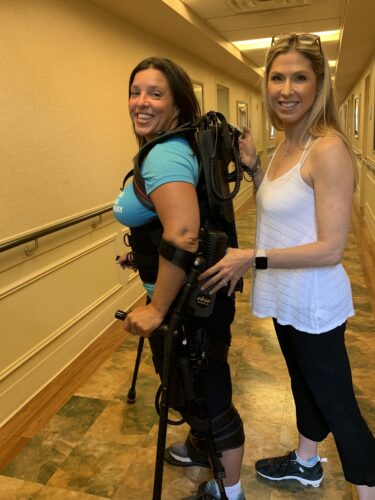
It is no wonder that Petrone, a former high school softball player, dancer and swimmer is doing everything possible to win that battle and regain her ability to walk.  Enter the EKSO, a wearable battery-operated exoskeleton that enables individuals like Petrone to stand and walk on level surfaces. The EKSO is just one of several therapeutic devices/robots that BNI is testing to help patients repair their nervous system. And while their clinics have robots to help restore function in other areas of the body for patients such as the wrist, arms and hands, the team at BNI is betting that a combination of a robot to train new functions combined with a drug to optimize new learning in the damaged nervous system will be the way forward.   

“When Jamie is upright with the help of the EKSO,  our data to date suggests that she is improving her mental health, her skin and bone integrity and her cardiopulmonary function. There needs to be a place that is leveraging the best in contemporary neuroscience to get people out of their wheelchairs,” urges Bialek. Essentially, the EKSO is helping Petrone rebuild neural pathways and her muscle memory through repetition. In the beginning, she had to look in the mirror when she used it but now she does not need it. “I see real progress with it.” Petrone’s situation is also unique in that she can’t take any prescription pain killers as many spinal cord injury patients do because of her Stevens- Johnson syndrome so exercise and restorative therapy offered at BNI really is her only hope.

Petrone with Amy Bialek
PHOTO BY Stacey Pfeffer

Petrone likes to keep active whether it be through adaptive sports such as waterskiing and biking or her performing career which is just as impressive as her determination to walk again one day. Petrone currently is the Executive Director & Founder of THISAbility, a Performing Arts Conservatory and Professional Theatre Company, cultivating inclusion in the arts. She is also the musical director for numerous schools in Westchester County through The Westchester Sandbox Theatre in Mamaroneck and Queens Theater in New York City, and teaches voice and piano privately.

She originated the role of Bonnie in the Off-Broadway show, The Healing, by Samuel D. Hunter (NY Times Critic Pick) and has also had recurring television roles on Madam Secretary and Law & Order SVU. In addition, Petrone was featured on the Today Show segment “Everyone Has a Story” where she sang and is also the subject of a documentary called And Seen which has won awards at film festivals and is continuing to play on the festival circuit.

The life of a performer is hard with Petrone auditioning for several roles but hers is ever more complicated by her disability and the therapy she requires to help her maintain her independent and active life. (Petrone lives alone, drives a car with hand controls and travels extensively.) Insurance wants her to receive treatment or therapies only in Connecticut where she resides. But Connecticut does not have access to state-of-the art rehabilitation therapies like those offered at BNI.

Besides auditioning for her roles and her various jobs, Petrone has also participated in a boot camp for spinal cord injury patients at the Kennedy Krieger Institute which is affiliated with John Hopkins University in Baltimore. When Petrone first went there, she was introduced to various robots to help her regain function. I felt like I was only getting compensatory therapy until then. I felt like I had wasted years of my life in this wheelchair. Why didn’t I know about these therapies?,” she asked. Petrone and medical experts agree that actor Christopher Reeve pioneered to change the paradigm of how spinal cord injuries are treated.

“There are a lot people that don’t know what is available to them. I wish that people knew about the advances in technology and what is happening more regularly now – these restorative programs could make a real difference in people’s lives,” Petrone noted.

Still Petrone wonders about what will happen to her when the study ends. “What happens next?,” she asks. “I see progress and I am killing myself to keep going – I have to keep going.”

New Grant Announced for Patients with Neurological Impairment

But there is some good news in store for patients like Petrone. Governor Andrew Cuomo just announced this summer a $5 million grant that will allow NeuroCuresNY, Inc. (NCNY) to conduct a two-year demonstration of its unique clinical trial network and process for testing drugs to treat disability due to neurological impairment. NCNY is a not for profit initiative and BNI is one of the founding members of it. The demonstration trial will focus on stroke, but set the table for combine the use of medication to repair the brain along with robotic training technology like the EKSO that Petrone used in her trial. The two-year trial will first focus on stroke patients but there are plans to evaluate treatments for disability due to other neurological conditions such as Alzheimer’s disease and spinal cord injuries like Petrone’s.

Commenting on the grant, Dr. Rajiv Ratan BNI’s Director said that “millions of Americans and their families struggle on a daily basis with the challenges from being disabled from neurological diseases such as stroke and spinal cord injury. The enduring lack of treatment options to significantly address the challenges that people with these neurological conditions face highlight the need for a novel, game-changing approach.”

Filed Under: Cover Stories Tagged With: BNI, Burke Neurological Instititue, Clinical Trial, Nervous System, optimistic outlook, robotics, Robots, spinal cord injuries

So You Want to Update Your Kitchen? An Interview with Felipe Gomes of Modern Tradition Kitchen & Bath

August 24, 2019 by Christine Pasqueralle

As any homeowner knows, taking on a renovation can be an arduous process. Where do you begin? How do you manage through the actual renovation? I have firsthand experience, having recently completed a major kitchen renovation with Modern Tradition Kitchen & Bath. I spoke with owner Felipe Gomes to get some helpful tips for those thinking of a home re-design in the future.

Gomes opened his first showroom in Pleasantville in 2016 and relocated to Thornwood this past July. His 15 plus years of experience working in the hospitality field as well as his involvement in numerous design and renovation projects led him to open his own business. Modern Tradition aims to provide customized services to make its clients dreams become a reality. The company also prides itself on being family-owned and oriented. Gomes and his brother Christopher, owner of Riverview Contracting Inc., work together on each project to ensure quality-control and a seamless design and construction process from start to finish.



When it comes to his own design approach, Gomes has sound advice to ensure a positive designer/client relationship. “Listen to everything, assume nothing. Write down everything and do what you promise without fail. The client hired you as an expert. Show him or her your expertise and stand by your opinion and work.” His method as a designer is to help make the homeowner truly love and enjoy the space in which they live. And at the end of the day, isn’t that the ultimate goal?

Gomes states, “My design philosophy is the belief that life inside of one’s home should feel good in every sense. A well-designed space should embody an extraordinary design that is timeless while maintaining a striking interior that is unique, luxurious, functional, livable, comfortable, and most importantly speaks the client’s language. A home should be designed for one’s self, it should reflect the personality of its occupants in a unified and well-tailored design.” I couldn’t agree more.

As for his advice for those thinking of taking on a home renovation, Gomes keeps it simple yet solid, “Ask questions, don’t second-guess yourself, think of the final result and trust the people you hired.” It can definitely be hard to let go, especially when your home is turned into a den of chaos during a renovation. But these are the experts after all, and as clients, we must find someone we trust to ensure that the vision we dreamt will come to life in the final results.

Before
After

For those overwhelmed with style choices, Gomes believes the Transitional style is always a great bet. “It combines elements from both traditional and contemporary designs to create a one-of-a-kind kitchen. The balance between a traditional kitchen’s attention to detail and the sleek lines of a contemporary  kitchen make for a beautiful transitional kitchen.”

In terms of upcoming trends, I asked Gomes what he sees as some of the top trends for 2020. The first: statement appliances in a wide range of color and finish options. The ability to really customize one’s space helps to ensure a polished, individualized look. Mixing metals is another big trend he sees on the horizon. “We love breaking rules and mixing metals are one of those classic design no no’s.

“But 2020 is finally the year of saying yes-yes to all the metal combos. It’s time to get funky people.”

As for my own kitchen renovation, I couldn’t be happier with the results. My new kitchen reflects not only my personality but also that of the rest of my home. It’s no longer a thorn in my side, but a place where family and friends can gather, enjoy each other’s company and make lasting memories.

Filed Under: Cover Stories, Sponsor News! Tagged With: breaking rules, Modern Tradition Kitchen & Bath, one of a kind kitchen, Transitional style, Updated Kitchen

Draw for Paws & Scarlett’s Rainbow Rescue: More Than $25K Raised for SPCA of Westchester To Date

August 24, 2019 by Stacey Pfeffer

“The Scarly Squad in Scarlett’s Garden shot on location at the Chwatko residence”. (L-R): Grace Frieder, Annabelle Fisher and Tate Shalov with Chwatko’s pets Ollie (dog) and Winnie (cat). PHOTO BY CAROLYN SIMPSON, DOUBLEVISION PHOTOGRAPHERS

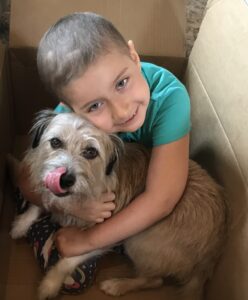
Besides Scarlett Chwatko’s love of reading (see Bookmark Buddies story on page 27), she had a passion for art and animals. In fact, she often said “If I could, I would adopt every animal in the world I would”.  Scarlett grew up with rescue animals and most recently had a beloved dog named Ollie and cat named Winnie.

Her love of animals and the SPCA of Westchester was set an early age. In fact, for her fourth birthday, she wanted an animal party and her mother, Robin Chwatko, inquired if the SPCA of Westchester in Briarcliff Manor could help with that request. Sure enough, they did and several rescue puppies and kittens were brought to the party so that her friends could play with them. Instead of gifts, Scarlett asked all guests to make a donation to the SPCA of Westchester.

Scarlett’s relationship with the local SPCA only deepened over time. She often served as a cage captain during adoption events held throughout the year at the shelter. Cage captains accompany the pets in their cages during adoption events and help keep them calm and comforted.

Scarlett with her dog, Ollie
PHOTO COURTESY OF ROBIN CHWATKO

Draw for Paws: Scarlett’s Idea

“Scarlett loved art and drawing and animals more than anything,” explains Robin. Scarlett came up with the idea of Draw for Paws. She was hoping that people would donate $20 to this SPCA of Westchester and in return she would draw their pets or favorite animal with the proceeds going directly to the organization. She created the original sketches, the concept, the Draw for Paws logo and the color scheme. She also wrote the mission statement for the organization at a “business meeting” with her mother at Starbucks.

Turning a Dream into Reality

For the holidays this past winter, Robin bought Scarlett the domain name for the website, drawforpaws.org and hired a graphic designer to help finetune her Draw for Paws logo sketch. “We have tried really hard to keep everything as close to her vision as possible,” said Robin.

Naming the Transport & Adoption Events

The SPCA of Westchester has a special relationship with an organization based in Mississippi called Homeward Bound. The SPCA works with them to transport hundreds of puppies a year from high kill shelters in the South to bring them to the SPCA here in Westchester to find their forever homes. These puppy adoption events held several times a year at the SPCA are hugely popular with many successful adoptions taking place but they are costly-roughly $50,000 a year to rescue, spay/neuter, transport and adopt out 300-400 puppies.

“When we knew Scarlett wasn’t doing well, I knew that people in the community would want to honor her. Although there are wonderful organizations that help kids with cancer, I knew that she would not want that to be her legacy,” explains Robin.

As Scarlett’s condition worsened, Robin reached out to the SPCA. Together they thought that naming the transport/adoption events in her honor would be an ideal way for the community to help an organization that Scarlett loved and was truly passionate about. Scarlett was always thinking about how she could help the animals at the SPCA. “She would donate all the blankets she received during hospital stays to the animals,” Robin recalls.

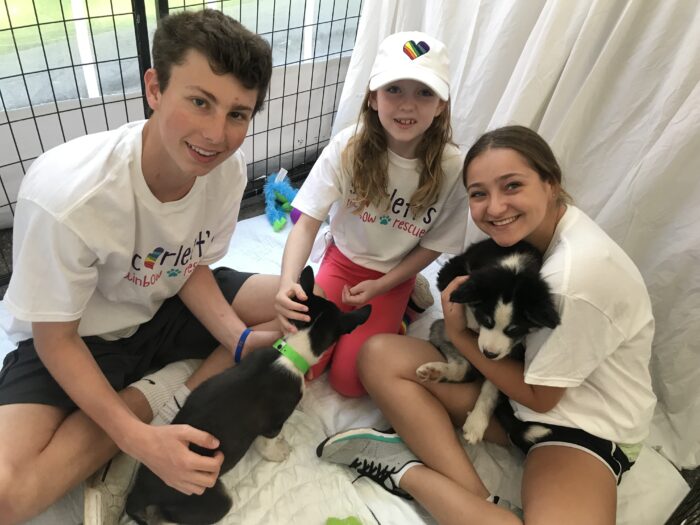
Cage captains, (L-R) Bryce Gell, Annabelle Fisher and Maddie Weiser at the inaugural Scarlett’s Rainbow Rescue event
Photo courtesy of Robin Chwatko

Brainstorming A Name for the Transports

When Robin and Scarlett first conceptualized Draw for Paws, Scarlett said she wanted to create every picture on her own. Robin suggested that Scarlett “employ” a few of her friends to help with the artwork.  So she asked three of her friends, Annabelle Fisher, Grace Frieder and Tate Shalov (all rising fourth graders) to join her on this endeavor. These girls are all founding friends listed on the drawforpaws.org website.

After Scarlett’s passing, her friends came up with the name “Scarlett’s Rainbow Rescue” for the transports and decided to call themselves the Scarly Squad, but their involvement didn’t stop there. The Scarly Squad looked through Scarlett’s artwork and chose pieces that appear on the Draw for Paws website. They, along with Scarlett’s friends, family, and teachers also helped serve as cage captains at the inaugural Draw for Paws/Scarlett’s Rainbow Rescue adoption event held this past June at the SPCA in Briarcliff, which helped to raise more than $25,000 with funds that the community made in her honor at spca914.org/Scarlett and from contributions made on drawforpaws.org since the program launched. At this time, all contributions made on the Draw for Paws website will directly fund Scarlett’s Rainbow Rescue transport/adoption events.

Anyone Can Be an Artist

“We knew Draw for Paws was a way to directly involve Scarlett’s friends and family,” explains Robin. Robin admits that she was a bit hesitant initially and was worried that the people would not like the portraits drawn by the child artists but the response has been overwhelmingly positive from both the artists and the recipients of the artwork.

In order to become a Draw for Paws artist, an artist profile is needed. Artists are required to fill in an outline of a bunny that Scarlett drew named the Scarly Bunny and add a few details about themselves on the website. “Her friends are literally drawing WITH Scarlett-  immersing themselves in her art by filling in this sketch. It is such a beautiful and special way to support her, remember her, and connect to her. It is also very therapeutic for so many of these kids who are feeling her loss.”

What’s Next for Draw for Paws

Robin hopes to expand the reach of Draw for Paws. Right now, the majority of the artists are local but they have had requests for portraits from Texas, New Jersey, Florida and California. “While our campaign will continue to fund Scarlett’s Rainbow Rescue, we encourage kids anywhere to start a Draw for Paws Campaign to help animals. For example, if an artist based in Florida wants to protect sea turtles, we will promote their campaign on our site and help them get up and running,” explained Robin.

Beyond Puppy Portraits

“The portraits are really incredible. People love them and want multiple drawings by different artists to collect them.” And the artists aren’t only drawing dogs, they’ve made portraits of cats, chickens, hamsters and dophins.

Currently, the artist is chosen randomly. “You can get a 5-year-old or a teen drawing your portrait,” said Robin but she is working to get celebrities and well-established artists on board in the future. “My favorite day of the week is sending out the orders – I feel Scarlett every time I send a portrait to a recipient. It is amazing to be able to honor her vision and spirit exactly as she wished.”

Draw for Paws at the Chappaqua Children’s Book Festival

Draw for Paws will have a special presence at this year’s Chappaqua Childrens Book Festival. Several illustrators will raffle original art as well as hold live “how to draw” demonstrations at the Draw for Paws booth.

Draw for Paws Portraits

German shepherd created by Rex, age 9, Manhattan
Cat created by Grace, age 9, Chappaqua
Chicken created by Ella, age 9, Tampa

Filed Under: Cover Stories Tagged With: 95, Art, art and drawing, Bookmark Buddies, Draw for Paws, Kittens, Puppies, Rainbow Rescue, Scarlett Chwatko, Shelter, spca

It’s A Family Affair: Local Award-Winning Father & Son Filmmakers

May 31, 2019 by Ronni Diamondstein

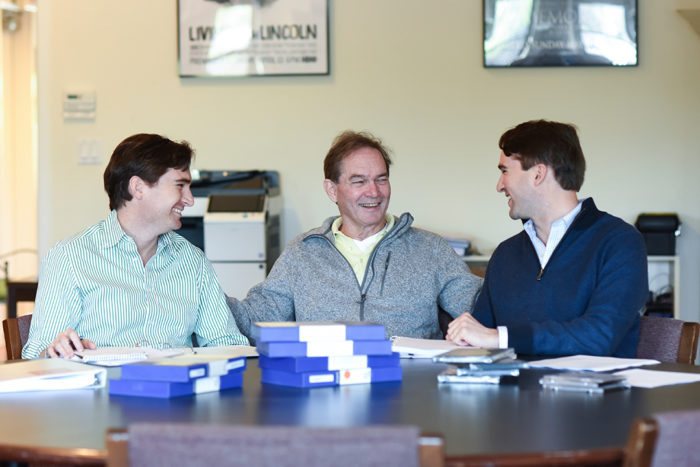
(L-R): Teddy, Peter and George

The Kunhardts Produce Documentaries That Shape Our World and Focus on Moral Leadership

For Peter Kunhardt, a six-time Emmy and a Peabody Award winner, collaboration with family is in his DNA. As Executive Producer and Director, Peter partners with two of his sons, Teddy and George, at Kunhardt Films to produce critically acclaimed and socially relevant documentaries about the people and ideas that shape our world.

After ten years as a producer at ABC News, Peter gave up the hectic commute to New York City and founded Kunhardt Productions in Westchester in 1987.  His first film project for HBO, JFK: In His Own Words, was in collaboration with his father, Philip B. Kunhardt, Jr., the longtime managing editor of Life Magazine. He had watched the toll that forty years of commuting from Chappaqua took on his father. Peter and his wife Suzy were raising their family in Chappaqua and he wanted to work closer to home.

A Family Business at Heart

“It’s definitely a family business with multiple departments,” says Peter Jr. All the Kunhardt children interned with their father. Peter Jr. worked on two Lincoln books with his father and grandfather. He is now the Executive Director of the Meserve-Kunhardt Foundation and the Gordon Parks Foundation that preserves the work of photographer Gordon Parks and educates the next generation of scholars and students on his work.

Teddy and George joined their father at Kunhardt Films in 2009. George knew as a teen that filmmaking was his future. Teddy, an artist and chef, took a slight detour and ultimately joined his father’s company. Both brought their gifts and talents.

“My skill set and interests are the creative and the technical. I’m more of the people person, in the trenches on filming and working with my crew,” says George whom his father and brother call the “peacekeeper.” “He’s the best spokesman for the company,” says Teddy.

Teddy’s skill set is the business side: deals, the budgeting and more of the legal side, dealing with the lawyers. Their father Peter is overarching, and knows everything about everything says George. “He sits back and listens and chimes in when needed when he has something appropriate or important to say.”

“I listen hugely hard to both Teddy and George. Frankly, they are taking over more and more of what I used to do, and I continue listening,” says Peter. They agree 95% of the time, but Peter will have the last word when they disagree.

While their business office is in Pleasantville near the Jacob Burns Film Center and Metro-North, which were draws for this location, most of the team is in New York at HBO.

“We are fortunate to be partners with HBO. People would be surprised to learn how long it takes to produce a film, and HBO gives us the time we need,” says Teddy. “Pleasantville is the brains, the budgeting, the pre-development side of the projects, and the heavy lifting of producing,” says George. “The HBO team is young, creative, hip and where the exciting culture of filmmaking is done.”

(L-R): George, President Bill Clinton and Teddy
(L-R): George, Hillary Clinton and Teddy
(L-R): Teddy, John McCain, George and Peter
(L-R): George, Joe Biden and Teddy


Exploring Moral Leadership Through Film

The notion of moral leadership is always their default in selecting subjects for their films. “Years ago, we said we wanted to explore this concept of moral leadership,” says Peter. “In this day and age of what we’re experiencing now it seems to be a more and more important thing to be doing to remind people what true leadership and true moral courage look like. Fortunately, we were a little ahead of ourselves picking an important kind of theme early on. That’s why it takes us so long to pick the people.”

“And sometimes you have to wait for the hook,” says Teddy. The hook for King in the Wilderness was the 50th anniversary of Martin Luther King Jr.’s death. He was on their list in 2009 but the film did not come into fruition until 2018. “We couldn’t have found a home ten years ago, but once the anniversary was approaching it all seemed right.”

Their very personal film in 2015, Living with Lincoln chronicles their six-generation struggle to preserve Abraham Lincoln’s image for more than a century. As a love letter to Peter’s grandmother Dorothy Meserve Kunhardt, it explores the emotional and physical connection to the president starting with William Meserve and his Civil War diary. Dorothy, a quirky Lincoln scholar, is best known as the author of the beloved interactive children’s book, Pat the Bunny.  It was a glorious burden for the family. “I never planned to dedicate so much of my life to Lincoln, it just happened. I felt I owed it to my father, just as he owed it to his mother, just as she felt she owed it to her father,” says Peter.

Teddy and George enjoy working with their father. “We know each other’s strengths and weaknesses. Our communication is so strong that it has been the key to our success,” says George. One of the downsides though is that they talk about their work all the time, which is fun for them, but not so much for their wives.

“We get a lot more from people because we are a family business,” says George. “When we interviewed Joe Biden for John McCain: For Whom the Bell Tolls, we got a lot more access from him. He loved that Teddy and I were brothers. He took my cellphone and called my dad, and told him how much he enjoyed working with us.”

Trust is Key

“The biggest challenge we face is gaining trust,” says Peter. “Once you gain the trust of your subject you begin getting better access, content and stories.” When they filmed Becoming Warren Buffett, Buffett gave them strict restrictions in the beginning, only one interview, but they ended up filming him for fifteen hours. “Trust comes in a few ways: for one, they have to feel that we’re not out to give you a gotcha question. We’ve never been in that business, but we’re not in the business of a soft fluffy story either.”

Storytellers at the Core

They take a deep dive into the lives of their subjects. “We’re not historians, business people or news correspondents,” says Teddy. “We’re storytellers and in order to tell the story we need to get all the pieces of the puzzle.” They often look for people who have a relationship or don’t have a relationship with their parents and explore that in the film.  “That’s a unique perspective to take because we’re very interested in lineage: Fathers/sons, fathers/daughters, mothers/sons, mothers/daughters,” says George. “That’s our wheelhouse. It is fun for us to do that within a film and something we look for when we do a project.”

“When you go back to someone’s childhood you learn about strengths and weaknesses and how they came to be in a way that would be hard to imagine by just focusing on the adult period of someone’s life and their success,” says Peter. “It’s fascinating to go back and see what influenced a child, what hurt a child, what helped a child. And how they were shaped by that.”   

On the Horizon

Teddy and George have brought some fresh ideas to the film company.  In addition to cable, there is now the film festival route.  Jim: The James Foley Story premiered at Sundance and won the Audience Award, King in the Wilderness had its world premiere at Sundance and True Justice: Bryan Stevenson’s Fight For Equality will open the AFI DOCS film festival in June. George says that one of the best things that they are doing now is the establishment of the Kunhardt Film Foundation with its mission to put their high-quality educational programs, raw interviews and teaching tools into the hands of the public and schools. “This is our future where we are heading towards. We are doing more not-for-profit,” says Peter.

Their next film, True Justice: Bryan Stevenson’s Fight For Equality will have a screening at the Jacob Burns Film Center on June 25th, and debuts on HBO the following day.

Always reflecting as well as looking forward, they are proud of their high-quality work and very thoughtful filmmaking. “We are fortunate in that we can continue to infuse values into the work we do, and pick people to tell their stories that we think have lessons,” says Peter. George sums it up well: “We’re curating an interesting perspective of people and ideas that people need to be learn about. That is what I hope people enjoy about Kunhardt Films.”

Filed Under: Cover Stories Tagged With: AFI DOCS film fetival, Bill Clinton, Chappaqua, Documentaries, Family, film, Filmmaking, HBO, Hillary Clinton, JFK: In His Own Words, Joe Biden, John McCain, Kunhardt Family, Kunhardt Films, Living with Lincoln, Local, Storytellers, True Justice

  • « Go to Previous Page
  • Page 1
  • Interim pages omitted …
  • Page 80
  • Page 81
  • Page 82
  • Page 83
  • Page 84
  • Interim pages omitted …
  • Page 149
  • Go to Next Page »

Primary Sidebar

Please Visit

White Plains Hospital
William Raveis – Armonk
William Raveis – Chappaqua
Northwell Hospital
Houlihan Lawrence – Chappaqua
Houlihan Lawrence – Armonk
Houlihan Lawrence – Briarcliff
NYOMIS – Dr. Andrew Horowitz
Westchester Table Tennis Center
Spavia
Compass: Miller Goldenberg Harris Team
Lipari & Mangiameli Dentistry
Raveis: Lisa Koh and Allison Coviello
Bristal Assisted Living
Maid Brigade
Kevin Roberts Painting & Design
Zwilling J. A. Henckels
Meagher & Meagher Attorneys at Law
Compass: Aurora Banaszek
Dr. Briones Medical Weight Loss Center
Decicco and Sons
CPW Vein & Aesthetic Center
World Cup Gymnastics
Play Nice Together
Wags & Whiskers Dog Grooming
Gleason Plumbing and Heating
Breathe Pilates and Yoga
Temple Beth El

Follow our Social Media

The Inside Press

Our Latest Issues

For a full reading of our current edition, or to obtain a copy or subscription, please contact us.

Inside Pleasantville and Briarcliff Manor Inside Chappaqua and Millwood Inside Armonk

Join Our Mailing List


Search Inside Press

Links

  • Advertise
  • Contact Us
  • Digital Subscription
  • Print Subscription

Publisher’s Note Regarding Our Valued Sponsors

Inside Press is not responsible for and does not necessarily endorse or not endorse any advertisers, products or resources referenced in either sponsor-driven stories or in advertisements appearing in this publication. The Inside Press shall not be liable to any party as a result of any information, services or resources made available through this publication.The Inside Press is published in good faith and cannot be held responsible for any inaccuracies in advertising or sponsor driven stories that appear in this publication. The views of advertisers and contributors are not necessarily those of the publisher’s.

Opinions and information presented in all Inside Press articles, such as in the arena of health and medicine, strictly reflect the experiences, expertise and/or views of those interviewed, and are not necessarily recommended or endorsed by the Inside Press. Please consult your own doctor for diagnosis and/or treatment.

Footer

Support The Inside Press

Advertising

Print Subscription

Digital Subscription

Categories

Archives

Subscribe

Did you know you can subscribe anytime to our print editions?

Voluntary subscriptions are most welcome, if you've moved outside the area, or a subscription is a great present idea for an elderly parent, for a neighbor who is moving or for your graduating high school student or any college student who may enjoy keeping up with hometown stories.

Subscribe Today

Copyright © 2026 The Inside Press, Inc. · Log in