Inside the World Trotting, Courageous Adventures of the Award-Winning Archipelago Films Documentary Team: Susan Todd and Andrew Young
Not overlooking the Hudson, or even Fitzgerald’s “great wet barnyard,” a landlocked, Pleasantville is easy to ignore. The Readers’ Digest came but went away and then went bankrupt.
The streets are crammed with Babbits, we assume, sheltering in what my father called “happily-ever-after architecture.”
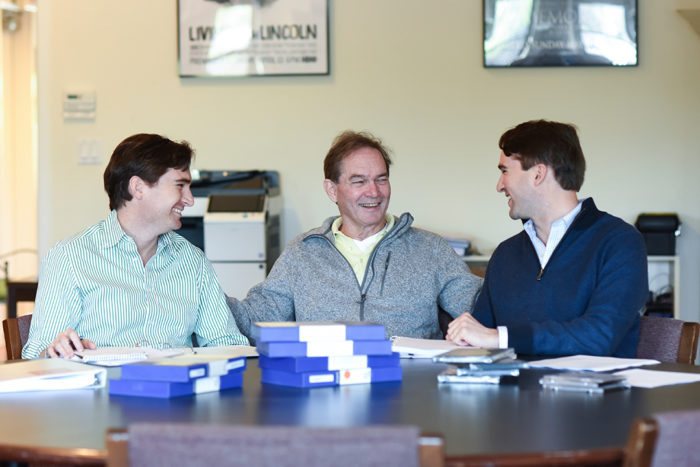
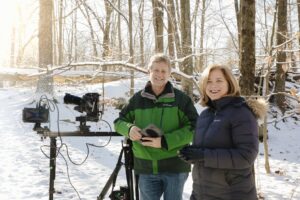
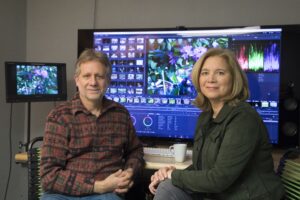
Courage is not the word that comes to mind, though Pleasantville is home to Andrew Young. He’s an Emmy Award-winning, Academy Award-nominated Director, Cinematographer, Writer, and Producer, who with Susan Todd founded Archipelago Films, Inc. Their 2018 documentary Backyard Wilderness won every award it could. What’s shocking though is the courage required to make a documentary.
 Let’s start with Andrew on one of his first outings.
The temperature was 110 degrees, so sweat was pouring inside the hazmat suit. Goggles fogged and breathing through a respirator, “I felt that I was walking into the belly of the beast,” he recalls. “Literally walking into the heart of the earth. You looked at what you thought was the wall, but it wasn’t the wall; it was solid bats…. You wear boots that go up to your shin. If you do get stuck, what’s left will be a skeleton, beautifully cleaned by the flesh-eating dermestid beetles,” he said, and chuckled. Predicaments that would terrify a civilian set Andrew Young to chuckling.
Snakes – which can imbed in the wall of the cave –are among the predators that dine on any bat foolish enough to think himself/herself safe after a night of hunting and now so close to home and sleep.
It was the majesty of nature, not the risks, that drew Andrew Young and Susan Todd to the profession in which they have succeeded magnificently. Andrew’s father, Robert M. Young, was a legendary film maker, so there’s a tradition to grow into.
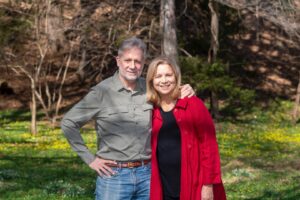
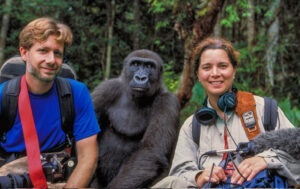
Pictured with this article is a beaming Lowland gorilla flanked by Andrew and Susan.
 Susan explained that cute baby gorillas harvested – mostly by the pet trade – are given up when they get too big to snuggle. The Congo Center they are pictured at works to re-habituate them to the wild.
The Lowland Gorilla to Susan’s left looked big enough for JV football. Susan says she “was never frightened. He followed us around. He wasn’t all that big,” she said, ignoring the enormous strength gorillas have whatever size they come in.
“Looks big to me,” I said.
“Little for a gorilla is still big,” Andrew explained. Susan admitted that she was at first put off by the Silverbacks. Instead of a simple “Hello there,” or ‘Hot enough for you?” a Silverback will make a noise that sounds as if you crossed a diesel engine with a pitbull and then broke the dog’s leg.
 “We were told to respond, in a similar vein, but at a slightly lower register,” Andrew said demonstrating a gutteral ahhem, ahhem, ahhem ahhem.
This was simple civility Andrew was told though he couldn’t entirely shake the suspicion that what the patriarch meant to say was “I’m about to tear you to shreds,” which a 600-pound gorilla could easily do and on a whim.
“The biggest trouble we had with the gorillas was the babies, because they would steal the lenses out of our bags,” Susan explained.
“And how much were those lenses worth?” I asked.
 “I don’t know,” she said. “Five, maybe 10,00 dollars.”
The film makers were instructed to act as if they didn’t mind at all, “because if they sense you care,” Andrew said, “it was a win. They’d take the lens and climb a tree.”
“What you had to do,” Susan said, “was just to wait them out. Wait until they got bored.”
Andrew will acknowledge that he was uneasy filming buffalo in rutt. The cows were curious about the man with the camera,
the bulls were curious about the cows.
The bulls are big. With terrible eyesight.
Brown Bear Encounter
It was filming Bears in Southwestern Alaska near Admiralty Island that he had a session that still turns my own bowels to water.
 Glowering skies and persistent rain were ruining the video of the annual salmon massacre. Noticing an Alaskan Brown Bear who favored a particular pool and hoping for better lighting below the surface, Andrew dove into the water to arrange a camera trap.
He was maneuvering equipment in extremely cold water, when his assistant called out in alarm: The bear was coming back. “We had no place to go,” Andrew told me, “So we just kinda flattened ourselves out on the shore. We lay very still.”
Blissfully uninterested in his 15 minutes of fame, the gigantic omnivore ambled past the supine documentary makers and went fishing. Larger than their more notorious relative the Grizzlies (Ursus arctos horribilis), an Alaska Brown Bear (Ursus arctos) comes with what Wikipedia calls “well developed dentition and claws.”
“I could hear him breathing,” Andrew recalls. Peering out of one almost closed eye, he saw the giant splash about for what might have seemed an hour but was probably 15 minutes.
Bear gone, Andrew was in the pool and trying to finish the job when his assistant gave the alarm a second time.
Back on shore and trying to appear as dead as one of Mathew Brady’s civil war soldiers, Andrew could “hear the bear breathing. I could see his head,” Andrew told me, holding his hands three feet apart to give an indication of one of the largest skulls of any land-based mammal.
Bored, or sated, the bear headed off a second time. Into the water went Andrew – his fingers stiff with cold – and managed to finish the camera set up.
Once the stage was set, the bear was gone, apparently done with the pool. Andrew built a stand in a tree. There he sat for days. Cold, frustrated and a feast for mosquitos, that’s where he stayed, his boredom only slightly ameliorated by the observation that the mother bear who settled with three cubs at the bottom of his tree showed little interest in the frustrated herbivore above.
 Finally, though, the bear came back. “The shot was terrific,” Andrew recalls. First seen fishing, the picturesque walk-in spotted the camera. There is video of the Alaskan Brown Bear reaching out for the lens with one gigantic claw.
It was almost certainly Andrew’s courage that kept him alive. Surprised by a hungry Brown Bear, your correspondent would have raced screaming away, quite possibly raising an idle question in the mind of the giant omnivore: “Nothing but fish all week. Maybe today I’ll try a something different. Something that tastes like chicken.” Though an Alaskan Brown bear weighs more than 1,000 pounds, he can go 35 miles an hour, which is much faster than I can go, and this despite a lifetime of training.
Danger and discomfort can team up to make the job harder. The dry side of Madagascar was scorchingly hot. Hot and dry, Susan and Andrew doused themselves in the relative comfort of a large, muddy pool. The luxury of this makeshift jacuzzi was only slightly marred by an enormous bug, a two-inch long boatman, who liked to skate the surface.
“Did he bite or sting?” I asked.
“I don’t know,” Susan said. “I don’t think so.”
They’d brought a portable pharmacopia, but Andrew still got so sick that Susan needed to help him back to their rat-infested shelter for several days of recuperation.
“People see the movies and they think we had an exotic vacation,” Susan says. Vacation it was not, though both consider it an honor to have been so close to nature however red in tooth and claw. Right before the interview, Andrew had gone to Mexico to photograph the Monarch butterflies.
Home Sweet Home
If life is having to go a long way out of the way to come back a short distance correctly, Archipelago Films exactly enacts that truth. After photographing exotic animals in exotic places, Susan and Andrew were drawn to their own back yard.
 Parents who had grown up playing outside, they were alarmed with the devices that seem to have kept so many younger people indoors, fascinated by imaginary, addictive, and highly manipulative worlds on their private screens. “We thought local animals could be ambassadors to the wild,” Andrew said.
When a beaver family used the stern of a rowboat flipped and pulled up on the shore near their house, Andrew inserted cameras, and his audience got a chance to observe an apartment that everybody else – beavers included – had to dive underwater to visit. There were frogs inside and even a snake. My own son Andrew helped with some of the manual labor, and I remember him telling me that many wild animals share their houses – and not just at dinner parties.
The most spectacular scene in the movie which changed its name from Pondominium to Backyard Wilderness, filmed a clutch of wood ducks nesting in a knot hole.
Which brings me to another quality exhibited by the film team but not necessarily noticed by the audience. Susan and Andrew are brave, but they are also imaginative. And – above all – persistent.
Say you suspect wood ducks have nested high in a tree near your house? Would you wonder how to get a camera up there, and – without disturbing the ducks – take video of the eggs hatching?
“What if,” is a phrase Andrew likes to use. Sometimes the projects fail, but when they succeed, the resulting footage is astonishing. I’ve been in movies audiences ensorcelled by a private world – a biosphere right outside their windows. Racoons of course and squirrels, mice in the walls but also coy wolves and white-tailed deer.
We held our breath when the fledgling wood ducks – not yet equipped to fly – jumped like so many Icaruses out of their nest and fell awkwardly down into the world.
My favorite scene was of a beaver who – having spotted the infrared from a camera in the family living room – picked up a clot of mud and leaves and blocked half the lenses. When he picked up another clot of mud and leaves, the screen went black.
Backyard Wilderness was shot in 2D. Two to three million people have already seen it in 3D, and it will soon be released in 4D. Netflix plans to air it on August 15.
Projects in the wings, include a movie about the lowland gorillas in Rwanda where a profitable tourist trade has led to the preservation of natural habitat. “A good news story,” Andrew said.
 Next up, and clearly central is a project titled Hardwired, which shows that the great outdoors is not an aesthetic to be enjoyed when the real work of the world is done.
This is a truth we must feel in our bones, since visits to the Rockefeller State Park Preserve reached an unprecedented 600,000 during Covid.
Writing in the Preserve Observer, Susan Todd makes the case that preserving nature is necessary if we intend to survive.
“There is nothing better for the human soul than to recognize that there is something bigger and mightier than us,” says writer and theologian Dr. Belden, she wrote. “But while people have long intuited that nature is good for us, only recently have scientists begun to demonstrate its health benefits empirically.” The Japanese speak of the need for vitamin N, by which they mean exposure to nature.
“Trees are definitely cheaper than health care,” Andrew told me, citing a study in Toronto that found that 10 more trees on a city block improved health outcomes for residents comparable to a $10,000 increase in annual salary, or an increase in lifespan of seven years.”
Parents of 11th graders eager to pay somebody else to write the college essay may also be interested to learn that students in a wilderness setting get grades 50 percent higher on intelligence tests.
“We are all at our best in nature,” Andrew said.