• Skip to primary navigation
  • Skip to main content
  • Skip to primary sidebar
  • Skip to footer

The Inside Press

Magazines serving the communities of Northern Westchester

  • Home
  • Cover Stories
  • Features
    • Portraits and Profiles
  • Advertorials
    • Lifestyles with our Sponsors
    • Sponsor News!
  • Wellness
  • Happenings
  • Advertise
    • Advertise in One or All of our Magazines–And/Or Subscribe
    • Advertising Payment Form
  • Contact Us
  • Search

Cover Stories

My “Farm to Table” Table

March 6, 2016 by The Inside Press

IMG_1549

By Dana Y. Wu

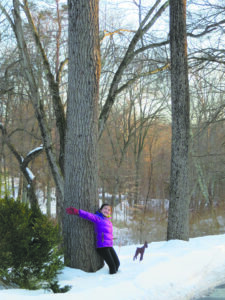
In 2014, when my family and I moved to Kipp Street, two black walnut trees swayed precariously over the driveway and power lines of our farmhouse colonial built in the 1900s. Their roots were exposed in the shallow, allopathic soil and black walnuts the size of tennis balls rained down on us.

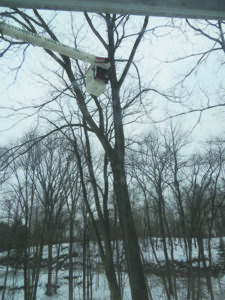
Reluctantly, we got the tree removal permit and called Bill Davies of Westchester Tree Life. He told us that the wood was valuable and offered to take the huge trunks to White Oak Farm in Yorktown for milling.
IMG_0729

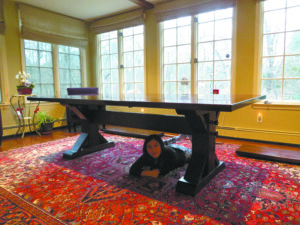
Jason Ballard (My Minds Design, Grafton, Vermont), a talented woodworker, had made built-ins and an antique barn beam mantle for our former house on Birch Lane. We asked if he could create an eight-foot dining table for the new house and he was thrilled to work with wood from our homegrown trees.

Bri Hart at White Oak Farm selected the best pieces for the table top for milling into nine foot planks. The wood was sawn to Jason’s specified dimensions and kiln dried for two months. When it was ready, Bri declared this was some of the best walnut he had ever seen. Serendipitously, another of Bri’s custom timber cuts was ready to head north and we happily piggybacked onto that delivery to get our 900 linear feet of walnut to Grafton.
IMG_0741

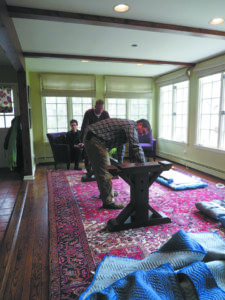
Maggie Nielsen was helping us furnish our home, on land that was part of the extensive Kipp family holdings from the mid-1700s. She designed a casual dining room for daily homework, reading and meals by our busy family of six. It took several discussions and wood samples by mail to get the table’s vintage character, the stain and the finish figured out with Jason. Maggie had suggestions about the table’s base to match the tone we had set with the dining room’s new paint, windows and rug from Caravan Connection in Bedford Hills.

After hours of Jason’s expert craftsmanship, the finished table took up almost his entire workshop during the weeks to took to dry all 25 coats of his signature polish. He delivered it in January 2016, and we were so excited to see how its proportions, color and warm feel were all in perfect harmony with the 100 year old house.

The table had finally come home.
IMG_1511

Our “farm to table” table soon will be joined with a beautifully handcrafted mirror, a sideboard and chairs, all made from this wood harvested from our property. They will become true family heirlooms. The organic, creative collaboration between Bill, Bri, Maggie and Jason brought the walnut trees that were growing outside into the heart of our home.

Dana Y. Wu, a Chappaqua mom of four, is an author, visual storyteller and local volunteer. Her not-for-profit management career includes experience at the New York Public Library. A life-long New Yorker, she graduated from Stuyvesant High School and Columbia University. She pursues her writing with the vibrant, creative community at the Jacob Burns Media Arts Center.
Filed Under: Cover Stories Tagged With: Chappaqua, craft, Inside Press, theinsidepress.com, tree, wood, woodworking

Here Comes the Sun: Solar Power in New Castle

March 5, 2016 by The Inside Press

A first commercial solar installation on Greeley Avenue in Chap- paqua, which won Sunrise Solar an award from the Town of New Castle’s Sustainability Committee.
A first commercial solar installation on Greeley Avenue in Chappaqua, which won Sunrise Solar an award
from the Town of New Castle’s Sustainability Committee.

By Eileen Gallagher

Looking to lower your electric bills? Longing to go green? Interested in protecting the environment? Curious about the Solarize signage that was appearing throughout town? Going solar might be the perfect fit for you!

Why did we see all those”Solarize” signs around town?

New Castle Sustainability Advisory Board chairperson Steve Wolk and Alicia Molloy (the initiative manager) described how Solarize came about in town:

New Castle and other towns were looking into Solarize Westchester, a program started by NY Sun (a NYS government program). Per their website, http://ny-sun.ny.gov/About/NY-Sun-FAQ, this program “is part of the Governor Andrew M. Cuomo’s commitment to “protect the environment and lower energy costs for all New Yorkers by improving the efficiency and reliability of the electric grid.”

Wolk described how the program can help towns to adopt a high amount of solar on residential homes and small commercial buildings by using the program to reduce risk and reduce the cost of solar.

New Castle was able to link with Somers because, as Wolk explained, the towns needed to be contiguous, and their colleagues were “great partners and people they could collaborate with and potentially share marketing materials and ideas.” The feeling was that there would be a higher probability of getting to be one of the “chosen towns” by working with Somers.

New Castle and Somers filled out an application in which they described what they would do as part of this initiative, and were selected for the program.

Why go solar now?

Molloy explained that there has really never been a better time to convert to solar in terms of pricing and incentives. “Energy costs are always going to keep going up.” Costs aside, she stressed the need for a greener future, leading the way to “get off of fossil fuels and think in renewable energy.”

Can solar panels really power a home?

If your house has a proper amount of sunlight, as a solar installer will assess, you could potentially power your entire home using solar energy.

Any power generated and unused by your home goes back into the grid, and you are credited for that portion.

Is your home a good fit for solar?

The ideal candidates for solar installation would be homes facing south, south-east or south-west, with little to no shade, and a clear roof of less than 15 years with no obstructions.  If the roof is shaded, trees might need to be trimmed. Ground-mounting is possible, but cost would be higher due to the need for a structure to place the panels on. Westchester and particularly New Castle is challenged by the large amount of trees.

Which provider to use?

Residents are always free to choose their own solar provider. For example, Sunrise Solar Solutions of Briarcliff Manor is a company whose CEO is a resident of Chappaqua. Rand Manasse, along with Sunrise Solar’s president, Doug Hertz, described their attractive solar installations as setting them apart from other installers. As a seven year subsidiary of Sunrise Building and Remodeling, they recognize the importance and value placed on the quality as well as appearance of the equipment on one’s home.

How long will it take to recover expenses?

According to Manasse, the average return on investment is five to six years for purchased systems and Day One for financed systems. And this is for a system that has a warrantied life of 25 years and will most likely produce energy for well over 30.

The savings on a solar system for the typical home in Westchester is $60,000  over the life of the system.

Selling your home in the near future?

Purchasing equipment rather than leasing might be a better fit for you. Per Hertz, “In a recent study by the Department of Energy it was shown that for every dollar invested in a solar system you add 3 dollars to the value of your home at resale.  Reporting from the Wall Street Journal and Bloomberg have shown issues with selling homes with leased systems. Not only does ownership create more value, but it removes the legal impediments to a sale that a lease entails.”

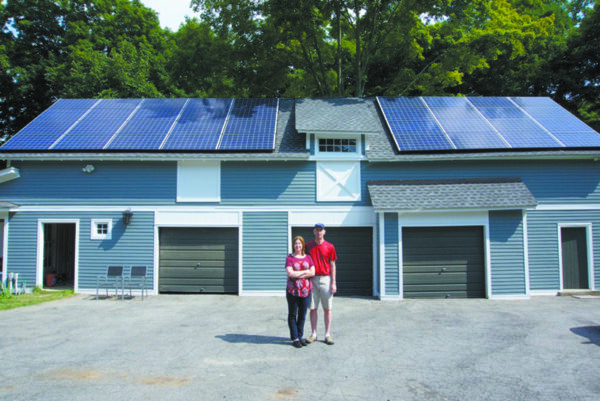
Peter Martin and Kendal Sandlin in New Castle

Tips from Sunrise Solar Solutions

  • Shop local. Not every Solarize partner is equally invested in the community. Once the campaign is over, a national firm with spread out interests may be far less responsive than a reputable local installer with longstanding ties to the community.
  • Look for long-term value, not bargains. The saying goes, it’s penny-wise and pound-foolish. When making a significant investment in your home, pricing is important, but it’s just one of many factors to consider. Invest in a system that can offer you significant savings for many years to come, not just today. It’s very important to note that a higher quality installation can actually save you more money in the long-term.

For more information, solarizewestchester.com/solarize-somers-new-castle/ and sunrisesolarllc.com

Filed Under: Cover Stories Tagged With: environment, Inside Press, solar, solar power, sustainability, theinsidepress.com, Westchester

Let’s Talk About It: Raising Resilient Kids

December 2, 2015 by The Inside Press

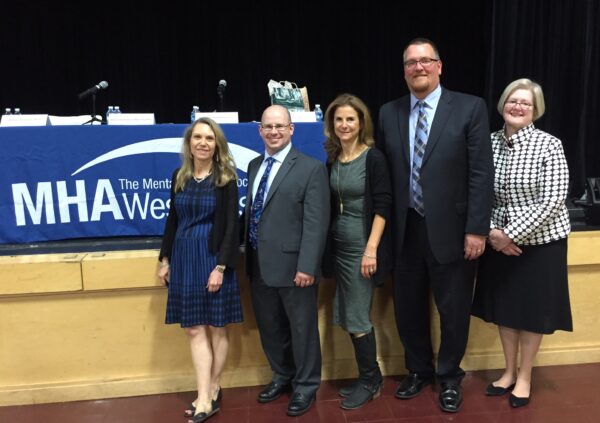
L-R: MHA’s Head of Personal Development, Education and Training Dr. Barbara Bernstein; MHA Board Member Sean Mayer; Educator Shari Applebaum; Byram Hills High School Principal Chris Borsari; and Reverend Frances Wise Grenley of Scarsdale Congregational Church

By Deborah Raider Notis

We live in a community in which everyone is hyper-focused on raising successful children. But do we spend nearly enough time teaching these successful children how to recover from disappointment, failure, and stress? How do we raise resilient children?

This was the focus of the Mental Health Association (MHA) of Westchester’s community conversation held in November at the Rosenthal JCC.

Moderator Sean Mayer, an MHA board member who lost his brother to suicide, asked a panel of experts, “In today’s high stakes, technology driven world, how do we help our youth develop strength and buoyancy?” The event, sponsored by The Inside Press, concerned reducing and identifying factors that cause anxiety, stress, depression, and the potential for suicide in children and young adults.

According to the MHA’s Dr. Barbara Bernstein, counselors are seeing more children with more mental health issues nowadays. Over one-third of college students polled said that they cannot function because they feel sad and hopeless, one half of these students suffer from anxiety, nine percent considered suicide, and 17% of high school students polled thought about suicide. She urged, “Early identification of these issues is critically important. We have to figure out why kids are not developing coping skills.”

“Teacup Children” Phenomenon

Panelist Shari Applebaum noted that resilience begins in childhood. “To build resilience with our kids we have to take a step back. Kids must find self soothing skills and must learn to handle disappointment on their own while still knowing that there is a support system.” She and Mayer believe that today’s parents are creating “teacup children,” children who are exceptionally fragile and break easily when faced with challenges. Applebaum feels that our community as a whole must reduce the emphasis on academic and athletic achievement as these pressures are overwhelming to many children–and don’t guarantee fulfillment.

Byram Hill’s Chris Borsari agreed that academic and athletic achievement are priorities in our community. When he started at Byram Hills High School, he wanted to understand why so many students were struggling. “We started out discussing stress,” as he was initially afraid to broach the subjects of mental health and suicide with his faculty and community. He developed Learn to Inspire workshops for his faculty and held coffees for parents to pinpoint what causes stress and anxiety for students. “Over time, people started to discuss suicide. There was a slow acceptance and realization that suicide is a health issue, just like broken bones and concussions but with potentially greater consequences.”

Reverend Francis Wise Grenley suggested that we prioritize kindness and compassion. She thinks local teens need to look beyond themselves and place themselves in a different context to give them some perspective on their problems. “In the modern era, we are the centers of our own attention, everything we do is so important to us.” To help give teens perspective, the Scarsdale Congregational Church takes teens on a Midnight Run to bring clothing and homeless into New York City and also takes them to a community in South Dakota living in trailers–with no windows, no indoor plumbing, and no heat. Grenley points out, “This give our teens a chance to see an entirely different reality.”

The hope is that experiencing this alternate reality will give them a stronger sense of priorities. Borsari notes that we live in “pinnacle communities” where people have found a unique level of success and prosperity. “The American Dream has always meant that you are going to do better than your parents,” notes Borsari. “If that only means money, then kids from these pinnacle communities are going to have a particularly tough time. We need to redefine success to make it more attainable for this generation.”

Technology: Too Much of a Good Thing?

Stress and anxiety are pervasive among children, teens, and young adults–some of whom are plugged in seemingly 24/7. So Mayer asked the panel whether they feel that technology is making growing up harder for our children. The whole panel agreed that it is extremely challenging to deal with texts, Instagrams, Snapchats, and all of the other apps that compel people to constantly compare themselves to everyone else.

Mayer also points out that many of these children have “duck syndrome,” they look perfect on the surface but are paddling furiously beneath the surface to keep up. He says, “It is hard to see all of these posts and think that everyone is having so much more fun than you are.”

Grenley acknowledges, “None of us are strangers to our smartphones. But kids are getting lost in their phones and missing out on face-to-face conversations. How many times have you seen kids sitting next to each other in the car texting each other?” Grenley and Mayer agreed that people are missing out on the beauty of the world around us and losing the ability to be present in the moment.

Teens and young adults need emotional downtime, away from social media outlets. Borsari believes,“ One of the hallmarks of adolescence is to be connected to the group. But you used to be able to go home and escape. Now there is no escape.” He is particularly concerned about kids’ inability to shut down and escape technology.

Grenley implores parents to stick to their standards because kids do better with boundaries. “Hearing the word ‘no’ is not a bad thing.” These rules and boundaries against which kids fight can ultimately give them a sense of belonging and a foundation for success. Most importantly, people need to know about the many available resources throughout our community that can help those struggling with depression, anxiety, stress, and thoughts of suicide. Michael Orth of the Westchester Department of Mental Health said that the county offers peer-to-peer support groups for college-aged young adults, for example. The Scarsdale Congregational Church has a support council and works with neighborhood associations to foster a sense of community.

Byram Hills High School has an open door policy, Transformation Workshops, and is working to reduce the stigma associated with suicide.  And, of course there is the Mental Health Association of Westchester. Just ask Mayer. Six months after his brother committed suicide he turned to the Mental Health Association for support, and today he works with them to create a network of support systems and conversations for others.

Deborah Notis is a writer and co-owner of gamechanger, LLC, a free referral service connecting Westchester families to highly qualified, competitively priced academic, athletic, music, and
art instructors.

RESOURCES

Westchester County Crisis Prevention and Response Team
914-925-5959

Mental Health Association of Westchester
Mount Kisco, 914 666-4646
White Plains, 914 345-0700
Walk-in Services; phone to confirm hours

National Suicide Prevention Lifeline
1-800-273-TALK (8255)

Bereavement Center of Westchester
914-787-6158

Westchester Jewish Community Services
To Inquire about a Support Group:
914-761-0600

Filed Under: Cover Stories Tagged With: children, depression, growth, Inside Armonk (Dec 2015), Inside Chappaqua (Dec 2015)

Progress on the ‘ChapLine’: Plans for a “Woodsy Trail” and Much, Much More

December 2, 2015 by The Inside Press

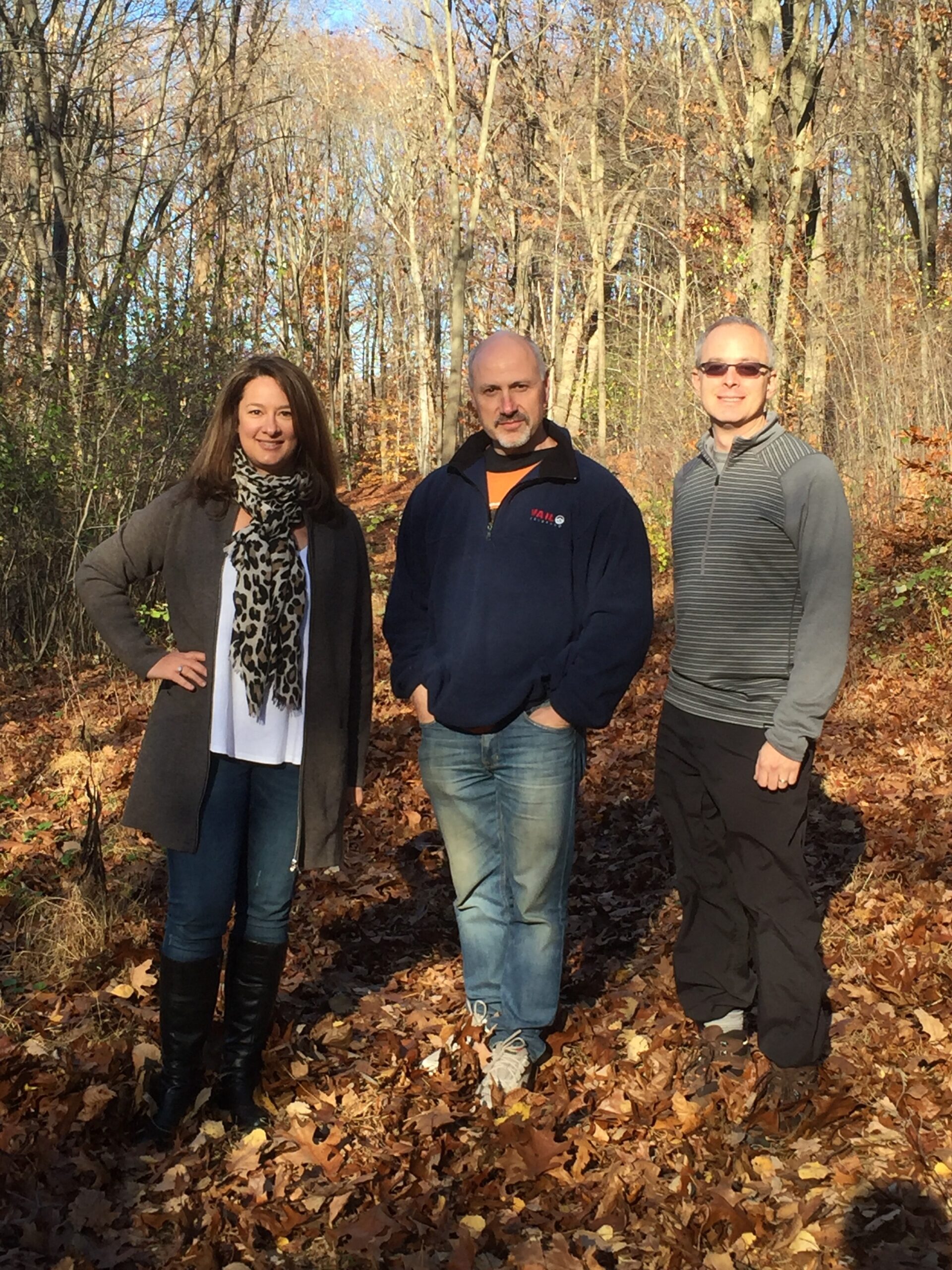
L-R: New Castle Deputy Supervisor Lisa Katz, New Castle Town Supervisor Rob Greenstein, and New Castle Resident and proposer of the ChapLine, Dan Googel

Story and Photo By Matt Smith

Imagine it’s a clear, calm, Spring, Saturday afternoon. You’re in town, having completed a morning of shopping, or finished lunch with a friend. As you would usually do, you head back to your car and prepare for the drive home. But imagine you didn’t bring your car–and instead, you travel home via bike, which is also the way you came. You ride along a woodsy trail, surrounded by trees and steeped in nature. As you pedal, you feel the cool, crisp air brushing against your face and the soothing warmth of the sun washing over your back. Just before you reach the clearing, you cycle across a bridge and look out at a lake, its ripples shimmering in the sunlight. Pure bliss. Wouldn’t that be just wonderful?

With any luck, you could be doing exactly that…and sooner than later, as the New Castle Town Board is steadily making progress on its previously announced plans to construct the proposed ChapLine.

The project would involve upgrading an existing path–cleared and graded in 2005 in order to install a sewer line–to create a fresh, 1.6 mile, multi-use recreational trail connecting Chappaqua Crossing to Horace Greeley High School, and the downtown shopping area (King St. and N. Greeley Ave.)

The project received new attention last year when New Castle resident Dan Googel–who was also, at the time, a member of the Master Planning Commercial Work Group–approached the Town Board at a public meeting, with new ideas for moving forward with the plan.

Noting that community members, according to a July 2014 report from the community work sessions run by Pace, had requested “a more walkable community, a more bike-friendly community, [and] more places for the community to gather,” Googel explained that the establishment of such a trail in Chappaqua would “be a cost-effective means to accomplish these goals.”

Though he acknowledges the town master plan is still not yet complete, Googel has been encouraged by the outpouring of positive feedback from the town and residents since his initial presentation. Comments New Castle Town Supervisor Rob Greenstein, on the matter: “There is still a lot of work ahead of us, but there is also enormous support for creating this trail, and I’m hopeful that we will finally get it done.”

Greenstein also recognizes the many benefits to having the trail completed. For one, he says, “it’s good for business,” as the trail would provide easy access to the downtown shopping area. Additionally, it would be good for the community, as according to studies from other towns and communities, such trails “actually increase the home values of these areas,” making them more attractive and vibrant.

Googel, on the other hand, stresses that having a walking/running/biking trail would encourage a healthy lifestyle, “providing a place for people to get exercise [and] to be outside.” Furthermore, “it’s environmentally friendly,” as it reduces the needs for cars (which cuts down on fuel expenses and gas emission) and “allows a great deal more students to get to school without having to drive.”

Equally important, it would provide residents with a safe alternative to biking or walking on the main roads. “Route 117 is dangerous,” comments New Castle Deputy Supervisor Lisa Katz. “So, to have anyone be able to walk from school or town [on a safer trail] would be phenomenal.”

Greenstein also notes that the trail would provide a more appropriate running course for members of the Greeley Track and Field team, who currently train by crossing Rt-117 and running up Annandale Rd, stating “Crossing Rt-117 in the afternoon is far from ideal, but what option do they [currently] have? ChapLine would give the team a safe option.”

While the Town is enthusiastic about the benefits the trail would provide, Board members are also aware of certain concerns and obstacles that may need to be addressed as they move forward. “We understand that there are neighbors who are affected [by this process] and we’ll do everything in our power to try to minimize and lessen those impacts,” comments Greenstein.

On the subject, Googel expressed that he would like to see the Town work with the affected residents during the path development process. “We want the adjacent neighbors to see this as a positive amenity,” he explains. “And we want to build the path in a manner such that it enhances their property in addition to [enhancing] the broader New Castle community.” Of note, the Town owns the land next to the affected private properties, and intends to evaluate either procuring easements and/or relocating the trail onto this Town-owned land.

Additionally, the team has recently issued an RFP for an engineering firm to conduct both a feasibility study and cost analysis for the competition of the trail. “We’ll have to do a SECQR [State Environmental Quality Review] as well,” says Greenstein, which will “identify any [additional] environmental concerns or technical issues.” Though Greenstein is confident in the Town’s ability to mitigate any major concerns, he explains that because the project is in such an early stage, “We may not even know what our biggest obstacle is yet.”

As for additional future plans, the Town would like to assemble a committee of sorts–which might include a member of the school board, the Town Board, the Planning Board, the New Castle Recreation and Parks Department, and a few of the affected neighbors–so that issues and questions about the project can be answered in a forum where everyone can be heard. Greenstein adds that having the committee might also benefit the newly elected Town Board members, giving them “a chance to quickly get up to speed.”

Furthermore, having received a generous donation of $1.5 million by Summit Greenfield (the owner of Chappaqua Crossing), in support of pursuing this project, the Town hopes to explore additional sources of funding after the feasibility study has been completed. “I have full confidence in this community, as family-oriented as it is, that people would be very supportive personally,” states Googel, on the subject. “The town will definitely come together on this issue.”

So, all in all, things are looking up. “This is a great opportunity,” adds Greenstein, “and we’re going to work hard to get it done, and get it done right.” Reiterates Googel, with a smile: “[The trail] is already here. It’s just begging to be completed.” And, when it is, he says, looking optimistically at the grassy path in front of him, “Hopefully, we can all have a great amenity for our families to enjoy.”

Matt Smith is a proud graduate of Skidmore College and a regular contributor to the Inside Press.

Filed Under: Cover Stories Tagged With: ChapLine, Chappaqua, hiking, Inside Press, theinsidepress.com, town, trail

A Personal Tribute to Jan Karski

December 1, 2015 by The Inside Press

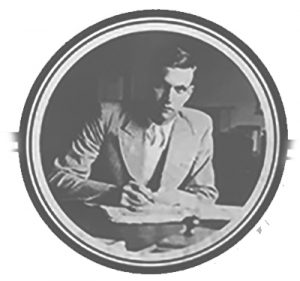
circle pixBy Francesca Hagadus

When I left the exhibit “One Man Who Tried to Stop the Holocaust” describing the courage of Jan Karski, I couldn’t help but be struck by how much of my life I owed to him.

The exhibit, sponsored by the Holocaust and Human Rights Education Center, ran in November and early December at the Iona College Art Center. It illustrates the life of Jan Karski with period photos, and is supported by exhibits of haunting art by Sheila Kimmelman and political cartoons lampooning Roosevelt for ignoring Karski’s warning and pleas for help to stop the Nazi genocide plan.

Karski was born in Lodz (pronounced WOULDGE), Poland in 1914. My mother, Maria Rozenberg (Hagadus) was born 13 years later, also in Lodz, a multi-cultural city with a population of one-third Polish Catholic, one third Jewish and the last third German and Russian citizens. My mother attended the Ursuline Academy, run by the Ursuline order of nuns, along with other Jewish girls. When Hitler invaded Poland in 1939, he overtook Lodz a few weeks later on Sept. 14.

My mother, at 12 years of age was no longer allowed to attend school. My grandfather owned and operated a textile factory, one of the main industries in Lodz. Sometime after the occupation, my grandparents were “taken away,” as my mother put it. She never elaborated. However, she had Catholic identity papers issued by the Polish Underground State of which Jan Karski was a key figure. He had infiltrated ghettos and concentration camps at great personal risk. He pleadingly reported to Franklin D. Roosevelt the dire situation of the Jews in Poland. He was ignored.

My mother, by then 15 years old, used her identity papers to hide in plain sight. She made her way to Germany as a displaced person, to France, and finally to the United States. She married my American father, Ronald Hagadus, in 1950 and lived in Westchester County until her death in 2014. As a fellow citizen of Lodz, my mother went with my father to New York to meet Jan Karski at the hotel where he lived and had written his memoirs, Story of a Secret State, published in 1944.

My mother considered herself both a Pole and an American. She and my father became trustees of the Kosciuszko Foundation in New York City. An artist in her own right, she exhibited her work worldwide, and promoted young Polish artists.

The profits from her exhibits were used to organize food and medicine to be sent to Poland during the Solidarity movement. She very much reflected the multi-cultural city into which she and Jan Karski had been born.

Visitors to the Jan Karski exhibit at the Iona College Art Center

Jan Karski received his Ph.D. from Georgetown University in 1952, where he taught Eastern European Studies in the School of Foreign Service until his retirement in 1992. I began my university studies at Georgetown in 1971, receiving my B.S. and M.A. in Foreign Languages and Russian Studies, in 1975 and 1977. Students fought to register for Karski’s classes.

Upon his death in 2012, Georgetown University Press reissued Story of a Secret State. A bench with a lifelike seated figure of Jan Karski was erected on the Georgetown campus so that students could continue to be seated with Professor Karski.

Jan Karski was not able to stop the Holocaust. Nevertheless, his tireless, often terrifying effort with the Polish Underground State allowed my mother to survive, flourish and raise her children to embrace education, freedom, service and tolerance.

Francesca Hagadus recently retired after 32 years of teaching French and Spanish at the Robert E. Bell School and at Horace Greeley High School. In her early years of teaching, she led numerous tours to France and Spain with her 8th grade students. She continues to travel as much as possible. She currently hosts international students studying  English at EF Language School in Tarrytown, and teaches English online to EF students. She has numerous free-lance jobs involving both French and Spanish. She is an avid skier with the Swiss Ski Club of New York, and a frequent visitor to MOMA. She lives in Pleasantville with her two sons, Timothy and Thomas.

Filed Under: Cover Stories Tagged With: Holocaust remembrance, Inside Press, Jan Karski, theinsidepress.com, tribute

  • « Go to Previous Page
  • Page 1
  • Interim pages omitted …
  • Page 107
  • Page 108
  • Page 109
  • Page 110
  • Page 111
  • Interim pages omitted …
  • Page 149
  • Go to Next Page »

Primary Sidebar

Please Visit

White Plains Hospital
William Raveis – Armonk
William Raveis – Chappaqua
Northwell Hospital
Houlihan Lawrence – Chappaqua
Houlihan Lawrence – Armonk
Houlihan Lawrence – Briarcliff
NYOMIS – Dr. Andrew Horowitz
Westchester Table Tennis Center
Spavia
Compass: Miller Goldenberg Harris Team
Lipari & Mangiameli Dentistry
Raveis: Lisa Koh and Allison Coviello
Bristal Assisted Living
Maid Brigade
Kevin Roberts Painting & Design
Zwilling J. A. Henckels
Meagher & Meagher Attorneys at Law
Compass: Aurora Banaszek
Dr. Briones Medical Weight Loss Center
Fleetwood Pastry Shop
Caramoor
Terra Tile & Marble
Elliman: Pam Akin
New Castle Physical Therapy
Joseph Richard Florals
King Street Creatives
Wags & Whiskers Dog Grooming

Follow our Social Media

The Inside Press

Our Latest Issues

For a full reading of our current edition, or to obtain a copy or subscription, please contact us.

Inside Pleasantville and Briarcliff Manor Inside Chappaqua and Millwood Inside Armonk

Join Our Mailing List


Search Inside Press

Links

  • Advertise
  • Contact Us
  • Digital Subscription
  • Print Subscription

Publisher’s Note Regarding Our Valued Sponsors

Inside Press is not responsible for and does not necessarily endorse or not endorse any advertisers, products or resources referenced in either sponsor-driven stories or in advertisements appearing in this publication. The Inside Press shall not be liable to any party as a result of any information, services or resources made available through this publication.The Inside Press is published in good faith and cannot be held responsible for any inaccuracies in advertising or sponsor driven stories that appear in this publication. The views of advertisers and contributors are not necessarily those of the publisher’s.

Opinions and information presented in all Inside Press articles, such as in the arena of health and medicine, strictly reflect the experiences, expertise and/or views of those interviewed, and are not necessarily recommended or endorsed by the Inside Press. Please consult your own doctor for diagnosis and/or treatment.

Footer

Support The Inside Press

Advertising

Print Subscription

Digital Subscription

Categories

Archives

Subscribe

Did you know you can subscribe anytime to our print editions?

Voluntary subscriptions are most welcome, if you've moved outside the area, or a subscription is a great present idea for an elderly parent, for a neighbor who is moving or for your graduating high school student or any college student who may enjoy keeping up with hometown stories.

Subscribe Today

Copyright © 2026 The Inside Press, Inc. · Log in