The Case for Saving Buttonhook Forest Following a Guided & Meaningful Tour
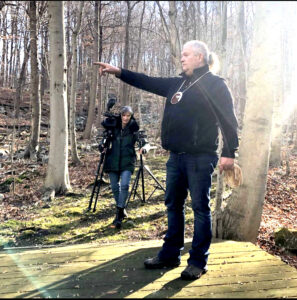
Photo courtesy of Tracey Bilski and Friends of Buttonhook
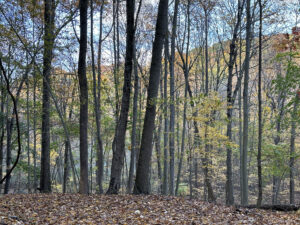
Walking through Buttonhook forest, I was immediately taken aback by the beauty of it all: the native plants, sunlit trees, vast amount of contiguous open space, and, of course, sacred indigenous stone structures. On a guided tour led by the Friends of Buttonhook Forest, I learned about not only the land’s diverse ecosystem, but also about the history of Native Americans in a way more interactive and meaningful than I had ever experienced.
Friends of Buttonhook Forest (FoBF), led by Tracey Bilski and Victoria Alzapiedi along with their tireless team of both long-time and new residents of New Castle, is a local non-profit organization dedicated to preserving the 20.3-acre Buttonhook forest that is currently owned by the Chappaqua Central School District (CCSD), who has been looking to develop the land.
Initially, the fight to preserve the forest stemmed from environmental concerns. When CCSD put the property on the market for sale in 2019, Alzapiedi and former Chappaqua resident and environmentalist Haley Ferraro started an advocacy effort in the hopes that the community would purchase the land from CCSD to preserve the forest.
“It was unthinkable that our community would intentionally cut down a forest – a precious and rare climate sink that helps clean the air that we and our families breathe – especially during a climate crisis. We wanted to save these trees that are home to countless birds, beneficial insects, and other animals – who would be displaced if bulldozers come to cut down this forest. Advocating to save this land just seemed like the right thing to do. The just thing to do. The ethical thing to do – to save this forest from being cut down to build luxury homes,” says Alzapiedi.
Saving Wildlife & Addressing a Climate Crisis
How could Chappaqua, a community that always seemed to value the importance of sustainability, choose to actively contribute to deforestation, biodiversity loss, and water and air pollution? “We’re in a climate crisis. It’s not anymore that you can just sit by and let things happen,” says Maxine Margo Rubin, member of Friends of Buttonhook Forest (FoBF).
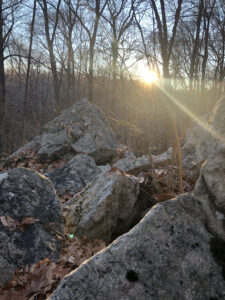 Buttonhook forest is home to thousands of creatures such as bobcats, foxes, coyotes, flying squirrels, box turtles, bats, many species of amphibians, hawks, owls, and migratory birds that would all lose their habitat if the forest is destroyed. “We have to help the animals that can’t talk for themselves,” Rubin adds.
But the animals are not the only living creatures at risk: CCSD’s construction plan calls for 676 of the 1400 trees residing in the forest to be cut down, all of which sequester immense amounts of carbon dioxide, maintaining a healthy air quality and curbing the speed of climate change. Since the school district bought the land in 1973 to build an additional school (a project that was never put into action), these trees were left untouched, growing, thriving, and holding carbon, for nearly 50 years. Evalyn Bladstrom, FoBF member, believes that we must “not just think short term, like the next 20 years, in terms of getting as much as we can monetarily, but long-term, the next hundreds of years, thinking about our own evolution as a species. What is sustainable, and what can we really expect when we remove nature?”
It was not until 2010 that CCSD decided to sell the land, hiring an engineering firm to subdivide the land into six lots for the construction of six $2 million homes. The plans received Preliminary Approval from the New Castle Planning Board in 2019 and CCSD put the land on the market for $3.5 million. After about a year with no bids on the land, it was taken off the market in 2020 during Covid, and returned listed at $2.5 million during the summer of 2021. CCSD eventually accepted a bid of $2 million from a developer in August 2021 subject to them receiving necessary approvals by March 2022.
Happening Now
Since the streams on the sides of Buttonhook forest lead to the Gedney Brook, which leads to the Croton reservoir, approval from the NYC Department of Environmental Protection is necessary before construction can begin. Despite persistent efforts, the school has been unable to receive the necessary NYC Stormwater Approval, which caused their initial contract with the developer to fall through last spring. So, the property went back on the market last summer, and FoBF saw this as the perfect opportunity to make a bid and secure the forest’s protection.
By this time, the fight for preservation had become even more critical as various elaborate and carefully crafted stone structures on the land had been confirmed by various archaeologists and indigenous leaders to be not at all random, but rather an entire complex of prayer stones, turtle effigies, and water markers laid by the Native Americans who once lived on this land. Now, saving this forest will not only preserve a diverse ecosystem, but also a sacred historical site for indigenous people who have time and time again had their history destroyed.
Lessons about Indigenous Culture
 The Ramapough Lunaape Nation stated in a letter sent to the New Castle Town Board and Council that “Prayers and intention set years ago will be broken, if even one stone is moved.” Our community has been given a momentous opportunity to right our history’s wrongs, and to set a local example of how to respect and teach about indigenous culture and history. Tracey Bilski, leader of FoBF, reflected upon the minimal information she was taught about who lived here in the past, and how her journey has served as a learning process for her: “we can use this as a case-study,” she shares.
To respect the value that this land holds for Native Americans, FoBF partnered with numerous tribes in order “to make sure that [they] are hearing them right and doing what is best for the earth and the animals, as well as the original caretakers,” shares Lynn Trotta, a local nature-mentor and member of FoBF.
And when the school opened a public bid on the land in June 2022, Friends of Buttonhook Forest partnered with Brothertown Indian Nation to place a bid for which they are still waiting to hear a response. They have extended the bid for review until May 2023, and until then, they remain hopeful. In the meantime, they are holding a fundraiser on April 25 at the Chappaqua Performing Arts Center to “celebrate Earth Day and showcase the importance of thinking globally and acting locally,” as stated on their website.
As a junior at Horace Greeley High School, currently studying United States History, I know firsthand that the district encourages students to learn from the mistakes of the past and apply what we have learned to injustices today. Throughout the year, we have learned about far too many massacres of Native Americans, forced removals, and destruction of their land, resources, and culture. Often, I am left feeling lost in terms of what I can do to help make up for this heart wrenching history of oppression: how can one begin to right thousands of years of wrongdoings?
Saving Buttonhook forest is where we can begin.
Land acknowledgements only mean so much: our words become worthless when they are not backed by action. Preserving this historical site is the perfect opportunity to put truth behind our promises of social and environmental justice, and to make a difference right here from our backyard. Because, as Rubin shared, “what we do local, goes global.”
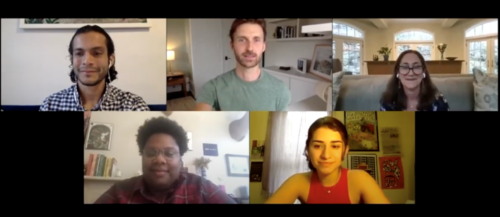
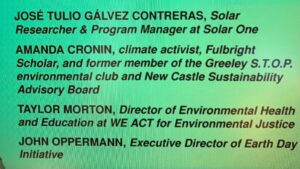 All participants addressed the importance of teachers and partnership in education. From experience, Taylor described “teachers as the best community organizers.” To lead to change, curriculums must, but often do not, address climate and environmental justice. Non-profits and community groups often play an important partnership in promoting education policy with lawmakers, while partnering with schools to develop sustainable programming and step in where schools lack the resources. For example, Contreras’ organization Solar One partners to provide k-12 students and teachers a green design lab to enhance learning through environmental projects. Morton noted that NYC schools have a sustainability coordinator to now “champion from the inside.” The speakers also discussed that community organizing was crucial – whether in advocating for policy change or providing resources through community organizations to supplement where communities and schools are lacking.
 The program was part of the Sustainability Advisory Board’s (SAB’s) on-going educational efforts and sustainability initiatives. SAB, made up of dedicated Town-appointed members and many volunteers, works behind the scenes to advise the Town on best practices for leading local environmental and conservation efforts. Among its initiatives, SAB spearheaded a gas leaf blower reduction ordinance, enacted by the Town Board and in effect from June 1 through September 30. The ordinance will reduce noxious noise, pollutants, and carbon emissions. Help SAB spread the word on this gas blower ordinance, and see SAB’s website for guidance on best practices for healthy yard cleanup and other initiatives.
 New Castle is proud to note that many residents remain in the community long after the kids have ‘grown and flown.’ The Recreation and Parks Department oversees senior programming to help promote and enhance the quality of life of adults 60 years and over living in the community. Recreation programs, fitness classes and a comprehensive array of supportive services are offered regularly, and encourage both continued independence and involvement in community life. Popular classes at the New Castle Senior Center on Senter Street include artistic pursuits like Watercolor & Drawing and Passport to Active Living daily workouts. Games such as Bridge, Mah Jongg and Poker are another great way to socialize and have fun, and all ability levels are welcome. Music-loving seniors appreciate the free Open Rehearsals of the Chappaqua Orchestra. Lectures, also free, cover topics as far-ranging as classical music to health and fitness. There is even a weekly Pizza ‘n Cinema meet-up featuring vintage and classic films. Senior transportation is available and affordable, and the Senior Watch, a voluntary program open to all, offers peace of mind to those who may not have family or friends available on a regular basis. Further information including the Senter Street Spotlight bi-monthly newsletter:
  Summer is everyone’s favorite season. Longer days, sunshine and warmth, and lots of great outdoor activities make for very happy campers–figuratively, but also literally. New Castle Town Camps are the very definition of happy kid campers. Open to all town recreation residents, there are camp groups for all ages: Tot Camp, designed with young three to five year old children in mind, offers half-day enrollment. Camp Adventure, loaded with fun activities for first through fourth graders, meets at Bell Middle School but includes off-site activities like field trips as well. On-the-Go Camp, for fifth through eighth graders, offers exciting daily excursions to all kinds of kid-approved fun destinations; and the C.I.T program for ninth and tenth graders prepares young teens to move from camper to counselor. There is also a Summer at the Art Center camp for children aged four through seven with a special interest in art.