• Skip to primary navigation
  • Skip to main content
  • Skip to primary sidebar
  • Skip to footer

The Inside Press

Magazines serving the communities of Northern Westchester

  • Home
  • Cover Stories
  • Features
    • Portraits and Profiles
  • Advertorials
    • Lifestyles with our Sponsors
    • Sponsor News!
  • Wellness
  • Happenings
  • Advertise
    • Advertise in One or All of our Magazines–And/Or Subscribe
    • Advertising Payment Form
  • Contact Us
  • Search

Cover Stories

A Conversation with Chappaqua’s Conductor Extraordinaire, Michael Shapiro

March 6, 2016 by The Inside Press

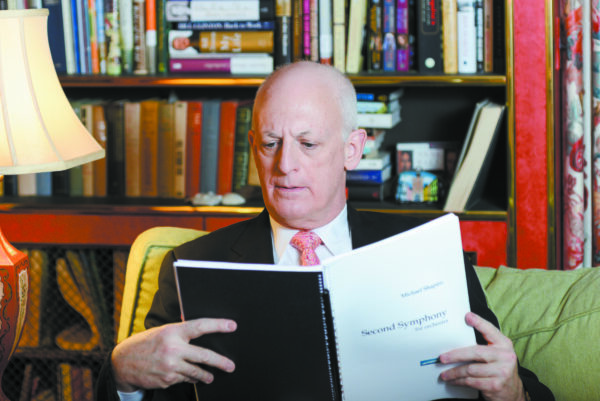
Michael Shapiro Photo by Carolyn Simpson
Photo by Carolyn Simpson

By Matt Smith

“The qualities that make a good conductor are, of course, a good ear, knowledge of the score, technical ability (hands, baton), a deep knowledge of all the instruments in the orchestra, and an ability to lead,” explains David Leibowitz, Conductor and Music Director of the New York Repertory Orchestra. “A great conductor has all these, but also that extra ingredient–a strong vision of how a piece of music should sound and how to convey that vision to the players.”

“That is what Michael has,” he continues. “He knows what he wants and he gets it. More important, he doesn’t stop until he gets it.” The “Michael” to which he refers is, of course, Michael Shapiro, world-renowned composer and conductor–and current music director and conductor of New Castle’s very own Chappaqua Orchestra.

Born and bred in Brooklyn, New York, Shapiro prides himself on his strong connection to music, and a strong passion for all types of the art form–something he presumably inherited from his father, a Klezmer band clarinetist who himself was “involved in all different forms of music.” In particular, “he loved swing jazz,” says Shapiro. “And through him [and his connections], I was able to hear some of the greats–like Louis Armstrong–live in concert, when I was a child. [I was] very lucky to grow up [in the business] and go to concerts continually, which has been a tremendous influence on me.”

Enjoying “the greats” set off a spark in little, seven-year-old Shapiro, who soon after developed his own interest in music. And he has since “done music all my life.” And indeed, throughout his career, Shapiro has conducted “literally all over the country,” working with such orchestras as the City of Birmingham Symphony Orchestra in the UK, Houston Symphony Orchestra, Virginia Symphony Orchestra, Charleston Symphony Orchestra, West Point Band’s The Jazz Knights, Traverse Symphony Orchestra, Garden State Philharmonic, Opera Theatre of Northern Virginia, and the Dallas Winds Symphony, to name a few.

He has also worked at a worldwide level, serving as vocal coach and assistant conductor at the Zurich Opera Studio in Zurich, Switzerland; as music consultant to the United States Holocaust Memorial Museum in Washington D. C., and as composer-in-residence at the Cabrillo Festival of Contemporary Music, where his original orchestral composition, Roller Coaster, received its West Coast premiere. Furthermore, he has also composed incidental music for Dateline NBC.

Of course, since 2002, Shapiro has served as music director and conductor of The Chappaqua Orchestra. Since beginning with the organization, which he notes “brought [him] back to conducting really fiercely,” he prides himself on taking the group “from one point to the other and making it a [more vibrant] presence in the culture of our town” He notes that under his tutelage, the orchestra has performed “all kinds of different literature…[and] is now very close to being an all-professional orchestra of the highest quality.”

And he’s not just tooting his own horn–or rather, waving his own baton; others think so, too. In fact, it’s well documented that under Shapiro’s leadership, the Chappaqua Orchestra has successfully “reached new artistic heights” in the last 14 years. Additionally, to his credit, the April 2006 performance of the Verdi Requiem,
conducted by Shapiro and performed in collaboration with the Taconic Opera, was even deemed the “musical event of the decade” in Westchester.

And if all that wasn’t enough, when he’s not conducting an orchestra, you’ll find him conducting business: “I’ve been involved in real estate for many years,” he shares. He’s also a bestselling author; one of his books, The Jewish 100, was, in fact, a New York Times bestseller and has since been translated into eight languages, include Chinese, Japanese, Portuguese and Russian, since its release in 1994 (Note: An updated edition was released more recently, in 2012). “And I love sports,” he says. “Particularly golf…I’m a golfer. And I love basketball [and] being tortured by the New York Knicks.”

He also enjoys spending time with his kids, and learning about music from them too. “My daughter loves rock music of the 60’s and early ’70’s,” he shares, with a laugh, “and she’s remarked how I know so little about it…because back then, in those days, I was listening to Brahms.”

Above all, however, he thanks partner Marjorie Perlin, for her insurmountable love and support. “[She’s] the most supportive person in my life,” he says. “She’s the best listener and the best critic. Her support has been completely total and has been a tremendous help in getting me to even higher levels, not only [in terms] of performance, but [in terms of] my own musical standards.”

So, given all of his present success, where does Shapiro see himself professionally in the next five years? He answers first, quite simply, “Doing the same, but in more prominent venues.”

“I’m always pushing the envelope as much as I can, and trying to get bigger and better performances,” he continues. “I’m really looking forward to writing more pieces for the theatre, either incidental music or ballet, and certainly [more] opera.”

Shapiro also seems to have a good sense of what is really important in terms of the art form. “The great performances and standing ovations and all the rest of those things are wonderful,” he explains, “but….working with fantastic, high-quality performers and producing works that you’re proud of [no matter what the result]… that’s what counts.” Shapiro recalls one such “massive” standing ovation at a concert this past January at Meyerson Symphony Center in Dallas, Texas. “That [standing ovation] doesn’t often happen,” he states, with a smile, “so, when it does, it’s just amazing.”
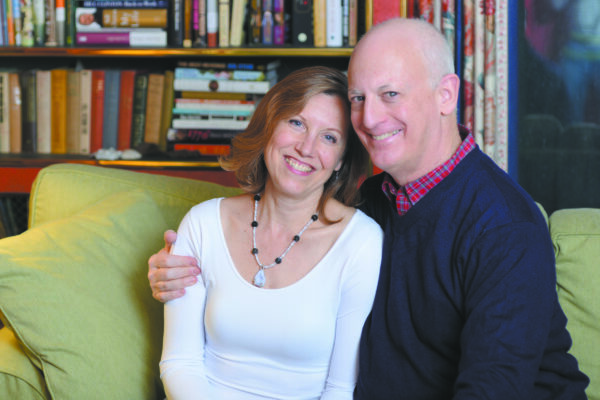
With his ”best critic,” Marjorie Perlin
With his ”best critic,” Marjorie Perlin (Photo by Carolyn Simpson)

So, considering such successes, when was the first time he knew he had “made it” as a musician? Ever so humble, he chuckled as he responded: “I’m still trying to make it.”

However, he does recall the “first major big performance” he gave–“when I knew I had something good,” he notes–at Westchester County Center in front of 2,000 people. “It was a commission by the now-defunct Philharmonic Symphony of Westchester” to compose music for narrator and orchestra to accompany a recitation of the signing of the Declaration of Independence–when he was just 25 years old.

“[The] piece premiered during the Bicentennial, so it was a big [deal],” Shapiro explains. “And [it] was narrated by José Ferrer, who won the Academy Award for Cyrano de Bergerac. The great pianist Van Cliburn was also on the program…so [these were] famous people [I was dealing with]. It was a great thrill for me to be around them and have that [experience].”

And as to how he has arrived to his current stature, Shapiro credits rigorous training. The first of his music teachers was Consuelo Elsa Clark, with whom he studied in Rockville Centre. “Miss Clark was an amazingly great teacher,” he shares. “And she came from a very strong tradition. It was great learning from her.”

From there, he went on to study conducting with Carl Bamberger at the Mannes College of Music (“and much later at Bard College with Harold Farberman,” he notes). “I also studied with other composers–Vincent Persichetti was a major influence. Sir Malcolm Arnold, too, [I studied with] briefly.”

Shapiro’s “most influential” composition teacher, however, was famed American composer Elie Siegmeister, with whom he studied privately “and rigorously,” for four years, while attending classes at Columbia and Juilliard, the latter where he eventually earned his master’s degree.

And of course, there was his score reading and ear training teacher, Mme. Renée Longy, known to generations of Julliard students, due to her rigorous demands, as “the infamous madame of dictation.” “She was extraordinarily difficult,” Shapiro confesses, honestly, “but ultimately, [a] very loving teacher.” In fact, Longy’s techniques proved to be so beneficial in the long run that Shapiro admits, “I still use [them] to this day when I conduct an orchestra.”

To that end, on the subject of teaching and further developing upon what one learns in school, Shapiro notes that once he discovered he had the musical talent, and enjoyed playing instruments, there was no question he’d pursue it full time:

“It’s like eating. When you’re hungry, you need to eat,” he says. “It’s the same way with music…It’s just a feeling… something you respond to… like anything else. You have a talent in it, you [pursue it].” “And then,” he adds, with a wink, “if you’re smart, you get the right teachers.”

Furthermore, to aspiring musicians, he advises: “keep your head down and just go to work,” he says, emphasizing that one should not compare him or herself to anyone else or their path. “And never stop reading. Or listening,” he advises. “Even at my stage, having [conducted] as long as I have, I’m always teaching myself by watching and listening to what others have done.”

His colleagues echo Shapiro’s advice, as many have continued to hone their skills through watching him work. “Michael cares deeply and fully about the art of music,” comments David Leibowitz, of the aforementioned New York Repertory Orchestra. “He is never anything less than 100% committed to [his] music–whether in performance or composing, or in just discussing what he likes and doesn’t like about a [particular] piece of music or performer. [Additionally], he has a very definite point of view [about what music should or shouldn’t be] and [he] argues his case well.”

Shapiro explains his art further: “Conducting is really listening [and] hearing to an extremely high level. [It’s about] manipulating the sound orally and not necessarily in words or in thoughts. To be a true composer, you need to compose every day [and] that means every day. To be a true conductor, you need to know your scores better than the individual players in the orchestra or band know their parts. The depth of knowledge has to be total, in the fullest sense of the word.”
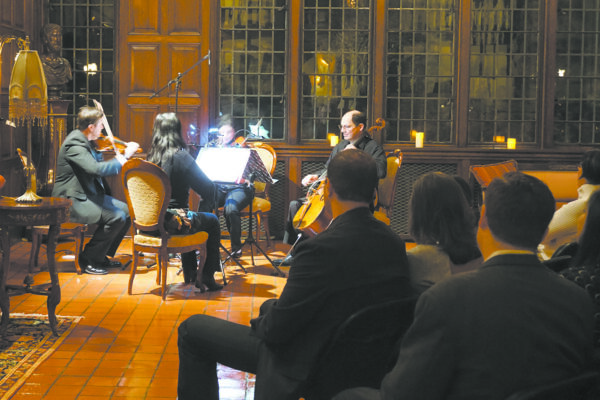
Chappaqua Orchestra members performing during a Winter fundraiser

But while he’s indeed adamant about one putting their nose to the grindstone, he also stresses the importance of letting loose and thinking creatively. “Without the creative [element] at the highest possible level, you can’t really do a fine job from a professional standpoint,” he says. “It all has to–and should–work together. You can’t really have one without the other.”

As a master composer at both the creative and professional level, Shapiro recognizes the value of music within a given community. He states, “Music [says] something [in a way] that words can’t. It’s ethereal, and that’s what makes it special. Music can lift us up to a different place. It can really move the spirit like nothing else.” And, having spent 40 years in the business, Shapiro obviously knows, and has witnessed, the power of music firsthand. Given this, when he composes, he draws inspirations from the great musicians of the past–musicians whose music moved his spirit in the same way as he describes. Stephen Foster, John Philip Sousa, Charles Ives, and George Gershwin are among those who influence Shapiro and his work. “As a kid, too,” he continues, “I was very influenced by [pianist] Arthur Rubinstein [and] by [conductor] Leopold Stokowski, whom you may remember from Fantasia.”

But while it’s nice to reminisce and draw inspiration from the past, Shapiro acknowledges the importance of advancing the art form and composing new work. And his colleague is the first to say that Shapiro himself is indeed doing just that. “Composers of our time keep the art form alive,” Leibowitz explains. “We cannot sustain a musical world that relies only on the music of the past. As a composer, [Shapiro] does the immeasurably important work of creating new and wonderful music.”

To that end, if he could leave a lasting mark on the New Castle community, Shapiro, who described himself in three words as “giving, loving, and inquisitive,” would like to be remembered for his contributions to the town through his work with the orchestra.

On a personal level, and in a similar vein, he’d like to be remembered as a composer for his score of Frankenstein, which, incidentally, made its world premiere at our very own Jacob Burns Film Center in Pleasantville. Since its premiere, says Shapiro, the score has enjoyed over two dozen performances nationwide “and continues to be asked for from Europe to Australia.”

But, he says, upon reflection, at the end of the day, “I don’t know any composer who doesn’t want to be remembered as a great composer. So [ultimately], I’d love my music to survive me.”

No doubt it will, but in the meantime, The Chappaqua Orchestra isn’t going anywhere anytime soon; in fact, the Town Board recently approved a lease issued last July to utilize Wallace Auditorium at Chappaqua Crossing as a full-time arts and cultural center–and a permanent location for the group. “I’m very happy about the development of the Wallace Auditorium,” says Shapiro, on the subject. “The orchestra now has a home.”

Their “home” will hopefully allow them to play and entertain audiences for years to come–it’s a good thing, too, as Shapiro makes note that these types of groups are unfortunately, not around much anymore. “When I was a kid in the ’50’s, there were 20 orchestras in Westchester,” he shares. “Now, it’s just Yonkers Philharmonic and The Chappaqua Orchestra. Some communities [today] don’t know how to support them.” Also, “Not as many people go to concerts of that kind…. and [because of that] many of us question the future of large ensembles such as symphony orchestras.”

With that in mind, Shapiro “welcome[s] everyone to come to our events and take some time to listen to new music.” And in that same vein of supporting music within our town, he states, “I hope that the work that I’ve done will reach more and more people within the community.” For more information on Shapiro and his work, please visit michaelshapiro.com.

Lover of all things musical, Matt Smith — a proud graduate of Skidmore College — is a regular contributor to the Inside Press, Inc.

Festive CO Fundraiser in Historic Chappaqua Home
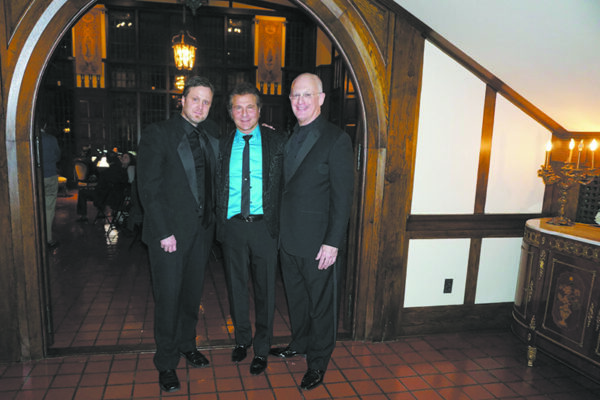
Chappaqua Orchestra’s David Restivo (left) with Frank Shiner and Shapiro.

Earlier this year: a Chappaqua Orchestra fundraiser took place in a gorgeous music parlor inside the historic Chappaqua home of Frank and Suzanne Shiner.

The program’s “first set” featured:

• String Quartet #1 by Leona Liu

• Dissonance Quartet by Wolfgang Amadeus Mozart: Katsumi Ferguson and Dave Restivo, violins;
Nicole Peragine, viola; Seth Jacobs, cello

• Fantasie for Soprano Saxophone and Piano by J.B. Singelee: Christopher Brellochs, saxophone and Cynthia Peterson, piano

• Meadowlark by Stephen Schwartz: Elizabeth Gerbi, Christopher Brellochs, Cynthia Peterson

A “second set” featured:

• String Quartet in F Major by Maurice Ravel: Katsumi Ferguson, Dave Restivo, Nicole Peragine, Seth Jacobs

• Two songs by Sheldon Harnick and Jerry Bock: Will He Like Me? and I Don’t Know His Name Erin Stewart, Cynthia Peterson

• Stormy Monday Frank Shiner, Christopher Brellochs, Cynthia Peterson

• Duet: That’s All I Ask of You from Phantom of The Opera: Erin Stewart and Frank Shiner

• Bring Him Home from Les Mis, arranged by Cynthia Peterson: Frank Shiner, Katsumi Ferguson, Dave Restivo, Seth Jacobs, Cynthia Peterson

Filed Under: Cover Stories Tagged With: conductor, Inside Press, Michael Shapiro, music, orchestra, theinsidepress.com, Westchester

New Community Leader Voices: Hala Makowska and Jeremy Saland

March 6, 2016 by The Inside Press

Editor’s Note: It was a hotly contested election this past November with Jeremy Saland and Hala Makowska winning two Town Board seats. Last election, we featured “Team New Castle,” so I decided to meet with Hala and Jeremy too in December at Chappaqua Station to simply glean their thoughts–at least the way they stood at holiday time–and for some “quick takes” on  various hot button topics in town! It was a pleasure getting to know each of them a little better!

Hala Makowska

FullSizeRenderSince the election, I enjoyed some down time with my family and am ready, excited and looking forward to my role and responsibilities for the town of New Castle. We have everything we need to be a very well-functioning board, and I feel that our diverse perspectives will help us have healthy discussions and ultimately lead to excellent decision making. At this particular point in time, I am focusing on the Master Plan and the downtown revitalization strategies–and making sure that the process ends up being as productive as it can be for the town.

I see Chappaqua Crossing on the top of our priorities, and I would like it to be successful so that our tax base can increase. Also, I think the Roundabout to address the traffic problem on 117 is another good focal point. I think that valid concerns remain about the intersection between the high school and the Whole Foods entrance and the exit from the Saw Mill Parkway coming into the retail zone. The safety concern is for the amount of traffic from retail shoppers, from the high school, and from the parkway.

Regarding Chappaqua Affordable Housing and the Hunts Lane location: As we know, I am not in favor.  It is an unsuitable piece of property. That is where a town parking lot could conceivably go, and I am disappointed that no new site has been identified or rezoned, frankly. I think that should have been the first priority. Now this will be more difficult. I have started to take a look at both the original permit and the present specifications. I am hoping that we can help find alternative locations. This is a timely issue since the provision expires next year.

The ChapLine is another hot topic. (The ChapLine is a functional recreation path which could connect downtown Chappaqua to Horace Greeley High School and to Chappaqua Crossing.) I think we need to closely weigh how the $1.5 million contribution from Summit Greenfield would be spent before it is committed to the ChapLine. And, I think that a more inclusive process to discuss how the available money could best be invested to make Chappaqua an even better place to shop, eat, and socialize, etc. I believe it’s local government that has the greatest impact on the quality of our everyday lives and the value of our property. I look forward to working with my colleagues on the Town Board to protect and improve both for all New Castle residents and business owners.

Hala Makowska can be reached at hmakowska@mynewcastle.org

Jeremy Saland

IMG_5675I am very excited to get to work on behalf of New Castle to move the town forward. I am grateful our community had the confidence in me to do so. There are a lot of things going on now and I expect there will be many more things happening during my term and in the years to come. I believe we all benefit when each one of us tries to do our part.


Conifer and affordable housing is one issue that demands immediate attention. It is simply a horrendous location. Living between the Saw Mill Parkway, an exit ramp and the train tracks is not the most welcoming place even though we, as a community, are open and inclusive. It is incumbent upon the Town Board to find a solution, and make sure any development of this type is a safe, inviting and a healthy place to reside.

Whether you support Chappaqua Crossing or not, it is here to stay. Of grave concern is that Chappaqua Crossing created a new hamlet and business district. This development will have a significant traffic impact and change our quiet community as we know it. We need to concentrate on downtown Chappaqua’s development and revitalization to offset this third hamlet. The same is true for Millwood. It is critical that we examine how we can better develop and utilize our existing hamlets while building their infrastructure and making them more attractive destinations.

Another important issue is the proposed ChapLine. On an island it is a good idea, but residents, not just Summit Greenfield and the Town Board, should be involved in this discussion. It’s not often a municipality can potentially access $1.5 million dollars. This opportunity should not be squandered. If the developer wants the best for a community that they are vastly changing and profiting from, then this process should be an open one. Whether it is giving matching funds to businesses, purchasing property, or some other idea, a common good can be reached if all of us are engaged.

Whatever issue New Castle faces, I am confident that with an ethical government, we can work alongside our neighbors and businesses to reach our true potential. Jeremy Saland can be reached at jsaland@mynewcastle.org

Filed Under: Cover Stories Tagged With: election, issues, meet

A Snow Day to Remember … with Distinguished author Barbara Winton

March 6, 2016 by The Inside Press

Barbara Winton enjoying the snow with the Saiontz boys.

By Stacey Saiontz

During the blizzard, my family was snowed in with our very special house guest, Barbara Winton. Barbara Winton is the daughter of humanitarian Sir Nicholas Winton and Author of the book about his life titled If it is not Impossible. Ms. Winton was in New York, as she was one of the speakers at the United Nations Annual International Holocaust Remembrance Day ceremony.

Winton and I had been in touch a few years prior. As the granddaughter of Holocaust survivors, I serve as the Co-Chair of the Museum of Jewish Heritage’s Annual Spring Ladies Luncheon. Each year we honor a female Holocaust Survivor. A couple years ago, the honoree, Hanna Slome, attributed her story of survival to being one of “Nicky’s children” and explained that she was saved from the Nazis by being put on the Kindertransport from Prague to England that was set up by Sir Nicholas Winton.

In 1938, Sir Nicholas Winton, a stock broker in London, England responded to a request from his friend Martin Blake to join him in Prague. Blake had gone to Prague to help the Jewish refugees who had fled to Prague after Germany annexed the Sudetenland.  After viewing the situation in Prague, Winton decided he needed to find a way to help the children. At the time, Kindertransports were helping children leave Germany and Austria to travel to safety in England. However, no one had set up a way to help the Czech children. Winton convinced the Home Office in England to agree to allow Czech children to be evacuated to England. The Home Office required a foster family to look after the children and a monetary amount to assist with repatriation at the end of the war.

Winton successfully organized eight trainloads of children, saving 669 children. The last train, the largest yet, was cancelled right before its departure as Germany invaded Poland resulting in the Czech border being closed. Unfortunately the majority of these children are thought to have died in concentration camps.

Although, Winton knew about her father’s work to save the Czech refugees, the mass public found out about his deeds in 1988, when a TV presenter in England discussed Winton’s rescue and announced on live TV that most of the audience in the studio were saved by Sir Nicholas Winton. It is estimated that there are approximately 6,000 people in this world who owe their existence to Sir Nicholas Winton.

While staying at our home, we organized a dinner honoring Ms. Winton. Three of her father’s “children” along with several Ambassadors joined us.  It was so moving to see the “children” interact with Ms. Winton.  Winton explained that while her father decided to organize the rescue mission because it was the right thing to do, he did not realize at the time the impact he would have on the childrens’ lives. It was not until meeting the “children” as adults that he realized how important his actions were on the “children’s” lives. May we all be inspired by the Sir Nicholas Wintons of the world to act ethically and try to make a difference in the lives of others.

Stacey Saiontz, a lawyer living in Chappaqua with her husband and two sons, is the co-chair of the Associates Board of the Museum of Jewish Heritage-A Living Memorial to the Holocaust; a board member of the Auschwitz Jewish Center Foundation; and a member of the Next Generation Board of the U.S. Holocaust Memorial Museum. She is also a Committee member of the Chappaqua Cure in our Lifetime and serves on the Advocacy board of FARE, the Food Allergy non-profit.

Filed Under: Cover Stories Tagged With: Barbara Winton, Holocaust remembrance, honor, Inside Press, Sir Nicholas Winton, theinsidepress.com

Playgrounds: Ready, Set, GO!

March 6, 2016 by The Inside Press

The author’s twin boys’ tandem sliding at the smaller playground at Gedney Park.
The author’s twin boys’ tandem sliding at the smaller playground at Gedney Park. Photo by EJ Rose Photography

By Heather Skolnick

What is the one place where everyone has fun (besides Disney)? The playground! What could be better than good, old fashioned fun outside?

Playgrounds offer an opportunity for children to be children. Playgrounds are one of the few places left where batteries are not needed, and there is nary an IPad, IPhone, or Playstation in sight. Kids can run around to their hearts’ content and can use their imaginations galore.

Playgrounds offer more than a place to just play. For moms and caretakers, they are a place to meet others.

New Chappaqua resident Nikki Cosentino has been using playgrounds as one way to meet other moms within the community. She comes with her two daughters and lets them play in an enclosed environment while she socializes. Nikki says, “We have moved twice since I had my first daughter, and I always head to the local playground right away to connect with other moms. The park was our first stop here after move-in day in April. Sure enough, I was able to chat with a local mom and get some inside tips on our new town while our kids played together.” Nannies, too, enjoy the social benefits of the playground. When my nanny started, she used the playground as a place to meet people caring for kids in the same age range.

Playgrounds also serve as a place where children can develop and hone social skills. Special Educator Janet Weingarden works with children in many of our local schools. She often uses the playground as a forum for learning. She said, “The way we learn social skills is through practice and watching others. Being in a playground is a particularly effective place to do both of those things.”

She continued, the playground “offers opportunities for sharing, turn taking, collaborating, cooperating and a fantastic opportunity to build empathy. There’s also an opportunity to practice social scripts…as well as problem solving skills.” It’s no wonder Janet often goes there with her students!

From a physical standpoint, the playground offers all kinds of ways to strengthen gross motor and motor planning skills. Play structures are also filled with opportunities to improve some sensory and vestibular sensitivities. Swinging on a tire swing provides vestibular input to help increase the ability to process movement. Jumping is an example of “heavy work” which many teachers and therapists have found to improve attention and calmness for hours afterwards. Physical activity also increases arousal level which can help raise confidence. All in all, the learning opportunities on the playground could rival the classroom!

Now that we know all the benefits of playgrounds, where can we find them within our community? Specifically in New Castle, there are five playgrounds from which to choose. According to the 2010 census, the town has an approximate population of 23,000 people, 23% of whom are under the age of 18. With about 5,300 kids to keep busy, it’s no wonder that the town has a plethora of exciting playgrounds!

Gedney Park is the first playground that comes to mind for most. It includes baseball fields, soccer fields, hiking trails and the pond. Gedney offers two playground areas. The main playground area includes two distinct playground structures (one for the bigger kids, one scaled down for smaller children) with all the standard fixings–twisty slides, bouncy bridges, things to climb, etc. There are also monkey bars, swings and even a clubhouse complete with sandbox area. What else could a child want? Town Recreation Superintendent Bob Snyder said that a new play structure offers tons of fun in a safe, updated format for children.

Still at Gedney, a short walk leads to another, smaller play structure. This area is ideal for families who might have another child playing baseball at the adjacent fields Some children like this mini playground because it’s more subdued, having far fewer children playing at a time. Lastly, Gedney Park also has clean bathroom facilities just off the path from the main playground. This is an important feature for the potty training set.

Discover the “Train Park”

Formally listed as Recreation Field Park on the Town’s website, my kids call it the “Train Park.” If someone doesn’t tell you it’s there, you’d never know. Set back behind Recreation Fields and also adjacent to the train’s rear parking lot, it’s not readily visible from the road. With its proximity to the town Library, it makes for a great combination outing. The playground itself offers lot of unique features sure to entertain the pre-school kids as well as more sophisticated activities like the “zip line” for older kids. This playground is also budgeted for an overhaul soon.

Chappaqua mother of two Dayna Lord recently had a playdate at Recreation Field Park. After her first visit there, she said, “This is one of the most kid-friendly parks around that can easily be combined with a trip into town, the library, diner or ice cream. This is a perfect park for toddlers and those learning to walk, too!” It sounds like she will be back soon!

Another fun option is Smith Park in Mount Kisco. This is a lesser known park as it is really tucked away amid residential streets. It offers a fun play structure with a well mulched ground to protect from any skinned knees. There’s a basketball court for older kids and a large grassy area for a catch or for walking your dog.

Millwood Park is another local option. Set atop the baseball field and adjacent to the tennis courts, the playground offers a standalone twisty slide, a set of swings, and a seesaw. This playground is a convenient option for families trying to entertain children while a softball game is underway.

Lastly, Amsterdam Park in Ossining also has a playground to entertain kids while a sibling is playing soccer. With so many options, there’s always a good reason to get the kids outside.

As the weather warms up, have the kids put down the electronics, and head to the playground!!

Heather Skolnick, her husband and three children live in New Castle. Heather works for a major retailer where she designs systems and processes to support Omnichannel shopping.

Filed Under: Cover Stories Tagged With: Chappaqua, community, Family, fun, Inside Press, kids, playground, theinsidepress.com

On “Giving Back to a Jewish Population in Cuba”

March 6, 2016 by The Inside Press

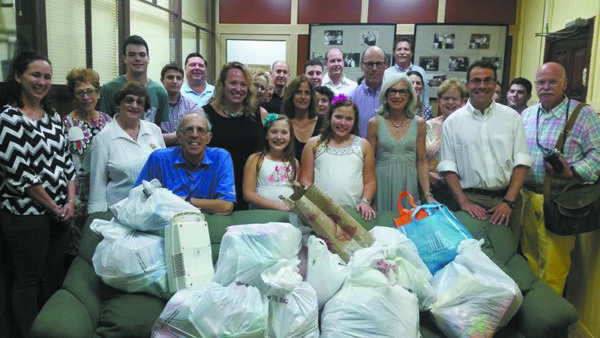
TBE Congregants delivered supplies to a Temple Beth Shalom in Havana

By Matt Smith

There is an old Hebrew saying, which stems from an early 20th century Zionist folksong: “Livnot uI’hebanot.” Translated into English, this saying means, “To build and to be built by it.” You may also know this saying: “It’s better to give than it is to receive.” However you know the adage, we’re sure you can agree it’s one to live by. And it’s certainly one Rabbi Jonathan Jaffe of Temple Beth El of Northern Westchester kept in mind this past winter when he sojourned to Cuba with a group of congregants for a project in community outreach.

“I think that for every generation of American Jews, there has always been an inspirational challenge to rise up,” explains the Rabbi. “[And as] I believe the theory of [Jewish American historian] Jonathan Sarna points out, my generation of American Jews is at a loss because of a lack of a challenge that way. We don’t have some all-encompassing, inspirational task to which we can dedicate ourselves.”

Entrance to Havana Jewish Cemetery

Given this fact, the Rabbi took it upon himself to create one for the people of his congregation. He turned his attention toward the tumultuous relationship between the United States and Cuba, which he saw as an opportunity to heal wounds–“an amazing goal to center the congregation around”–and a way to “fulfill that need” for a present-day, inspirational challenge by giving back to the Jewish population in Cuba.

And so, the trip was constructed under the auspices of “bringing supplies and donations to the needy populations, especially the Jewish populations, in Cuba.” The group of congregants, which totaled around 25 people of various ages, brought in over 2,000 pounds of supplies–medical, hygienic, dental, and school/office–and donated an additional $2,000 to various Jewish communities throughout the country.

While there’s no doubt he enjoyed his time in Cuba (the group took part in walking tours, scuba diving, music and food), the Rabbi admits that, during the trip, his eyes were opened to how much the country is still struggling culturally and economically– and found that especially humbling when he found himself without his American luxuries.

“It’s hard to lead a synagogue trip when you can’t use a credit card or cell phones,” the Rabbi acknowledges. “And that’s [the case because] the bureaucracy and the limited markets available make things very difficult at times.” Additionally, he notes that “not only did they not have cell phones, but even the nice hotels don’t have voicemail [systems available] in the rooms. So, if you wanted to contact someone, you went downstairs and you had someone write down a note and go up and slip it under the person’s door. It felt like we were stuck in the Stone Age from a communication standpoint.”

Rabbi Jaffe was also particularly struck to see the lack of resources firsthand–and the impact the loss had on the town’s residents. “We were walking around the very small town of Trinidad,” the Rabbi explains, “and [we had] a college student [who] was drinking out of his Gatorade bottle… and a man approached him and asked if he could have the [Gatorade] bottle because he needed something to feed his child milk. They don’t have baby bottles. It makes you realize how privileged we are.”

Considering this overall American privilege, and the relationship Cuba has not only with America in general, but specifically, the Jewish people, Rabbi Jaffe comments that he felt the trip “was an amazing experience in Jewish peoplehood.”

“We share a common bond, a common history, a common ancestry, and that wherever you go in the world, you can always find a Jewish population and [know] that you’ll be treated as an insider rather than an outsider. And that it’s this beautiful global aspect of Judaism, in that you have to leave your community and your shell in order to experience that.”

Observing how his own group of congregants experienced the trip was a source of joy too. “[We had people] from nine years [old] through their mid-70s [and] the group just beautifully gelled. It was really nice to see.” Livnot uI’hebanot. “And,” says the Rabbi, with a smile, “we are all closer for it in the end.”

Filed Under: Cover Stories Tagged With: community outreach, cuba, Inside Press, Jewish community, Judaism, Temple Beth El of Northern Westchester, theinsidepress.com, Westchester

  • « Go to Previous Page
  • Page 1
  • Interim pages omitted …
  • Page 106
  • Page 107
  • Page 108
  • Page 109
  • Page 110
  • Interim pages omitted …
  • Page 149
  • Go to Next Page »

Primary Sidebar

Please Visit

White Plains Hospital
William Raveis – Armonk
William Raveis – Chappaqua
Northwell Hospital
Houlihan Lawrence – Chappaqua
Houlihan Lawrence – Armonk
Houlihan Lawrence – Briarcliff
NYOMIS – Dr. Andrew Horowitz
Westchester Table Tennis Center
Spavia
Compass: Miller Goldenberg Harris Team
Lipari & Mangiameli Dentistry
Raveis: Lisa Koh and Allison Coviello
Bristal Assisted Living
Maid Brigade
Kevin Roberts Painting & Design
Zwilling J. A. Henckels
Meagher & Meagher Attorneys at Law
Compass: Aurora Banaszek
Dr. Briones Medical Weight Loss Center
World Cup Gymnastics
Armonk Tennis Club
Houlihan: Kile Boga-Ibric
Decicco and Sons
New Castle Physical Therapy
Pinsky Studio
Joseph Richard Florals
Donna Mueller

Follow our Social Media

The Inside Press

Our Latest Issues

For a full reading of our current edition, or to obtain a copy or subscription, please contact us.

Inside Pleasantville and Briarcliff Manor Inside Chappaqua and Millwood Inside Armonk

Join Our Mailing List


Search Inside Press

Links

  • Advertise
  • Contact Us
  • Digital Subscription
  • Print Subscription

Publisher’s Note Regarding Our Valued Sponsors

Inside Press is not responsible for and does not necessarily endorse or not endorse any advertisers, products or resources referenced in either sponsor-driven stories or in advertisements appearing in this publication. The Inside Press shall not be liable to any party as a result of any information, services or resources made available through this publication.The Inside Press is published in good faith and cannot be held responsible for any inaccuracies in advertising or sponsor driven stories that appear in this publication. The views of advertisers and contributors are not necessarily those of the publisher’s.

Opinions and information presented in all Inside Press articles, such as in the arena of health and medicine, strictly reflect the experiences, expertise and/or views of those interviewed, and are not necessarily recommended or endorsed by the Inside Press. Please consult your own doctor for diagnosis and/or treatment.

Footer

Support The Inside Press

Advertising

Print Subscription

Digital Subscription

Categories

Archives

Subscribe

Did you know you can subscribe anytime to our print editions?

Voluntary subscriptions are most welcome, if you've moved outside the area, or a subscription is a great present idea for an elderly parent, for a neighbor who is moving or for your graduating high school student or any college student who may enjoy keeping up with hometown stories.

Subscribe Today

Copyright © 2026 The Inside Press, Inc. · Log in