• Skip to primary navigation
  • Skip to main content
  • Skip to primary sidebar
  • Skip to footer

The Inside Press

Magazines serving the communities of Northern Westchester

  • Home
  • Cover Stories
  • Features
    • Portraits and Profiles
  • Advertorials
    • Lifestyles with our Sponsors
    • Sponsor News!
  • Wellness
  • Happenings
  • Advertise
    • Advertise in One or All of our Magazines–And/Or Subscribe
    • Advertising Payment Form
  • Contact Us
  • Search

Armonk Cover Stories

The History Behind the Beloved Armonk Eagle

April 18, 2019 by David Propper

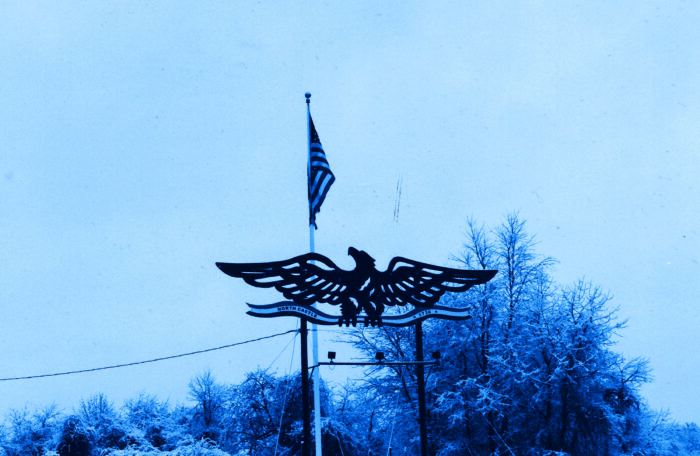
Recognizable across generations and indisputable in its significance, the Armonk Eagle has proven to be a special symbol in the Town of North Castle dating back decades.

What began as a simple 12 foot by 40 foot structure that was only supposed to grace the town temporarily has become a landmark rich in history. The origin of the Armonk Eagle goes back to 1976, when the town was preparing for America’s 200th birthday.

The entire country was in a patriotic mood then, which made an eagle the perfect symbol to soar above North Castle during its parade that year, Christine Eggleton, North Castle Historical Society president, explained. Originally, it was only supposed to stick around for the bicentennial, but ended up having an extended stay and has been replaced more than once when the elements battered up the previous eagle, noted Eggleton.

When one town administration decades ago was considering taking the beloved eagle down, Eggletown told the supervisor back then he shouldn’t be surprised if there is staunch opposition to that idea. She was right.

“It turned out he must’ve asked a lot of people (about taking the eagle down) and people felt very strongly about the eagle,” Eggleton said.

It’s an unofficial, visual landmark in the town, Eggleton said. When people are giving directions to visitors, they’ll reference the eagle.

“You know you’re in Armonk when you see the eagle,” she said.

Town historian Sharon Tomback said creating the first Armonk eagle was a massive community effort that required several local volunteers, including and most notably residents Arthur Soka, Charles Elson and John Schnoor.

“You’re driving up Route 22 and there’s the flags flying, the lights on the flag on the eagle and it’s a sense of civic pride and patriotism and community all rolled into one,” Tomback said.

Troy Soka, whose father was Arthur Soka, said the original plan was to place the eagle along Route 120 where the bicentennial parade would take place and suspend it overhead, but that proposal was shot down by the state department of transportation, Soka said. The alternative spot was near the IMB property, on the corner of Route 120 and Route 22, which is where the eagle continues to fly today.

“(My father) always made a big deal about how if you drove on Route 22 from Kensico coming from North White Plains when you approach the eagle and get closer to it, it appears to rise up as if it was taking off,” Soka said.

The eagle had a lasting meaning for Arthur decades after it was built. Even after Arthur moved to Florida, he would occasionally ask Troy, a New York resident, if his eagle was still in Armonk. In fact, in the third sentence of Arthur’s 2010 obituary, it states his involvement with the Armonk eagle and a plaque in town commemorates him for his efforts.

Soka said it gratifies him to see that Armonk has embraced the eagle as “its symbol.”

“And now God forbid you took it down, it would be an uproar,” he added.

But in 2013, losing the eagle was a possibility when it was once again in disrepair and the town didn’t want to use taxpayer dollars to replace it, said former North Castle councilwoman Diane Roth.

When a Garden Club member went to put flowers under the eagle, she noticed a piece of the eagle’s wing broke off and was in the flowerpot. Roth worked to find potential private dollars to pay for it and eventually phoned The Engel Burman Group, which owns the Bristal Assisted Living Facility in town. Although the price tag was a hefty $25,000, the donation came through. For the first time, the eagle was made out of steel metal so it could last much longer than wooded predecessors.

“I think it’s one of the iconic symbols of North Castle and America,” Roth said. “Keeping a memory of our past strengthens our future.”

So iconic that eagle symbols are seen on the badges of the North Castle Police Department and the North Castle Beautification Committee has spearheaded putting them on street signs and welcome-to-town signs.

Armonk Chamber of Commerce President Neal Schwartz, who owns College Planning of Westchester in town, said the eagle is one of three symbols that defines North Castle: An apple, Frosty the Snowman and finally the eagle, which is an all-encompassing symbol for the entire town.

Beautification committee member Angela Monforte said the eagle welcomes visitors and residents alike to the community like a “town mascot.”

“It symbolizes small town living,” Monforte summed up.
Filed Under: Armonk Cover Stories Tagged With: 1976, 200th Birthday, American Eagle, Armonk, Armonk Eagle, eagle, Garden Club, history, Landmark, North Castle, Symbol, Town Landmark

Meet a Local Alopecia Awareness Advocate

April 18, 2019 by Shauna Levy

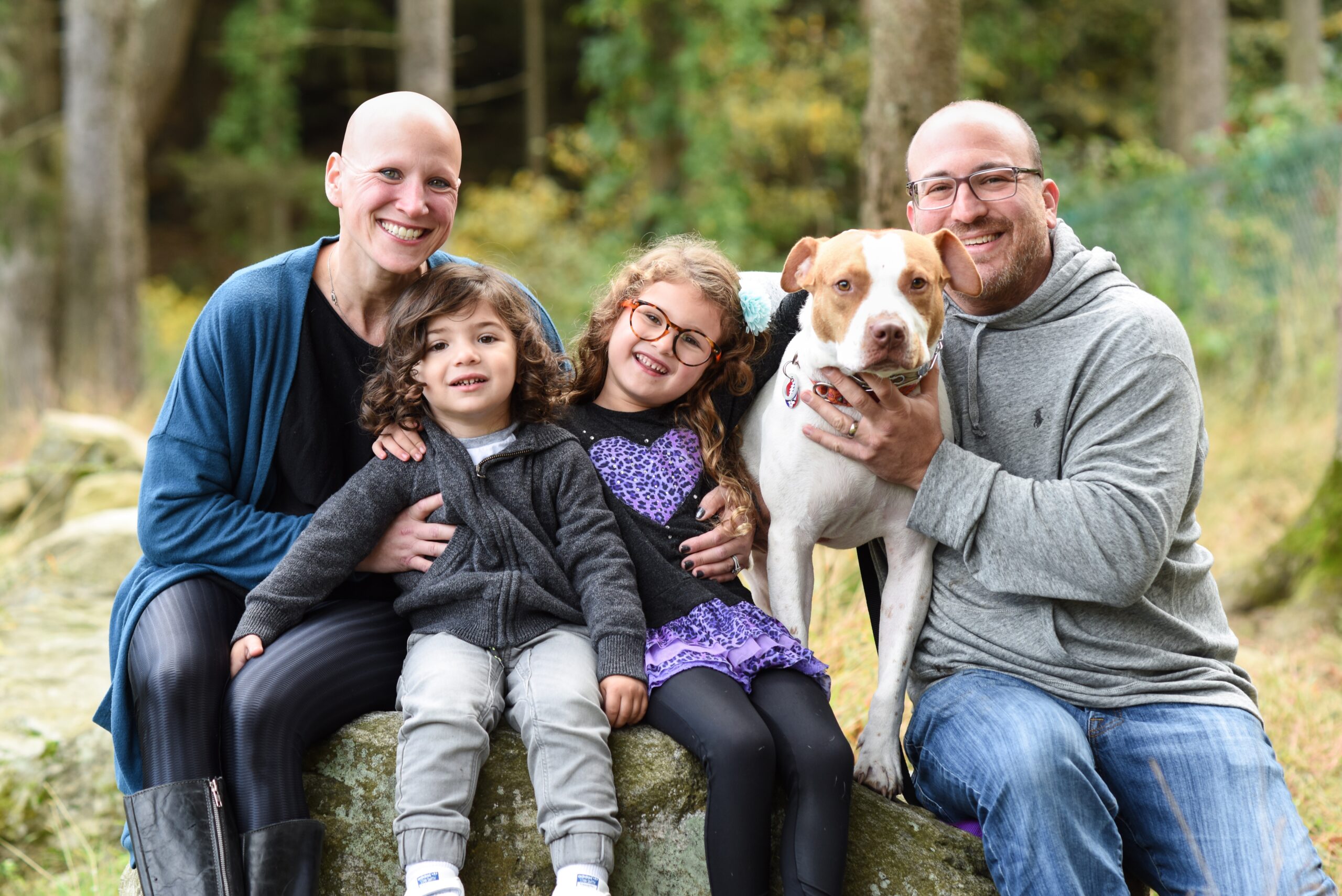
Photo by Carolyn Simpson courtesy of Ali Lambert Voron

Ali Lambert Voron on How to Celebrate the Beauty of What Differentiates Us

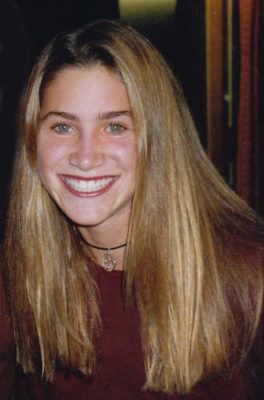
Ali Lambert Voron of Briarcliff Manor is many things. She is a voiceover actress, motivational speaker, blogger, entrepreneur, philanthropist and a mother. She also happens to be bald. Yet, instead of allowing that single attribute to define her, Voron flipped the narrative and is redefining society’s views of “normal.” Through optimism, humor and a steadfast decision to be happy, she harnesses every challenge life presents, transforming them into opportunities.

Lean and long, with bright eyes and a warm smile, Voron’s captivating presence radiates both inner and outer beauty. From a young age, she found joy in spreading happiness and light, saying, “My mom always strived to make others smile, especially if she sensed they were in a bad mood. I inherited that. I had an amazing childhood. Then, I lost my hair.”

Redefining Normal

At the age of 16, Voron began noticing bald patches in her head. Those discoveries prompted a confusing journey of misdiagnoses including hair-pulling disorders, depression and the potential of lupus. Voron recalls, “I felt happy and didn’t think I was stressed, but then I began second guessing myself. When a dermatologist finally diagnosed me with alopecia areata, an autoimmune disease that results in hair loss everywhere on the body, it was almost a relief.”

With the support of her family, Voron met the diagnosis with what would become her trademark optimism. A variety of treatments including serums and topical injections were used that produced hair regrowth, but only temporarily. “The most insecure part for me,” she says, “was that I never actually imagined being bald. I thought I’d have patches, but that it would come back. I never foresaw what actually happened and over a period of a year, my hair got thinner and thinner until it eventually all fell out.”

Initially, Voron bought a wig, but that didn’t last long and she emerged from the experience stronger than she thought possible. She explains, “Wearing a wig just wasn’t me and it didn’t take long before I whipped it off for good. I realized that I wanted to be myself regardless of whether that broke social norms. Strangely, I almost viewed myself as lucky for having learned this valuable lesson early on.”

A Sense of Humor Helps

Losing her hair at such a formative time was not without challenges. The headmaster of the private school Voron attended encouraged her to run for president of the school, a recommendation Voron credits as a “true gift.” With guidance from her “very funny” parents, she launched into campaign mode and put together a slideshow of bald leaders who she hoped to emulate including Mahatma Gandhi, President Eisenhower and Mr. Clean since he is the “leader of household cleaning products.” She won the election and gained a valuable platform to prove that although she was different, she remained the same, explaining, “As president, you make speeches in front of existing and prospective students, alumni and parents regularly. I got to show my community and myself that I was okay–different, but normal and even a leader–and, I got that opportunity over and over again.”

A Cycle of Kindness

Her story gained traction and Jennifer Saltiel, a family friend and aspiring writer (coincidentally, also a current Chappaqua resident) reached out. The resulting article, No-Hair Day, was published in “Chicken Soup for the Woman’s Soul” as well as “Chicken Soup for the Teenage Soul.” Voron began receiving letters in droves from people undergoing cancer treatment who were inspired to forgo their wigs to teenagers who were encouraged to look past their own insecurities. Voron says, “Those letters inspired me to realize how much we can help one another. I helped them and their outreach helped me. It was an amazing cycle.”

Years later, a chance meeting at the New Orleans’ Jazz Fest, introduced Voron to her husband. A fellow Philadelphia native, they had been orbiting one another for years, as his mother was even Voron’s second grade Hebrew school teacher. The first years of marriage would also show that they shared a strong sense of resilience. Voron explains, “I got very sick with ulcerative colitis in the beginning of our marriage. Autoimmune diseases like alopecia and colitis are closely genetically linked. I ultimately had my colon removed. Though I have no recollection, my parents reported that when I left the operating room, I raised my fist in the air and said, ‘the monster is out!’ At that same time, my husband’s mom died of brain cancer. Like my alopecia, these traumatic experiences made us stronger and taught us that we will emerge from the bad days to see the good ones.”

The Vorons have extended that philosophy to how they parent their children, ages three and six. Voron explains, “I love that my kids have a mom who looks different because it sends the message that it’s not just okay to be different–it’s cool. If you’re not different, you’re the same and that’s not exciting or special.” So, when Voron learned that a bald Bratz Doll hit the market, she naturally seized the opportunity.

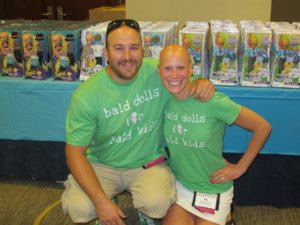
The couple launched a grassroots effort, “Bald Dolls 4 Bald Kids.”

“I understand firsthand how having this doll would be so impactful, so it became my mission to get enough dolls to the National Alopecia Conference, a place where going wigless is the norm,” explained Voron. With only three weeks until the conference, armed with sheer will and energy, the Vorons raised $14K, enough money to provide dolls for every child in attendance at the event. The family maintains a small inventory of the dolls, which they distribute at intervals to children with cancer and alopecia.

A Path of Inspiration

Voron’s experiences have laid the foundation for living a life with a focus on kindness and empathy. “Initially, it bothered me that at least one person would approach me to ask about my hair daily, until my husband pointed that each of these people had their own story to tell. It literally changed my whole perspective. By simply giving them ten minutes, I was giving them an important gift. Now, I go through my day wondering how I can help that random stranger. You can let something destroy you and crumble into a ball or you can make the decision to not allow that. That’s an empowering concept and it’s my privilege to share it.” And, Voron spreads that message, proudly embracing her differences as what makes her special as she inspires everyone in her path to do the same.

Filed Under: Armonk Cover Stories Tagged With: Ali Lambert Voron, Alopecia, bald patches, Briarcliff Manor, hair loss, inner beauty, love, misdiagnoses, optimism

Spiral Giving Teaches Local Children About Philanthropy

April 18, 2019 by Sue Bolen

What makes a philanthropist? Google the word and a bevy of images of Bill Gates, Warren Buffet and Oprah Winfrey pop-up making us believe that a philanthropist is well known and extremely rich and that to earn the label of philanthropist one must make a huge financial impact to society. Two Chappaqua women, Sue Fuirst and Julie Gerstein, set out to show how even small donations can have a big impact on our community, and while doing so dispel the idea that only the super rich can be philanthropists.
In 2015, Fuirst and Gerstein introduced Spiral Giving as an extracurricular program to the Greeley and Byram Hills high school communities. Their program teaches the fundamentals of philanthropy through a specially designed curriculum that focuses on the value of local impact.  “We discuss the needs of our neighbors and donate money to local charities through a grant-awarding process that the students themselves administer,” tells Gerstein. Spiral Giving participants learn to embrace the many needs in and around our community and realize that they have the power to make a meaningful, measurable impact. While doing so, they gain an understanding of the nonprofit and philanthropic landscape of Westchester County.

Fuirst and Gerstein feel that service projects and volunteerism help to teach charity and benevolence, but often worry that these are seen as one-off events–something that is checked off as done, not something that one does. Spiral Giving was formed to help teens identify the social issues that matter to them and to provide them with the tools necessary to make a difference in this increasing backdrop of need.

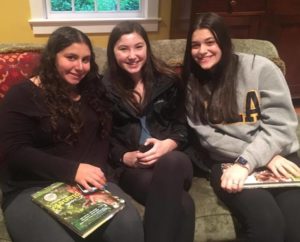
Girls (L to R): Sami Miller, Chloe Greenstein and Natalie Bass

Leadership Opportunities for Participants

Spiral Giving also provides communication and leadership opportunities and encourages stewardship around giving back. Orestes Rellos, a senior at Horace Greely High School, is a third-year participant and Peer Leader at Spiral Giving. Rellos comments, “Spiral Giving is all about personal growth and leadership development, while learning about the needs of various segments of our community and doing the greatest good by giving back. Giving back takes on even greater meaning and personal application as we, the students, contribute the money that funds Spiral Giving grants. We request, review, and approve grant applications. Spiral Giving is about us, students learning, understanding and then helping our community.”

Over the past four years Spiral Giving has awarded 22 micro-grants to Westchester-based charities and nonprofit agencies. The students recently awarded a grant to Lifting Up Westchester, a nonprofit that assists those struggling to overcome the challenges of poverty, homelessness, and hunger, and provides support that leads to greater self-sufficiency. Anahaita Kotval, Executive Director of Lifting Up Westchester commented, “I love that Spiral Giving engages its student members to critically think about what funding an issue really means and that they are empowering young people to help those in need.” Learning about the various agencies’ budgets has exposed the students to something that was previously unfamiliar.

Bailey Todtfeld, another Peer Leader, says, “Spiral Giving is unique in that it shows us the business side of nonprofits, a side that teenagers rarely see. Learning about nonprofits as a business has taught me the importance of responsible usage of funds and the challenge of sustainability within organizations.”

Inspiring the Next Generation of Philanthropists

At the heart of Spiral Giving is the issue of how parents and educators can work together to inspire the next generation to become engaged in issues surrounding them. Spiral Giving wants the next generation to become invested in their future and to feel empathy for their neighbors.  Fuirst believes, “This is often a challenge in communities such as ours, where basic needs are small and personal wants are big.  Places where the discrepancy of wealth between towns is often large and affluence can lead to misplaced values.”

Spiral Giving illustrates how individuals can become a philanthropist.  By giving teens the power to make an impact at this formative time in their lives, Spiral Giving has the ability to alter the perception of high school students and show how each person has the potential to change a life, strengthen a community, and make an impact on the world.

Spiral Giving’s grants are funded by Spiral Giving 501c3 through student fundraising, collective giving and private donations. Please visit www.spiralgiving.org to donate or learn more.

Filed Under: Armonk Cover Stories Tagged With: Byram Hills High School, education, extracurricular, Horace Greeley High School, peer leaders, philanthropy, spiral giving

Strong Showing at Upstate Science Competition for Byram Hills Teens

April 12, 2019 by The Inside Press

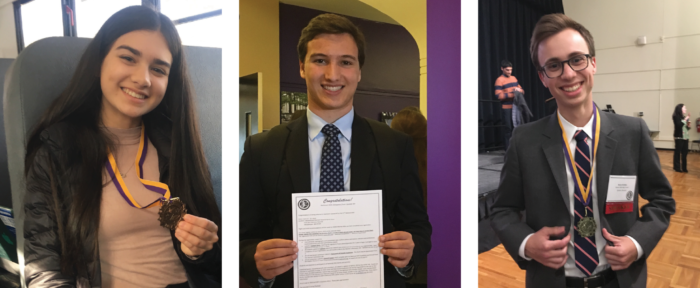
L-R: Emma Lucchino, Joshua Freedman, Renner Kwittken

Byram Hills High School’s Joshua Freedman won the top prize and a $2,000 scholarship and Renner Kwittken finished fourth at the Upstate New York Junior Science and Humanities Symposium last month.

The strong finish allows both seniors in the high school’s three-year Authentic Science Research Program to advance to the National Junior Science and Humanities Symposium in Albuquerque, New Mexico in late April.

At the regional competition held on March 27 and 28 at the University at Albany, Joshua and Renner were among the six finalists who competed by giving 12-minute presentations on their research. Joshua competed in the biomedical science category; Renner’s work was in the biochemistry category.

“I am very proud of them both,” said Stephanie Greenwald, Director of the Byram Hills Authentic Science Research Program. “They worked extremely hard at articulating complex scientific research so the public can understand the work they’re passionate about. It’s always nice to see more students in the science research program being recognized for their outstanding work.”

Joshua’s research focused on targeting nanoparticles for cancer diagnosis and treatment. His project involved creating a novel targeted anti-cancer nanoparticle that binds to a receptor only expressed in cancer. He found that his nanoparticle specifically bound to cancer cells in vitro. In the future, this could allow doctors to create sharper and more accurate images of tumors.

Renner’s work also involved nanoparticles. The goal of his research was to enhance the delivery of nanoparticles, small medicines that are less than the width of a strand of hair. He synthesized three novel nanoparticles and improved their delivery using a standard FDA-approved chemotherapy drug, cyclophosphamide. His results were found in mice models and could potentially work in clinical trials, moving nanoparticles into the forefront of anti-cancer therapy.

In New Mexico, Joshua will compete with an oral presentation. Renner will be a poster presenter.

Also in Albany, Byram Hills senior Emma Lucchino won third place as a poster presenter. She analyzed the relationship between the bacteria living in our gut and in our immune system.

Filed Under: Armonk Cover Stories Tagged With: Authentic Science Research Program, awards, Byram Hills High School, New York Junior Science and Humanities Symposium, Science, science research, Winning

Preventing & Recognizing Concussions: Keeping Your Young Athlete Safe

March 8, 2019 by Stacey Pfeffer

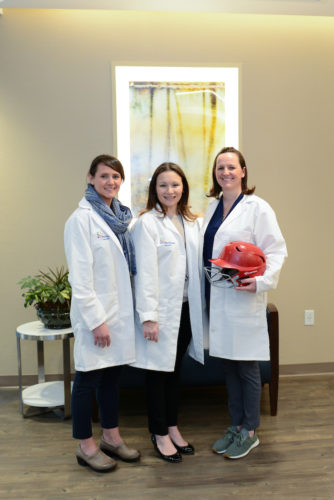
(L-R): Lisa Rusch, PT, DPT, GCS, Chari Hirshson, PhD and Sarah Todd, PT, DPT, CLT
PHOTO BY CAROLYN SIMPSON, DOUBLEVSION PHOTOGRAPHERS

With the 53rd Super Bowl behind us and a spike in media coverage on NFL players and concussions, the 2017 season saw the highest rate of diagnosed concussions (291) in NFL players in a six-year period, according to the NFL and Quintiles, an independent third-party company. Although 2018 figures showed a 29 percent decrease in the number of concussions, it still remains a serious health problem for players.

Although NFL players may be at a higher risk for sustaining a concussion, which medical researchers refer to as a type of traumatic brain injury (TBI), they are not the only athletes experiencing concussions. Many high school athletes and younger ones are also suffering from concussions in our towns and the problem seems to be county-wide. In fact, in 2016 the former County Executive Rob Astorino formed the Westchester County Concussion Task Force to address the problem.

In observance of Brain Injury Awareness Month in March coinciding with the spring sports season kicking into high gear, Inside Press spoke with leading medical practitioners at Northern Westchester Hospital (NWH) to separate fact from fiction when it comes to concussion prevention, treatment and management.

Changing Perceptions About Concussions

When many people think of concussions, they think of an athlete on a football field who perhaps has lost consciousness. While losing consciousness can certainly be a symptom of concussion, there are a host of other concussion symptoms and they don’t necessarily present themselves at the time of injury. Concussions are a type of brain injury that results from a bump, blow or jolt to the head or by a hit to the body that causes the head and brain to move back and forth. This back and forth movement can cause the brain to bounce around in the skull which can result in stretching or damaging brain cells. Many health professionals classify concussion as a mild TBI (traumatic brain injury) because the injury is usually not life-threatening and in most cases, symptoms resolve on their own. However, some patients have lingering symptoms that require treatment from a specialist trained in concussion management.

Ryan Esposito sustained a concussion falling off his scooter without a helmet

Chari Hirshson, PhD is a neuropsychologist with NWH who specializes in brain injury and treats both adults and children (ages 8 and up) who have sustained a concussion. According to Dr. Hirshson, who sees her patients at the hospital’s Ambulatory Care Center at Chappaqua Crossing, “concussion symptoms vary from patient to patient,” she explains. “It is important to take a multi-disciplinary approach with patients that have lingering symptoms because their symptoms can be multifaceted, encompassing physical, emotional and cognitive realms,” adds Lisa Rusch, PT, DPT, GCS, a Supervisor in the Concussion Rehab Program at NWH.

Acknowledging that concussions can be diagnosed by urgent care specialists, pediatricians or in the ER, an MRI or CT scan rarely shows signs of concussion. “Most of the time, these tests come back normal. It is not like with an X-ray that shows a broken bone. This can make it difficult to gauge the severity of the injury,” says Dr. Hirshson.

Varying Symptoms

Patients with a concussion can experience observable signs such as:

  • Appearing dazed and confused
  • Forgetting instructions
  • Moving clumsily
  • Answering questions slowly
  • Losing consciousness (even briefly)
  • Showing mood, behavior or personality changes
Ryan recovering from his concussion. PHOTOS COURTESY OF FAINE ESPOSITO

Patients with a concussion may also report these symptoms:

  • Headache or “pressure” in the head
  • Nausea or vomiting
  • Balance problems or dizziness/blurred vision
  • Bothered by light or noise
  • Feeling sluggish, hazy, foggy or groggy
  • Confusion, concentration or memory problems
  • “Feeling down,” irritable or anxious
  • Changes in sleep patterns

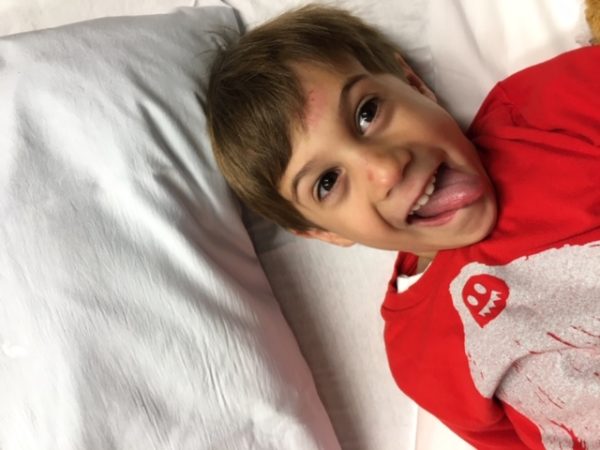
Some patients do not exhibit any symptoms until a few hours or even a few days after the injury. That was the case with Ryan Esposito, an Armonk child who decided to take his scooter down the porch and ride it without a helmet and unsupervised when he was five years old. He fell down the stairs by his driveway and while his head was bruised and bloody, he did not exhibit any concussion symptoms that afternoon upon examination by a pediatrician. “The doctor did not want to give him an MRI because he was so young but told us to take him to the ER if he starts vomiting,” recalls his mother Faine Esposito. Sure enough, at midnight Ryan started vomiting and was taken to NWH and diagnosed with a concussion.

Falls: A Leading Cause of Concussion

Despite many people believing that contact sports are a leading cause of concussion in children, more than 55 percent, in children up to 14 years old, are actually due to falls like Ryan’s. Hirshson adds, many of her adult patients sustain their concussion as a result of falls which could have been easily prevented. “I’ve seen falls resulting in concussion from women wearing jeans that are too long, or men who are carrying messenger bags with a strap that is too long and they trip. These injuries are not related to football, or skiing. These are things that can happen in everyday life,” she says.

Nevertheless, sports-related concussions due to being struck by an object or person is the second-leading cause of concussion in youth, accounting for 24 percent of cases in children up to 14 years old. In addition, 71 percent of sports and recreation-related TBI emergency department visits are among patients 10-19 years old. According to 2017 statistics from the US Centers for Disease Control and Prevention (CDC), 15 percent of high school students have had one or more concussions and 6 percent experienced two or more as a result of either playing a sport or being physically active. The rates were higher among males and the more sports a child played the higher the prevalence of concussion. Even more troubling was the fact that 40 percent of high school athletes reported that their coach was unaware of their symptoms. The researchers also found that some high school athletes tried to hide their symptoms from their coaches so that they would not get reduced playing time.

“I’ve seen falls resulting in concussion from women wearing jeans that are too long, or men who are carrying messenger bags with a strap that is too long and they trip. These are things that can happen in everyday life,” Hirshson says. PHOTO BY RAWPIXEL ON UNSPLASH

Gender Disparities in High School Athletes and Concussion Prevalence

There also appears to be a gender disparity in terms of the prevalence of concussion when high school athletes of both genders are playing the same sport. Females are more likely to suffer from concussion when playing soccer, basketball and lacrosse. Some of the reasons may be due to proper safety equipment. Boys are required to wear helmets in lacrosse while girls are not. Lauren Dinhofer, a senior who plays varsity lacrosse at Horace Greeley High School feels that helmets for her teammates should not be mandatory. “The use of helmets for me gives off the idea that girls are more protected, so you can be more aggressive on the field. However, helmets for girls don’t really have adequate materials for protection. Unlike boy helmets, girl helmets are soft and won’t make a difference against a check to the head. They invite more contact instead of offering protection.” But Melissa Mykytiuk, an Armonk mother of three boys who played lacrosse and ice hockey fervently disagrees. “Why don’t girls who play lacrosse wear helmets? Those sticks and balls are hard. It’s crazy to me.”

The Road to Recovery: Part 1: Return to School

Many of the patients who visit Dr. Hirshson or Rusch have been referred by a physician or a pediatrician. With a comprehensive approach tailored so that each patient can return to school and/or play, the team in the Concussion Management Program at NWH offers physical therapy, speech therapy, occupational therapy and neuropsychology. A coordinated team with their colleague Sarah Todd, PT, DPT, CLT who is the manager of Outpatient Rehabilitation Program at the hospital’s Chappaqua Crossing site, demonstrates why specific training in concussion management and a multi-disciplinary approach to care is critical to successful treatment. They often find a patient will seek treatment for one symptom, for example balance disturbance, and upon evaluation and assessment, additional effects of the concussion, such as memory issues, are uncovered and able to be treated.

Dr. Hirshson specializes in neuropsychology. The neuropsychological tests she performs can last from 4-8 hours and are designed to assess a patient’s cognitive strengths and weaknesses. “Typically, we don’t do neuropsychological testing until three months post-injury if cognitive symptoms have lingered,” explains Dr. Hirshson. If necessary, Dr. Hirshson will help young students manage their symptoms post-concussion before that 3-month period and help them transition back to school. The rigorous demands of high school, college applications and entrance exams can be very taxing on a student with lingering concussion symptoms. In certain cases and upon Dr. Hirshson’s clinical observations, some students may require support from the school, and she will work with the district to advocate for this, if necessary.

It is really important for a student suffering from concussion to get what medical professionals call adequate “cognitive rest” because this helps the brain recover. For example, if a student has an important test coming up, studying for it uses a lot of brain power and instead of using that energy for the brain to recover, it gets depleted which can ultimately delay recovery. Dr. Hirshson assesses each student and makes recommendations for returning to school on an individual basis “Take your cues from your kids,” advises Mytkiuk. Each of her three sons had a different recovery time from their concussion. “It’s frustrating because you don’t have control over when your kid’s brain gets better.”

Dr. Hirshson always tells her patients, “Don’t do something that doesn’t feel good. Don’t look at a screen if it hurts your head. Slowly build up tolerance. If you got a concussion over the weekend skiing, then don’t play soccer on Tuesday. Allow yourself the proper time to recover.”

Road to Recovery: Part 2: Return to Play

While the priority for all students recovering from concussion is to get them to return to school, for high school athletes returning to the field is often a main goal of recovery. With more than 4,000 New York based students under 19 treated at hospitals for sports-related traumatic brain injuries, following a return to play protocol is very important. In 2013, all states were mandated to pass laws to address concussion management in school athletics.

NY state school nurses, certified athletic trainers, coaches, and physical education teachers are mandated to complete sports concussion management training every two years. In addition, in both the Byram Hills School District and the Chappaqua Central School District, high school athletes undergo IMPACT (Immediate Post Concussion Assessment & Cognitive Testing) pre-season for a baseline assessment and upon returning to the field. Not all New York State school districts conduct IMPACT testing. Before a student returns to play, they must have medical clearance from a physician permitting it.

While Dr. Hirshson helps students return to the classroom, Rusch and Todd help students return to athletic endeavors. They help students suffering from symptoms such as neck pain, vestibular (inner ear) dizziness or disorientation and provide therapy to help them strengthen their eyes or restore equilibrium in addition to several other modalities. Todd often works on improving the vestibular system which can affect balance. “We retrain and recalibrate the vestibular system with dynamic exercises such as hopping on one foot on a foam board,” explains Todd. “We are part of that return to play conversation with the athletic trainers. We ensure that the athlete takes on exercises with increasing intensity in a controlled setting and then we make recommendations regarding return to play,” notes Rusch. “Interestingly, the research is indicating that patients who sustain a concussion are three times more likely to sustain a lower extremity injury of the knee or lower leg,” adds Todd.

“Each specific discipline that is part of the Concussion Management Program uses measurement tools to identify symptoms, measure their severity and develop a plan to progress so that patients return back to school and/or the field,” sums up Todd. “Because each concussion and its symptoms are unique, see a medical professional with credentials in concussion management who understands all the nuances,” advises Dr. Hirshson.

Ryan like most concussion patients had his symptoms resolve quickly and is now a happy six-year old back to playing on scooters and riding bikes. “But he remembers the injury and tells all his friends to be careful and of course wear a helmet,” his mother adds.


Helpful Helmet Tips

While there is no such thing as a “concussion-proof helmet,” the CDC notes that a proper fitting helmet can protect from a serious brain injury. Todd, who herself is a triathlete says that “helmet manufacturers are studying the dynamics of concussion and improving their designs based on the research.” As the biking season gears up, the CDC recommends the following tips when purchasing a helmet. The CDC also offers sports-specific guidelines for helmets available on www.cdc.gov/headsup.

Start with the Right Size

  • Bring the bike rider with you to assess fit.
  • Measure the child’s head size.
  • Sizes vary from brand to brand, so look at the helmet’s fit and sizing chart.

Get a Good Fit

  • The helmet should fit snugly all around with no spaces between the foam and bike rider’s head.
  • Ask your child how the helmet feels. A too tight helmet can cause headaches.
  • Have your child wear the hairstyle they will be wearing to ride the bike. If a long-haired child cuts their hair short, adjust the helmet accordingly.
  • The helmet should not rest too high or too low on the rider’s head.
  • Make sure your child can see straight forward and side to side.
  • The side straps should make a “V” shape under and slightly in front of the bike rider’s ears.
  • Chin straps should be centered under the bike rider’s chin and fit snugly so that no more than one or two fingers fit between the chin and strap.

Take Care of the Helmet

  • Check for damage. Do not use a cracked or broken helmet or one that is missing parts.
  • Clean it only with warm water and mild detergent.
  • Keep the helmet away from direct sunlight and do not store in a car.
  • Do not decorate with stickers or paint as this could affect the helmets safety.

Look for Labels

    • Have the date of the manufacture in case of a recall.
    • Purchase a helmet that is US Consumer Product Safety Commission (CPSC) certified.


Replace the helmet if it is damaged and has been involved in a crash!

Source: CDC Heads Up campaign

Filed Under: Armonk Cover Stories Tagged With: advice, Athletic fields, Bicycle Helmet, Brain, CDC Heads Up Campaign, Concussion Management, Concussion Symptoms, Concussions, falls, head injury, High School Athletes, kids, Neuropsychology, Northern Westchester Hospital, Physical Therapy, Precautions, Preventing Concussions, Recognizing Head Injuries, Risks, Traumatic Brain Injury, Westchester County Concussion Task Force

  • « Go to Previous Page
  • Page 1
  • Interim pages omitted …
  • Page 4
  • Page 5
  • Page 6
  • Page 7
  • Page 8
  • Interim pages omitted …
  • Page 41
  • Go to Next Page »

Primary Sidebar

Please Visit

White Plains Hospital
William Raveis – Armonk
William Raveis – Chappaqua
Northwell Hospital
Houlihan Lawrence – Chappaqua
Houlihan Lawrence – Armonk
Houlihan Lawrence – Briarcliff
NYOMIS – Dr. Andrew Horowitz
Westchester Table Tennis Center
Spavia
Compass: Miller Goldenberg Harris Team
Lipari & Mangiameli Dentistry
Raveis: Lisa Koh and Allison Coviello
Bristal Assisted Living
Maid Brigade
Kevin Roberts Painting & Design
Zwilling J. A. Henckels
Meagher & Meagher Attorneys at Law
Compass: Aurora Banaszek
Dr. Briones Medical Weight Loss Center
EyeGallery
Roamfurther Athletics
Decicco and Sons
World Cup Gymnastics
Beascakes Bakery
Joseph Richard Florals
King Street Creatives
Donna Mueller

Follow our Social Media

The Inside Press

Our Latest Issues

For a full reading of our current edition, or to obtain a copy or subscription, please contact us.

Inside Pleasantville and Briarcliff Manor Inside Chappaqua and Millwood Inside Armonk

Join Our Mailing List


Search Inside Press

Links

  • Advertise
  • Contact Us
  • Digital Subscription
  • Print Subscription

Publisher’s Note Regarding Our Valued Sponsors

Inside Press is not responsible for and does not necessarily endorse or not endorse any advertisers, products or resources referenced in either sponsor-driven stories or in advertisements appearing in this publication. The Inside Press shall not be liable to any party as a result of any information, services or resources made available through this publication.The Inside Press is published in good faith and cannot be held responsible for any inaccuracies in advertising or sponsor driven stories that appear in this publication. The views of advertisers and contributors are not necessarily those of the publisher’s.

Opinions and information presented in all Inside Press articles, such as in the arena of health and medicine, strictly reflect the experiences, expertise and/or views of those interviewed, and are not necessarily recommended or endorsed by the Inside Press. Please consult your own doctor for diagnosis and/or treatment.

Footer

Support The Inside Press

Advertising

Print Subscription

Digital Subscription

Categories

Archives

Subscribe

Did you know you can subscribe anytime to our print editions?

Voluntary subscriptions are most welcome, if you've moved outside the area, or a subscription is a great present idea for an elderly parent, for a neighbor who is moving or for your graduating high school student or any college student who may enjoy keeping up with hometown stories.

Subscribe Today

Copyright © 2026 The Inside Press, Inc. · Log in