• Skip to primary navigation
  • Skip to main content
  • Skip to primary sidebar
  • Skip to footer

The Inside Press

Magazines serving the communities of Northern Westchester

  • Home
  • Cover Stories
  • Features
    • Portraits and Profiles
  • Advertorials
    • Lifestyles with our Sponsors
    • Sponsor News!
  • Wellness
  • Happenings
  • Advertise
    • Advertise in One or All of our Magazines–And/Or Subscribe
    • Advertising Payment Form
  • Contact Us
  • Search

North Castle

Westchester County Airport: A Hidden Jewel For Air Travelers In The Region

October 21, 2016 by Stacey Pfeffer

Westchester County Executive Robert P. Astorino; Lt Col Joseph Wooley, Civil Air Patrol; Peter Scherrer, Westchester County Airport at a rededication ceremony this past July for the Lockheed T-33 jet, known as the “T-Bird” after the WWII plane was restored for a year. Photos Courtesy of the Office of the Westchester County Executive
Westchester County Executive Robert P. Astorino; Lt Col Joseph Wooley, Civil Air Patrol; Peter Scherrer, Westchester County Airport at a rededication ceremony this past July for the Lockheed T-33 jet, known as the “T-Bird” after the WWII plane was restored for a year. Photos Courtesy of the Office of the Westchester County Executive.

It’s another busy morning at Westchester County Airport. On the runway, a JetBlue flight is about to take off to Orlando with several young Westchester families en route to Disney. Another runway has a handful of business travelers coming in on a United flight from Chicago. Meanwhile a Westchester-based CEO is boarding his corporate jet for a meeting in Rochester.   

Opened in 1945, Westchester County Airport operates 24 hours a day, seven days a week, and currently has six airlines offering flights, serving approximately 1.75 million passengers a year. The airport’s code, HPN, actually stands for Harrison, Purchase and North Castle, not White Plains Airport, as many people mistakenly believe, because the airport’s footprint is owned by all three towns. The airport employs 1,300 workers full-time and brings in an estimated $735 million to the region, according to a 2010 analysis.

The main terminal at Westchester County Airport.

The airport first began commercial flights in 1948 and the National Guard maintained a base at the airport from 1952 to 1983. In 2005, the airport began to offer discount flights to several key destinations for the first time.   

With residential properties surrounding the airport, the county works hard at limiting noise and other environmental hazards.

A Westchester County Airport Advisory Board meets monthly and the board discusses topics such as noise/odor complaints with meetings open to the public.  The board consists of eleven members appointed by the County Executive with representatives from the surrounding areas and aviation specialists. Residents can track flights and complain about any noise issues via www.airport.westchester.gov under the flight tracking tab. The County and Board have also been instrumental in capping terminal use to 480 passengers per hour to limit the impact on surrounding communities.

“The Westchester County Airport serves a very important purpose for the residents and businesses not only in North Castle but in the surrounding region,” notes Michael Schiliro, the Town Supervisor of North Castle. “In April, the North Castle Town Board adopted a Resolution requesting that North Castle be considered an Interested Agency for the proposed legislation modifying the Terminal Use Agreement. It is important to strike a balance between sustaining the level of service expected by the users of the airport while addressing the environmental, traffic, and noise impacts of North Castle residents. We intend to be an active participant in the process.”

“I think when people hear the words development or expansion they confuse construction with that,” notes Richard Conrad, an Advisory Board member from North Castle who is also the CEO and Owner of GP Aviation, a company that operates and sells business jets. For example, the airport recently built a separate building on the right hand side of the terminal for baggage screening to make it safer and efficient for all passengers. “The airport really is a jewel of Westchester, offering accessibility, ease of entry/egress from the airport and civilized travel with fewer crowds than other nearby airports. The county and [County Executive Rob] Astorino are huge proponents of it and are constantly looking for ways to improve the airport experience for everybody.”

Samantha Shinnick, an Armonk resident, uses the airport frequently and likes that “it’s a small airport with pretty good service (except when it snows). They run the operations smoothly based on security lines, etc.” However, she wishes there were more reasonable taxi services available and would like Uber to be allowed on-site.

There are several fixed-base operators (FBOs) at the airport such as Million Air and Signature Flight Support and these operators offer the convenience of driving right up to your plane and having staff handle your baggage. “It’s just another level of civilized travel,” comments Conrad.

In addition, Conrad notes that the airport is a “mecca for business aviation,” bringing in millions of dollars to the area.

Stacey Pfeffer lives with her husband and three young children in Chappaqua. She has written for New York Family Magazine, Kveller.com, Westchester Parents and Inside Chappaqua. She has flown to Florida several times via Westchester County Airport.
Filed Under: Armonk Cover Stories Tagged With: airport, National Guard, North Castle, plane, Westchester County Airport

As One Town Resolves the HUD Dispute, Another Fights On

August 25, 2016 by The Inside Press

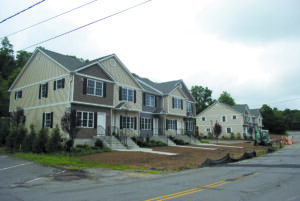
Affordable housing is being built on Old Route 22 in Armonk. Andrew Vitelli Photos.

By Andrew Vitelli

“It’s really mind-boggling, if you think about it,” New Castle Supervisor Rob Greenstein says. Sitting just a stone’s throw from the site of the controversial Chappaqua Station housing project, Greenstein is referring to criticism of the town coming from the U.S. Department of Housing and Urban Development and from a monitor appointed following a 2009 settlement between HUD and Westchester County. “I think they should be singing our praises and holding us up as an example of doing more than our share. And instead, we’re criticized.”

In purely numerical terms, New Castle has more than carried its weight; even without Chappaqua Station, which Greenstein opposes, more than 30 units are in the pipeline. But the fight over Chappaqua Station, built on Hunts Lane between the railroad tracks and a Saw Mill Parkway exit ramp, has dragged on for years and put the town in the middle of a bitter fight between HUD and county leadership.

On Old Route 22 in Armonk, meanwhile, a row of freshly-built multifamily homes has sprung up, construction equipment sitting outside. In July, North Castle was removed from a list of municipalities facing legal action over their zoning laws and the concentration of multi-family housing within the municipality. The town’s presence on the list, the town’s supervisor says, had more to do with the lack of infrastructure throughout much of the town–along with the flooding of Kensico village a century ago–than any discriminatory intent on the town’s part, and in the end the HUD-appointed housing monitor agreed. “I’ve found them to be very receptive to our communications,” Supervisor Michael Schiliro says.

These towns are just two of more than 30 towns and villages impacted by the settlement, but their stories give a closer look at how the settlement has played out in many of these communities.

The Settlement

The housing settlement, which has cast a shadow over Westchester politics for nearly a decade and brought the county to the center of a battle over federalism, government overreach, and allegations of modern-day segregation, was signed in August 2009 by then-County Executive Andrew Spano. In 2007, the Anti-Discrimination Center, a Manhattan based non-profit which fights housing discrimination, sued the county over accusations that the county had been collecting federal funds earmarked for low-income housing without meeting the requirements necessary to receive these funds. In February 2009, U.S. District Court Judge Denise Cote ruled that the county had failed to conduct an analysis of impediments to address claims of housing discrimination. Facing the possibility of liabilities of more than $150 million, Spano had no choice but to agree to the settlement, under which Westchester admitted no wrongdoing but agreed to commit $51.6 million to building 750 affordable housing units, mostly in municipalities, including New Castle and North Castle, with few black or Latino residents.

That November, Rob Astorino, a Republican and an opponent of the settlement, unseated Spano to become county executive. While Astorino vowed to comply with the settlement, the last six and a half years have been marked by recurring conflict between HUD and the county. There have been spats over which projects should be counted towards the settlement, over legislation banning landlords from rejecting people with government housing vouchers, and over the county’s effort to press towns and villages to adopt a model zoning ordinance.

A continuing source of strife has been the county’s obligation to conduct an analysis of impediments, including those based on race or resistance to affordable housing, to identify exclusionary zoning. The county has submitted eight analyses to HUD, finding no exclusionary zoning regulations. HUD has rejected every submission. This dispute has cost the county more than $20 million in grant money from HUD.

For both sides, though, the principles in play go beyond the sum of the projects and the dollars involved. Astorino has called HUD’s actions “Washington-driven social engineering,” a sentiment echoed by, among many others, the Wall Street Journal’s editorial board. On the other side have been allegations of thinly-veiled racism, with The New York Times editorial board accusing the county of “keeping Jim Crow’s spirit alive.”

The Challenge in Chappaqua

New Castle is not only one of the richest communities in the country, but home to both the Clintons and Governor Cuomo. Add to that the town’s role on the wrong side of a watershed 1977 zoning ruling, Berenson v. New Castle, and it’s understandable that Chappaqua would end up in the spotlight, Greenstein says.

“The truth is, it makes it a perfect little town to make an example of, and I think that’s part of the problem,” says the town supervisor. “Because of those three reasons, I think that there are some people biting at the bit to make an example of us, and we have definitely felt that pressure.”

New Castle, which adopted the model zoning ordinance in 2011, has one major affordable housing project that has sailed through with little opposition: a 28-unit affordable housing project called Chappaqua Crossing at the site of what was once the Reader’s Digest building on Roaring Brook Road. Conifer Realty purchased the Chappaqua Station site in September 2010. Conifer’s plans for the site (originally 36 units) were at the time backed by Barbara Gerrard, then the town’s supervisor, as well as the town board. One of the proposal’s early critics, as Greenstein now points out, was James Johnson, the HUD-appointed monitor overseeing Westchester’s compliance with the settlement, who in an April 2012 letter to the board suggested that the site was isolated and stigmatizing.

The monitor signed off, however, after the developer made changes to the site’s design to help integrate the project into the community aesthetically, created public space within the building, and addressed traffic concerns. One change was to downsize the complex from 36 to 28 units.

“Some would say he flip-flopped on the issue,” Greenstein says of the monitor, who recently resigned from the case. “I haven’t changed my opinion. I think that site is isolating and stigmatizing.” The town board granted Conifer a special permit in September 2013, contingent on Conifer obtaining the necessary variances and permits. By then, however, public opposition to the project had begun to take hold. In the 2013 town board elections, Greenstein ran on the Team New Castle ticket along with town board candidates Lisa Katz and Adam Brodsky. Opposition to Chappaqua Station was a significant factor in Team New Castle’s election to all three positions. With the supervisor and a majority of the town board opposed to the project at its current location, along with concerns voiced by Building Inspector Bill Maskiell, progress on the development has slowed in the last two and a half years.

The root of the resistance to Chappaqua Station–whether born from flaws in the project or a wider resistance to public housing–is much contended. In February 2014, Conifer filed a Housing Discrimination Complaint with HUD, stating that during public debate opponents of the project claimed that “the project would be a stigmatized ghetto, that the children who lived there would be ostracized by children who live in the Village, and that the project would be where the ‘blacks and Hispanics’ live.”

Holly Leicht, HUD’s regional administrator for New York and New Jersey, says it’s hard to answer with any certainty whether opposition is due to the project itself or reflects a fear of any affordable housing. “There are probably people on both ends of the spectrum,” Leicht explains. “There usually are in these situations, where there’s a controversial project.”

But Greenstein points out that the town’s other major affordable housing project under the settlement, Chappaqua Crossing, has received little pushback from the community.

“When you look at that building, you’re not going to say, ‘That’s affordable housing.’ You’re going to say, ‘That’s housing,’” Greenstein says, referring to Chappaqua Crossing. Turning his attention to Chappaqua Station, he remarks, “Now compare that to this project over here. That’s on a third of an acre, from lot line to lot line there’s not a blade of grass.”

“There’s no question that people are opposed to this particular location,” Greenstein adds. “I want to make it clear that people are not opposed to affordable housing.”

The battle over the project has also ensnared the county. In December of 2013, the county’s Board of Legislators voted to withhold funding for the project; a year later, the board approved funding, on the condition that the project must receive all the necessary variances. The monitor faulted the county for counting the units towards the settlement agreement (it needed financing in place for 450 units by the end of 2014) but also blamed the county for failing to push New Castle to end the impasse. This May, Judge Cote said the units could count towards the settlement but also said the county had breached its obligation by not weighing in on behalf of the developer against local opposition.

The proposed site of Chappaqua Station has drawn opposition from a wide segment of New Castle residents and officials.
The proposed site of Chappaqua Station has drawn opposition from a wide segment of
New Castle residents and officials.

Mike Kaplowitz, the chairman of the Board of Legislators, says the project has been problematic from the get-go.

“Pretty much, nobody is happy,” Kaplowitz says. “That project is so messy. I don’t meet many people in New Castle who are happy on either side of that issue.”

Leicht acknowledges that the town has some legitimate concerns over the project, but says HUD is worried that the town is dragging its feet.

“I think that a legitimate back and forth, and focusing on the health and safety issues, is fine. The sense was that this is being protracted for a very long time,” she says. “I think part of the frustration is that things keep coming up sequentially rather than part of one process that is condensed.”

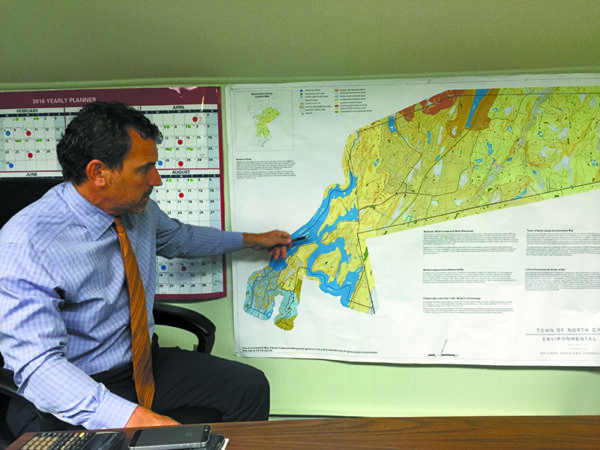
North Castle Supervisor Michael Schiliro explains restrictions imposed by his town’s infrastructure.

A Solution in North Castle

Around a century ago, the Village of Kensico was flooded due to the creation of the Kensico dam, leading many of the village’s residents to move south to what is now the Hamlet of North White Plains. Supervisor Schiliro believes this piece of history along with the hamlet’s proximity to White Plains has led to a higher population density, and a concentration of the town’s minority population, in North White Plains that exists to this day.

Today, one zoning district in downtown North White Plains has three-and-a-half times the rate of minority households as the town as a whole. Additionally, large parts of the town are zoned for single-family housing, with these districts primarily white.

For the housing monitor, this itself amounted to prima facie (legal language meaning presumed until proven otherwise) evidence of clustering under what’s known as the Huntington test (named for the 1988 watershed case Town of Huntington v. NAACP).

“Do I disagree with their findings? No. They’re mathematical. We technically fail the Huntington test,” Schiliro admits. “But part of it is something that happened 100 something years ago, which developed a denser zoning or development here.”

The town’s zoning is based more on the limits of its infrastructure than anything else. In the rural northern parts of the city, sewer and water is sparse outside downtown Armonk. This prohibits the kind of housing density seen in North White Plains. Schiliro, a Democrat elected in 2013, met with officials from the monitor’s office his first year in office, giving them a tour of the town to show them the restrictions preventing multi-family housing throughout most of North Castle.

In May of this year, however, the housing monitor released a report placing North Castle on a list of seven municipalities whose zoning could result in liability under the Huntington test or the related Berenson test (named after the 1977 ruling involving New Castle). “In the absence of remediation,” the report stated, “the Department of Justice is encouraged to give serious consideration to bringing legal action against one or more of these municipalities.”

“I was disappointed because genuinely I felt that we had made a lot of progress,” Schiliro says, looking back at the May report. “So our reaction was, let’s sit down with the monitor and the monitor’s office again. It wasn’t any animosity, any anger. It was just, let’s communicate.”

Schiliro again met with officials from the monitor’s office in June following the report’s release and pressed the town’s case. A month later, the monitor withdrew his recommendation of legal action, noting progress made by the town and also acknowledging environmental and infrastructural constraints.

While the issue was ultimately resolved, the monitor’s decision to place North Castle on such a list in the first place was viewed by some of HUD’s critics, particularly the Astorino administration, as an example of “breathtaking” government overreach. A spokesman for Astorino said the county executive was puzzled by the monitor’s initial decision, as was Westchester Legislator Margaret Cunzio, who represents North Castle.

“I think it was unfair because since day one they had been compliant and they had been working with both the monitor and the HUD office,” says Cunzio, a Conservative. “The town has done nothing since day one but try to fulfill their requirements.”

Schiliro carefully avoids any criticism of HUD or the monitor.

“It must be a challenge for them,” he says. “It’s a lot of work to really understand all the towns in the county, and each town is very different.”

Schiliro also notes that the town has made progress since the monitor’s 2014 visit. North Castle adopted the model zoning ordinance in 2014, and 25 affordable housing units are in development throughout Armonk.

“The town has always had affordable type housing for decades,” Schiliro notes. “We listened to what the latest communications were from the monitor and we made some adjustments to our code like creating the model ordinance so the future units would conform with what the parameters of the lawsuit were.”

Light at the End of the Tunnel?

At the end of the year, the county is obligated to have financing in place for the 750 units required under the settlement. But the county’s need for affordable housing has no end date.

“If we get to the end of the settlement and 750 units have been built but everyone is saying, ‘I never want to have to deal with the federal government, or the federal government’s money, or affordable housing, again,’” Leicht explained to legislators at a June meeting, “then we have not really met our goal here.”

Speaking to the Inside Press, Leicht circles back to this idea when asked whether New Castle, with 60 affordable housing units in the works including Chappaqua Station, has in fact done more than its share.

“These projects are happening, and I am optimistic that the 750 units will be met, but I don’t really think anybody would say that’s the entire affordable housing need in the county,” Leicht comments. “I haven’t had anybody, no matter where they stand on this settlement, not acknowledge that Westchester really has affordable housing needs.”

When people move into that housing [in Chappaqua], we will do everything in our power to make them feel welcome and part of the community.” –Robert Greenstein

Even some of Chappaqua Station’s opponents now seem resigned to the likelihood that it will be built.

“I’d like this project not to go forward because it’s a terrible site,” Kaplowitz says. “But unfortunately the wheels are in motion and there’s nothing we can do to stop it.”

Greenstein notes that there’s no guarantee the project will meet the conditions required for the building permit, but acknowledges the futility of risking litigation to try to stop it from moving forward.

With the housing monitor absolving North Castle of its Huntington test failure, this reporter asks the town’s supervisor, is the town in the clear regarding settlement compliance? “I would think we should be,” Schiliro replies diplomatically. “We will just continue on this path,” he continues. “As new developments come about, the model ordinance is in place; we’ll continue to further affordable housing like we’ve been doing for decades.”

At year’s end, the county is set to have the 750 units in the works, theoretically winding down its obligations under the settlement. But if the past is a guide, nothing is that simple.

In his letter of resignation Johnson, the housing monitor, wrote that his successor should be prepared to deal with the case for some time to come.

Andrew Vitelli, a Westchester native, is the editor of Inside Armonk Magazine.

Filed Under: Armonk Cover Stories Tagged With: affordable housing, Affordable Housing in Armonk, Armonk, Board of Legislators, Chappaqua Crossing, Housing, HUD, Inside Press, North Castle, theinsidepress.com, Town of New Castle, Westchester affordable housing

Michael J. Schiliro, Leading Armonk into the Future

March 6, 2016 by The Inside Press

Schiliro-0005

Supervisor Michael J. Schiliro 

Age: 51

Party: Democrat

Supervisor since: 2014

Town Board since: 2008

Current term ends: 2017

Profession: Banker

Previous Political Office: Councilman 2008-2013

Wife: Lori

Daughters: Paulina, 20; Emma, 17; Gina, 11.

Pets: Two dogs, Rudy and Cosmo

Goals in Office
Macro: Leave the Town better than when he started.
Micro: Provide residents with honest, transparent, fair, and apolitical representation with integrity, and always strive to improve the quality of life in our Town. Listen to residents and be accessible. “There is no purer form of government than local municipalities.”

Mets or Yankees? Mets!

By Deborah Raider Notis

Photos by Cathy Pinsky

From the Miller House, which headquartered George Washington during the Battle of White Plains, to Smith’s Tavern, which housed travelers for over 200 years, North Castle is a thriving town with a rich history. Over the past few years, North Castle, and most notably Armonk, experienced a bold revitalization. Building this enticing new hub required time and teamwork, much of which was led by Town Supervisor Michael J. Schiliro. Yet, as North Castle continues to grow, Schiliro impresses, “We need to move forward, but we cannot forget this town’s legacies.”

Schiliro, who was elected to the position of Town Supervisor in 2013, feels that Armonk was well-planned out in a very methodical way. And while downtown Armonk was substantially developed over the past few years, the town was careful not to overbuild or overgrow. “When I moved to Armonk, people constantly said how different it was from a decade earlier,” Schiliro said. “We have just continued with that growth.”

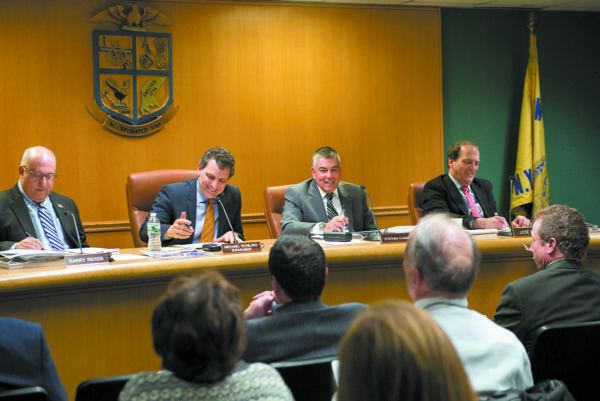
Supervisor Schiliro (second from left) leads a North Castle Town Board meeting.

Schiliro has been intrinsically involved in town politics, planning, and volunteering since he moved here 17 years ago, when his oldest daughter was three years old. He and his wife raised their three daughters and two dogs in Armonk, in a house that is walking distance from town. He was a founding member of North Castle Citizen Core Council (NC4), a group of North Castle resident-volunteers that was formed in 2003 to assist and protect residents in the event of an emergency. Amongst the many altruistic efforts of NC4, Schiliro and his fellow volunteers at NC4 were responsible for setting up round-the-clock shelter for North Castle residents during Hurricane Sandy. He also served on the North Castle Town Board for more than five years before being elected Town Supervisor of Armonk.

As Town Supervisor, Schiliro is the leader of the Town Board, and essentially, the Chief Executive and Financial Officer of North Castle. He works closely with the newly appointed Town Administrator Joan Goldberg, who is North Castle’s Chief Operating Officer, meeting with her weekly. He meets with town supervisors throughout Westchester County monthly. And the buck stops with him for all budget, zoning, code, and planning decisions.  But Schiliro credits the North Castle Town Board with working as a cohesive team on all decisions that impact the area. He is particularly careful about making any major changes in the small business area. “I started out as a member of the North Castle Town Board, and I know the importance of working together as a team and keeping the best interests of the town first.”

Supervisor Schiliro with his dogs, Rudy (L) and Cosmo

Schiliro is particularly careful about making any drastic changes in downtown Armonk. He is exceptionally aware of zoning requirements and served on the Town Board when the middle income housing program was being implemented in Armonk. He is now working with Westchester County to contribute an adequate number of affordable housing units in Armonk. “We always had middle income units, now we are building affordable units. For this program, we are just following the rules,” states Schiliro. Armonk is building affordable housing units in Brynwood, on the old lumber yard, and on Old Route 22, amongst other places.

Building up the town without overdeveloping has been a primary mission for Schiliro, who hopes to create a Vision Committee comprising entrepreneurs, financial experts, and professional firms. When he joined the Town Board, Schiliro played a key role in turning around North Castle’s finances. He helped to make sure that North Castle restored its AAA Moody’s rating, which they lost in 2008. He also helped to re-envision the town’s finances and budget. Today, the North Castle budget is over eight million dollars, up from $800,000 in 2008. Schiliro also worked to put checks in place to prevent future budget crises.

Supervisor Schiliro with Con dential Secretary Mindy Berard

Building up downtown Armonk and opening up Armonk Square was a proud accomplishment for Schiliro, who likes to think of Armonk as a walkable town. Making it a reality required a significant amount of collaboration by residents and town department heads, but the results were well worth the work. “Armonk Square has brought so much life into Armonk. People in other towns talk about it, it’s won awards, and it has drawn people here to visit and dine,” effuses Schiliro, who enjoys doing occasional restaurant “crawls” to get a flavor of the many different and lively restaurants in town. The new development has also made Armonk an even more desirable place to live, as people particularly appreciate the liveliness and accessibility of the town.

Schiliro is hoping to make the same positive changes throughout the rest of North Castle as well. As the Town Board reviews and updates North Castle’s comprehensive plan, Schiliro is hoping to revive commerce in Banksville and tweak the North White Plains business district to enhance profitability.  “Banksville is a very rural area that used to have a small but thriving downtown area. I would like to see that area revitalized,” notes Schiliro.

With so much happening throughout North Castle today, Schiliro continues to acknowledge the past. He takes time at every board meeting to acknowledge a past board as well as individual citizens who contributed to the town. Every meeting has “Dori time,” a moment to note positive events in North Castle and named for Town Historian Doris Watson. “A town like this is only as great as the people who put time into it, and all of these people have so much value and historical significance because they helped create what is here today.” Like his predecessors, Schiliro will most definitely be remembered as someone who contributed to North Castle’s growth and prosperity.

Deborah Raider Notis is a writer and co-owner of gamechanger, LLC, a free referral service connecting Westchester families to highly qualified, competitively priced instructors. She lives in Pleasantville with her husband, four boys, and their dog Oscar.

Filed Under: Armonk Cover Stories Tagged With: Armonk, Inside Press, Michael Schilliro, North Castle, supervisor, theinsidepress.com, town

They’re up for the Vote!

October 21, 2015 by The Inside Press

By Louise T. Gantress

North Castle includes the three hamlets of Armonk, Banksville and North White Plains. The first two are residential suburban whereas North White, as it is called, is quasi-urban. Elections are at large, with positions voted on by the entire town. North White often feels it is “apart” rather than a part of North Castle because elected officials tend to live in either in Armonk or Banksville. Not long ago local government in the Town of North Castle was rife with contention. A lack of civility upset most residents.

This year, Supervisor, two Council positions, Clerk, and a Judge are up for election. However, only the Council positions are contested. The unopposed: Supervisor Michael Schiliro, Clerk Alison Simon and Town Justice Elyse Lazansky. There are three candidates for two Councilman positions: Stephen D’Angelo, Guy Mezzancello and Jose Berra. Additionally, the seat for County Board of Legislators (BOL), District 3, which includes North Castle, Mt. Pleasant, Pleasantville and parts of Greenburgh, Ossining and Sleepy Hollow has two candidates vying for the position (left open in July when Legislator Michael Smith unexpectedly withdrew): John Diaconis and Margaret Cunzio.

Michael Schiliro, Supervisor, running unop- posed for a second term

Michael Schiliro is seeking a second term as Supervisor. He is cross endorsed by the Democratic, Republican, Conservative and Independence parties. Schiliro said, “The real task is to balance development with maintaining the small, quaint town atmosphere with three distinctly different hamlets” and “provide the level of service people expect.” He seems to be successful; a longtime resident said, “Dark clouds have lifted from town politics. Mike’s uncontested status speaks to his results and professionalism.”

Incumbents can point to the restoration of the town’s fund balance and its AAA rating from Moody’s Investors Service, and contracts signed with all four unions include contributions towards health care. Negotiation with Brynwood concluded with a “fee simple” solution to tax the proposed multiunit housing as separate properties, and not a lower condo rate. A new source of revenue will be added in 2016 once Governor Cuomo signs the bill allowing North Castle to levy a hotel tax. State Senator Latimer and Assemblyman David Buchwald shepherded the bill’s passage.

The three Council candidates agree on keeping taxes low, paving roads and saving Miller House, the headquarters of General Washington during the Battle of White Plains.

Stephen D’Angelo, current Councilman seek- ing re-election

Stephen D’Angelo is a current Councilman running for a second term. He points to the “revitalization” of the town during his tenure, including Armonk Square, new restaurants, and an accelerated road paving schedule. He said that town taxes were kept under the state cap and resolution of Miller House is ultimately a county responsibility.

D’Angelo is not taking anything for granted in this  year’s election. “I will work hard to get their votes, I will work hard for the town,” he said. He is an 11 year resident of the town, a graduate of Manhattan College and CPA who maintains his accounting business in Armonk.

Guy Mezzancello, currently completing his first year in office

Guy Mezzancello is completing his first year in office, having won a special election, by 22 votes, to fill the council seat vacated when Michael Schiliro became Supervisor. Initially Jose Berra was selected to fill the position. Mezzancello said, “You need time to get things done. I learned a lot this year.” He lists priorities as parking in downtown Armonk and paving roads. He wants to keep seniors in town, but has no specific plan. He would consider a bike lane where feasible.

To fix the roads quickly, he would take advantage of low interest rates currently available and go to a bond issue. He is appalled that Miller House sits in disrepair and would like to see it rebuilt on site as soon as possible. The town has done a “fairly good job” of keeping taxes under control, and coordinating with other towns for equipment or other purchases is helpful.

Mezzancello moved to Armonk in the mid-1980s from Harrison and has been involved in Little League baseball, becoming commissioner. He also served on the Planning Board. “I think you have to listen to everybody,” he said. He operates a contracting business and said he is “unafraid to tackle” the town’s contracts because he “knows the gray areas.”

Jose Berra, seeking election to town council

Jose Berra proposes accelerating the pace of road repair but, even if the town bonds, he would like to remain within the current budget for road maintenance. He wants to start a dialog, including special tax breaks, to keep seniors in town. Parking is a concern, but he rejects meters along Main Street in favor of a satellite lot for shop employees. He would investigate traffic rules for bicycles as slow moving vehicles and educate cyclists.

Berra favors cost sharing with other towns, bulk purchases and using part-time town workers “as appropriate.” He supports efforts to have the county step up to its responsibility to Miller House. A graduate of the University of Chicago Law School and a CPA, he worked for the US Treasury and private business. He wants to bring his “unique background to address issues” to make North Castle “even better.”

Both BOL candidates want to keep taxes low, save Miller House, and support County Executive Astorino for a resolution of Dept. of Housing and Urban Development (HUD) Settlement which stipulates the construction of 750 units of affordable housing available to non-county residents, including out-of-state.

John Diaconis, a current candidate for Board of Legislators

Romance brought John Diaconis (Democrat, Independence, Working Family) to Armonk when he wed Anne Danzig, long time Armonk resident and a co-founder of the North Castle Citizens Corps Council (NC4).

Diaconis was Treasurer of the Friends of Miller House and co-chaired the Ethics Task Force. He says “the proposed ethics code will be one of the strongest in the state and covers elected, appointed and board volunteers.”  Formerly he served on the town board in New Castle and was a town prosecutor.

Diaconis said drawing on reserves and borrowing are short term tactics to keep taxes low, and he would explore cost savings through shared services. As an attorney, he handled housing discrimination cases and has experience with HUD. He agrees with the position of the county executive to keep the Settlement limited to the four points of the Agreement and would work towards a resolution which dissolves the Agreement, not allowing HUD to expand its interpretation. He supports saving Miller House and ethics reform in the county.

Diaconis also stated that his goal is to “bring people together” and that he is a “builder” and “fair minded.” He would assist the District in any capacity, especially to share information for decision making to the benefit of the towns in the District. “Public service is really the highest calling. I want to make a difference and serve the public.” He is a partner of the law firm of Bleakley Platt & Schmidt.

Margaret Cunzio, a current candidate for Board of Legislators

Margaret Cunzio (Republican, Conservative, Reform) was raised in Armonk. Her father, Vincent Masi, was chair of the Conservative Party and she was a district leader. She has years of behind-the-scenes experience, including volunteer activities. “This is not about me,” she said, “it’s your job (as an elected) to listen and come up with a solution.”

Cunzio intends to work with the county executive to fight HUD because she believes the Settlement overrode home rule and says, “We need working class housing for our residents.” She wants no tax increase, and will investigate “creative” solutions, including consolidation among the various towns for shared services.

She will focus on economic development, while keeping the “charm” of the county, to broaden revenue sources so as not draw down fund balance. Cunzio remembers Miller House as a child and would look into the best means to preserve it, including a partnership similar to Playland.

She said, “I want to be present and to listen. We need to find a way to move forward in many different ways.” Cunzio is an adjunct professor at Iona College and at Western Connecticut State University, a former elementary school teacher and a current fitness instructor at Equinox in Armonk.

Cunzio has served on the Mount Pleasant Architectural Review Board, with the Mount Pleasant Recreation Department’s Senior Program and volunteers with the rescue program of the Westchester SPCA.

Louise T. Gantress is a freelance writer and author of Bitter Tea, a novel available at www.amazon.com/Bitter-Tea-Louise-T-Gantress  

Filed Under: Armonk Cover Stories Tagged With: Inside Press, local election, local government, North Castle, theinsidepress.com

Celebrate the History of North Castle

September 1, 2015 by The Inside Press

By Deborah Notis

Historic Smith’s Tavern, fitting headquarters for the North Castle Historical Society. Collections of The North Castle Historical Society Photo

The North Castle Historical Society, established in 1971, is rich in local and national history. Headquartered at Historic Smith’s Tavern on Bedford Road in Armonk, the North Castle Historical Society has a membership of almost 500 addresses with 23 trustees.

The North Castle Historical Society is dedicated to promoting and encouraging the study of North Castle’s history. Historians affiliated with the North Castle Historical Society engage in continuous research to uncover new insights into the history of North Castle. The historians also work to preserve buildings of historical and architectural interest.

“We invite our community to learn and celebrate our vibrant history,” states Sharon Tomback, the Recording Secretary for the North Castle Historical Society’s Board of Trustees. She points out several noteworthy points of interest in the area, including the Widow Brush House, known to many residents as La Cremaillere Restaurant, the Middle Patent Rural Cemetery, which is the oldest cemetery in North Castle, and the Elijah Miller House, which served as Washington’s headquarters in 1776.

Historic Smith’s Tavern, the headquarters of the North Castle Historical Society, is a landmark property. Throughout the 18th and 19th centuries, the tavern provided multiple, unique purposes. At some point, Historic Smith’s Tavern served as everything from a military headquarters, a taproom and a town hall to a stagecoach stop and post office. In the 20th century, Smith’s Tavern was a private residence, a schoolhouse and even a restaurant.

In addition to the North Castle Historical Society’s headquarters at Smith’s Tavern, the Society operates three other historical buildings–the Brundage Blacksmith Shop, the East Middle Patent One-Room Schoolhouse and the 1798 Quaker Meeting House. Each ancient building is furnished to reflect the colonial era. Brundage operates a forge and other tools that would be used in a traditional, colonial era blacksmith’s shop. The Schoolhouse accommodated first through eighth graders throughout the 19th and 20th centuries. Furnished like a colonial era classroom, the schoolhouse has a working school bell that can still be rung by visitors.

The North Castle Historical Society hosts several rotating exhibits. Period clothing, quilts, colonial era photographs and photographs from collections, dolls, shoemaking, and postage and greeting cards from various collections. “We have wonderful volunteers who staff the Educational Center on Wednesdays and Sundays. They welcome both drop-in visitors and pre-scheduled groups,” notes Tomback.

Every year, local fourth grade classes schedule a Colonial Crafts Day with the North Castle Historical Society. The students spend approximately five hours doing up to 13 separate activities. They make candles, quilt, perform tinsmithing, watch the blacksmith at work, practice writing with a quill, make butter and participate in various other workshops designed to give them a flavor of colonial life.

The North Castle Historical Society also hosts several community events throughout the year. They sponsor meetings and lectures. This year, they planned a wine tasting and a Halloween Haunt. The wine tasting took place at the Historic Smith’s Tavern’s Educational Complex on August 2nd. The Halloween Haunt, scheduled for October, will also be held at Smith’s Tavern. Pumpkin decorating, games, snacks and ghost stories are planned for this fun-filled afternoon. Both of these events serve as fundraisers and are open to the community. The objective is to increase local awareness about as well as help raise funding for the North Castle Historical Society.

Interestingly, the North Castle Historical Society does not receive any government support. With donations and volunteers, it maintains the inside and outside of the historic buildings, runs all programs, and continues to research the vital history of North Castle. The trustees hope residents will donate their time and funds to help to keep these buildings and their programs relevant and available to the community at large.

“There are hundreds of interesting history lessons in North Castle,” notes Tomback. If residents want to learn about The Battle of White Plains, the Underground Railroad stop between North White Plains and Armonk, or the history of the Kensico Dam, the information is available through the North Castle Historical Society. And the North Castle Historical Society encourages people to invest in the history that makes North Castle a historically unique place to live.

Deborah Notis is a freelance writer and owner of gamechanger, LLC, a free referral service connecting Westchester families to highly qualified instructors.

Filed Under: Armonk Cover Stories Tagged With: historical society, history, Inside Armonk, Inside Armonk (Sept 2015), North Castle

  • « Go to Previous Page
  • Page 1
  • Interim pages omitted …
  • Page 5
  • Page 6
  • Page 7

Primary Sidebar

Please Visit

White Plains Hospital
William Raveis – Armonk
William Raveis – Chappaqua
Northwell Hospital
Houlihan Lawrence – Chappaqua
Houlihan Lawrence – Armonk
Houlihan Lawrence – Briarcliff
NYOMIS – Dr. Andrew Horowitz
Stacee Massoni
Purple Plains
Compass: Donna Gordon
Westchester Table Tennis
Compass: Miller Goldenberg Harris Team
Repose
Dodd’s Wine Shop
Rocks by Jolie B. Ray
Outer Boundaries Travel
Jean Jacques
The Briarcliff Manor
Eye Designs of Armonk
Beecher Flooks Funeral Home
EyeGallery
Raveis: Lisa Koh and Allison Coviello
Play Care Early Learning Center
Breathe Pilates and Yoga
Gleason Plumbing and Heating
New Castle Physical Therapy
Houlihan Lawrence: Bruce Wenig

Follow our Social Media

The Inside Press

Our Latest Issues

For a full reading of our current edition, or to obtain a copy or subscription, please contact us.

Inside Armonk Inside Pleasantville and Briarcliff Manor Inside Chappaqua and Millwood

Join Our Mailing List


Search Inside Press

Links

  • Advertise
  • Contact Us
  • Digital Subscription
  • Print Subscription

Publisher’s Note Regarding Our Valued Sponsors

Inside Press is not responsible for and does not necessarily endorse or not endorse any advertisers, products or resources referenced in either sponsor-driven stories or in advertisements appearing in this publication. The Inside Press shall not be liable to any party as a result of any information, services or resources made available through this publication.The Inside Press is published in good faith and cannot be held responsible for any inaccuracies in advertising or sponsor driven stories that appear in this publication. The views of advertisers and contributors are not necessarily those of the publisher’s.

Opinions and information presented in all Inside Press articles, such as in the arena of health and medicine, strictly reflect the experiences, expertise and/or views of those interviewed, and are not necessarily recommended or endorsed by the Inside Press. Please consult your own doctor for diagnosis and/or treatment.

Footer

Support The Inside Press

Advertising

Print Subscription

Digital Subscription

Categories

Archives

Subscribe

Did you know you can subscribe anytime to our print editions?

Voluntary subscriptions are most welcome, if you've moved outside the area, or a subscription is a great present idea for an elderly parent, for a neighbor who is moving or for your graduating high school student or any college student who may enjoy keeping up with hometown stories.

Subscribe Today

Copyright © 2026 The Inside Press, Inc. · Log in