• Skip to primary navigation
  • Skip to main content
  • Skip to primary sidebar
  • Skip to footer

The Inside Press

Magazines serving the communities of Northern Westchester

  • Home
  • Cover Stories
  • Features
    • Portraits and Profiles
  • Advertorials
    • Lifestyles with our Sponsors
    • Sponsor News!
  • Wellness
  • Happenings
  • Advertise
    • Advertise in One or All of our Magazines–And/Or Subscribe
    • Advertising Payment Form
  • Contact Us
  • Search

Inside Press

Bearing Witness to Racism: A Laser Sharp Focus at Packed Multi-Faith Event

January 31, 2018 by Inside Press

Article and Photos by Grace Bennett

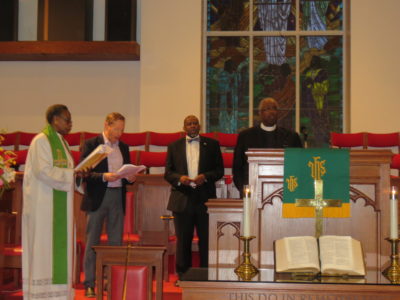
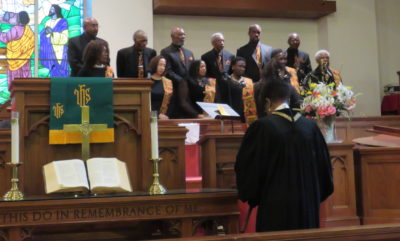
January 28, White Plains, NY— At the Mount Hope A.M.E. Zion Church, nearly 400 persons gathered to ‘face racism together, bear witness, and build hope.’ Leaders from ten sponsoring organizations,* spoke decisively and powerfully about racism unique to our times, and the impact of racism inside our communities. The multi faith service**—with its moving candle lighting ceremony, sermons, prayers and rousing choral music–was a call for unity and also for continued involvement with attendees also invited to ‘break bread together’ during the Church’s potluck ‘Beloved Community Dinner’ and learn more at social action tables. Those gathered, noted Clifford Wolf of the AJC Westchester/Fairfield, “are here tonight to be heard as a community of communities.” He spoke of the AJC’s history as rooted in civil rights activism citing its leadership joining Martin Luther King, Jr., in the historic 1965 march from Selma. “It is in our DNA,” he said, “We will never be silent.”
Current events–ranging from the fatal shooting of Trayvon Martin to the hate-filled and deadly White Supremacist march in Charlottesville–were recalled.

But there also the everyday insults endured right here in the county, related Wolf. He shared  stories gathered by the AJC from persons experiencing discrimination in housing or even during routine activities. After the mother of one young girl shopping for a dress together noted the dress was expensive, the storekeeper stated: “There is a Salvation Army store across the street.”
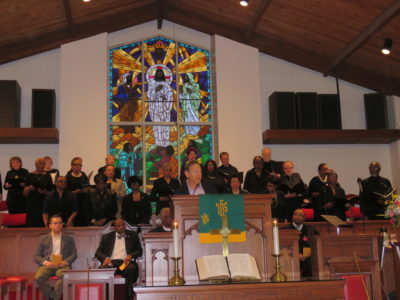
One sermon took on Trump—and hinted at his enablers. Dr. Stephen Pogue of the A.M.E. Zion Church, began his talk “Facing the Giant,” looking around the packed auditorium and said, “We need ABC, CBS and NBC to be here,” Then, adding (to some laughter) “I don’t know about Fox News.”  He then likened the times today and its challenges to as when David faced Goliath. 

“We have to be bold enough to stand together to face the giant… the giant is real…” he said, but… “Our God is bigger,” he added.
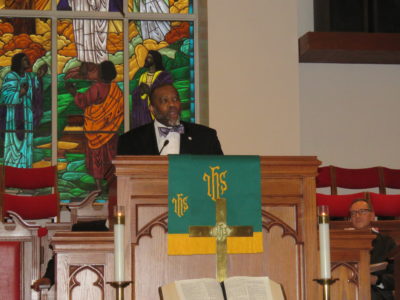
He spoke too of a future with an end to the racial divide.

“One day in White Plains, little black boys and little black girls will join hands together with little white boys and little white girls,” he preached, “and we will all be able to sing together, ‘Free at last. Free at last!’”

Rev. Kymberly McNair, Coordinator of Community Education and Engagement at My Sisters Place, described the experience of being a black woman in 2018…the ‘insidious trauma’ felt and ‘micro-agressions’ leveled at you. Comments like “Kym, you are so articulate.“ (“It is never said without a note of surprise,” she noted wryly) Or, “Where are you from? No, I mean where are you FROM, from?” 

“It is all the ways we get ‘othered.’” she said.

“Every day, I stand at the intersection of racism and sexism…being both whitesplaned and mansplaned… Racism doesn’t end where the Dixie line ends either.”

Another highlight of the evening was a reading from “The N Trial,” authored by Philip Hall in Rehabilitation through the Arts,” a Katonah-based program with volunteers who work with those in prison. The passages ‘to a jury’ were performed by Clarence Maclin citing in the argument:  ‘malicious and reckless speech’… “Words are like strikes and stains,” he said. “…”They have power over us mere mortals… “People have lost their lives because of words.”

One of the final sermons was by Rabbi Jeffrey Sirkman of Larchmont. He quoted the Rev Dr. MLK Jr. who sat in his Birmingham jail cell in April, 1963, reflecting:

“Maybe I expected too much. I guess I should have realized that few members of a race that has oppressed another race can understand the deep groans of those that have been oppressed…” [and, concluding, his ultimate disappointment] “Shallow understanding from people of good will is more frustrating than absolute misunderstanding from people of ill will.” The narrow-mindedness of the hate-filled is unfortunate, but all-too-expected.  The inability of a white, moderate majority to perceive the privilege of a whiteness engrained, and the pain of a societal prejudice that persists, is unacceptable…”

Rabbi Sirkman added many of his own words, too. “Our world today at best seems like a dream deferred,” he stated. “When one of us is in those chains of bondage, all of us are enslaved.”

One person seated in the congregation was State Assemblyman David Buchwald. “This event clearly shows that our community can come together to stand for unity, not division, for justice, not hate,” said Buchwald, later. “We must remain vigilant against those voices that spread hatred and seek to divide us.”

Grace Bennett is publisher and editor in chief of the Inside Press, and the 2017 recipient of the Holocaust and Human Rights Education Center’s Bernard Rosenshein ‘Courage to Care’ award.

*Sponsoring organizations:

  • AJC Westchester/Fairfield
  • The Church of Jesus Christ of Latter Day Saints, Westchester Stake
  • Hudson River Presbytery, Presbyterian Church (USA)
  • Metropolitan New York Synod of the Evangelical Lutheran Church in America
  • New York Annual Conference of the A.M.E Zion Church
  • New York Annual Conference of the United Methodist Church
  • Roman Catholic Archdiocese of New York
  • Westchester Jewish Council
  • Westchester Board of Rabbis
  • Yonkers Islamic Center

A 40-strong list of sponsoring Houses of Worship and Institutions can also be found at https://global.ajc.org/westfair/racism 

** The service began with an invocation by the Rev. Gregory Robeson Smith, of Mount Hope, an Islamic Reading by Hussein and Lamya Etzoghby.  Additional program prayers and speakers to individuals noted in story:  Rabbi Shira Milgrom, Congregation Kol Almi in White Plains; President Bradley Jeffries of the Church of Jesus Christ of Latter Day Saints, Westchester Stake; Rabbi Adir Yolkut, Westchester Jewish Center, Mamaroneck; Rev. Dr. James E. Taylor, First Baptist Church, Mamaroneck;  Rev. James O’Hanlon, Dean of Tappan Zee Conference of Evangelical Luteran Church in America; Rabbi Zach Sitkin, Congreatation Beth El, New Rochelle; Rev. Doris K. Dalton, Deacon, NY Annual Conference/United Methodist Church and Executive Director, MLK Institute for Non Violence; and Rev. Wil Tyrell, S.A., Director of the Duchesne Center for Religion and Social Justice, Catholic Chapllain, Manhattanville College. Attending choirs beautifully sang: Let My People Go, He Could Have Let Me Drown,  Draw the Circle Wide, Lift Every Voice and Sing, I’m Gonna Lift My Brother Up, and We Shall Overcome.
Filed Under: Inside Westchester Tagged With: AJC Westchester/Fairfield, Bearing Witness, Building Hope, Mount Hope A.M.E. Zion Church, Multi-Faith, Multi-faith event, Racism, white plains

HBO’s “The Number on Great-Grandpa’s Arm” Airing January 27 Moves Bet Torah Audience

January 24, 2018 by Inside Press

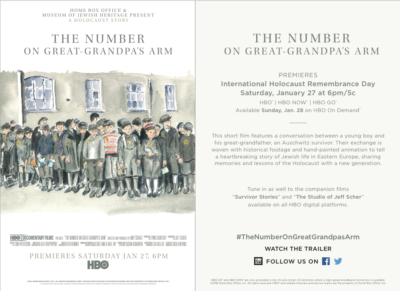
Family Documentary Presented by HBO with the Museum of Jewish Heritage – A Living Memorial to the Holocaust, the short film “The Number on Great-Grandpa’s Arm” debuts this Saturday, January 27, from 6 p.m. to 6:20 p.m (ET/PT).

“A17606. That was his number and he told us back then that your number was your name. That is all he was to them.” Elliott Saiontz

Article and Photos by Grace Bennett

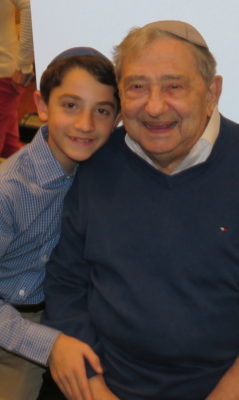
Elliott Saiontz with his great grandfather Jack Feldman

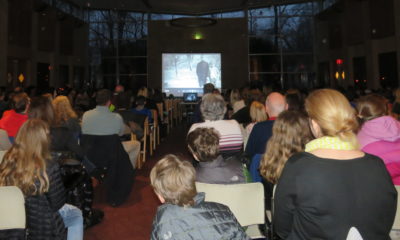
Mount Kisco, January 22–Hundreds of parents and their children packed the Bet Torah Synagogue sanctuary for an early screening of “The Number on Great-Grandpa’s Arm,” a powerful 19-minute HBO family documentary directed and produced by Amy Schatz. Filmed two years ago, it depicts 10-year-old Elliott’s adoring relationship with his great grandfather, the soft spoken and big hearted 90-year-old Jack Feldman. Through the film, Elliott first asks Jack questions about his experiences, and then we hear Jack’s heartbreaking answers.

At the film’s start–and with a backdrop of historical footage and the striking animation of acclaimed artist Jeff Scher throughout–Jack describes happy childhood memories of Poland (in his hometown of Sosnoweicz) predating the war. He tells his great grandson of an eclectic hat collection or of watching soccer games. Jack speaks of a close knit family, a successful family business and summertime vacations.

The documentary quickly segues into Jack describing harrowing experiences surviving Nazi brutality… from the forced wearing of yellow stars, confinement in a ghetto (“We had maybe 15-20 people sleeping in a room.”) to his separation from his family (“They grabbed me and took me away.”), of Auschwitz and of the notorious death march.  (“A lot of people couldn’t make it. Thousands and thousands just died.”)

Bet Torah’s Rabbi Aaron Brusso and Edna Friedberg, a historian with the U.S. Holocaust Memorial Museum, spoke before the film with remarks sensitive to and frequently directed to the children in the room. “History is what happens to real people. It’s not just a flat idea; it’s something that happens to me and to you,” said Friedberg. She challenged the kids to explore their personal connections to the Holocaust as well. “If you have a connection to it, you as kids can be detectives on it too.”

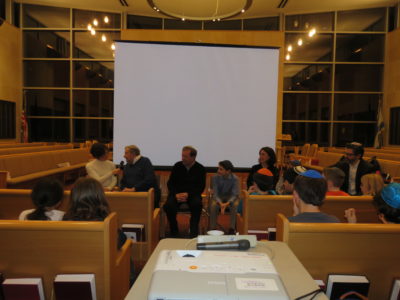
Following the screening, Feldman and Elliott  participated in a panel discussion. Jack was asked how old he is today. Not missing a beat, he quipped: 72.  Laughter filled the sanctuary–the light moment a reprieve from the darkness of what was being discussed. Elliott’s grandfather, Sammy Feldman (92-year-old Jack Feldman’s first son) told attendees: “Between the ages of 12 and 17, hopefully you were enjoying your life… the Holocaust changed all that for the children of Europe. They were bullied and lost all their privileges. They lost all their rights.”

Rabbi Brusso noted fondly, “I wish I had a grandpoppy Jack.” Turning to Elliott, he offered his appreciation for “how you hold his hand and rub his arm.” He compared that kind of tenderness to Nazis “who treated people like objects.”  Elliott’s example of caring and kindness, in contrast, are “how we preserve every human being.”
On the panel, too: Elliott’s brother Jared and his mom Stacey Saiontz (“without whom it is safe to say we would not be having this program today,” noted Freidberg). Saiontz, a member of the group GenerationsForward of the Holocaust and Human Rights Education Center in White Plains, described a serendipitous meeting between herself and Sheila Nevins, a producer at HBO–ultimately leading to the film’s production. Elliott’s younger brother Jared, 10, answered a child’s question about when he learned of the Holocaust. He said his whole life he listened to his Mom interviewing his grandpa and started slowly learning.

Questions to the panel were mostly from children attending. More than one questioner seemed to want to find the good in human souls. Children are after all instructed to seek out ‘the helpers.’  “Was there ever a Nazi soldier undercover who tried to help the Jews?” one young girl asked. Elliott related that his grandfather was helped by a Nazi who knew his father and protected him from selection to the gas chamber. “Individual choices made a huge difference and could save a life,” said Friedberg. But they were also sadly the exception. 

“Why were Jewish people blamed for Germany’s problems?” another asked. Friedberg explained how the Nazi regime employed the dynamics of bullying to encourage the persecution of Jews. “People feel powerful by leaving one person on the outside,” she said. The Nazis were “building on an existing hatred and stereotypes about Jews.” The Nazis also targeted and murdered hundreds of thousands of Gypsies, Jehovah’s Witnesses, gay men, political prisoners and persons with mental and physical disabilities. 

But by far, it was the Jewish population that was decimated. Before the war, Friedberg continued, there were nine million Jewish people living in Europe; six million were murdered. “Two out of three.” She invited attendees to visit the U.S. Holocaust Memorial Museum to learn more.

Grace Bennett is publisher and editor in chief of the Inside Press, and the 2017 recipient of the Holocaust and Human Rights Education Center’s Bernard Rosenshein ‘Courage to Care’ award.

Resources:

www.mjhnyc.org/‎   The Museum of Jewish Heritage

https://www.ushmm.org/  United States Holocaust Memorial Museum

www.hhrecny.org Holocaust and Human Rights Education Center


Release info from HBO:

THE NUMBER ON GREAT-GRANDPA’S ARM was directed and produced by Amy Schatz; executive producer, Sheila Nevins; producer, Lynn Sadofsky; edited by Tom Patterson; animation by Jeff Scher; director of photography, Alex Rappoport; music composed by Keith Kenniff; production executive, Susan Benaroya; supervising producer, Lisa Heller.

It debuts this Saturday, January 27, from 6 p.m. to 6:20 p.m (ET/PT).

The film will also be available on HBO On Demand, HBO NOW, HBO GO and affiliate . THE NUMBER ON GREAT-GRANDPA’S ARM will be included in a signature initiative that is part of a robust education program offered by the Museum of Jewish Heritage – A Living Memorial to the Holocaust. This effort is designed to use the film with a companion special installation and curriculum to connect stories of the Holocaust across generations.Additionally, companion segments featuring young people in conversation with survivors will be made available on HBO digital platforms.

Director-producer Amy Schatz’s notable HBO projects include the recent “Saving My Tomorrow” series, plus “An Apology to Elephants,” the “Classical Baby” series, “A Child’s Garden of Poetry,” “‘Twas the Night,” “Goodnight Moon and Other Sleepytime Tales” and “Through a Child’s Eyes: September 11, 2001.” Her work has won five DGA Awards, seven Emmy® Awards and three Peabody Awards.

Animator Jeff Scher’s work is found in the permanent collections of the Museum of Modern Art, Academy Film Archive, Hirshhorn Museum and the Pompidou Centre.


Filed Under: New Castle News Tagged With: Auschwitz, GenerationForward, HBO Family Documentary, Holocaust and Human Rights Education Center, Holocaust Survivor, International Holocaust Remembrance Day, Jack Feldman, Museum of Jewish Heritage, The Number on Great Grandpa's Arm, U.S. Holocaust Memorial Museum

‘Kiss Today Goodbye” at the Westchester Broadway Theater

January 21, 2018 by Inside Press

A CHORUS LINE
Conceived and originally directed and choreographed by
Michael Bennett
Music by Marvin Hamlisch
Lyrics by Edward Kleban
Book by James Kirkwood Jr. & Nicholas Dante

Directed and Choreographed by Mark Martino
Musical Direction by Bob Bray
January 11– April 1, 2018


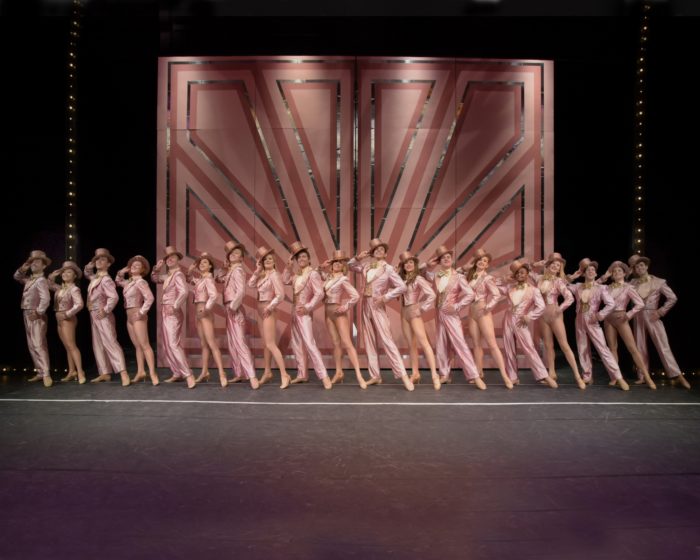
The Chorus Line Cast
Photos by John Vecchiolla

Elmsford, NY– WBT opened it’s 2018 theatre season with the hit Broadway musical A Chorus Line.  This mega-hit captures the very soul of musical theater, and is one of the longest-running Broadway musicals ever. This beloved and iconic musical by James Kirkwood & Nicholas Dante with a brilliant and show-stopping score by Marvin Hamlisch & Lyrics by Edward Kleban, is a celebration of those unsung heroes of the Musical Theatre, the chorus dancers, valiant, over- dedicated, underpaid and highly trained troopers who back up the star and often make them look more talented.  The characters portrayed in A Chorus Line are based upon the real life experiences of Broadway dancers.

Everything is on the line for 17 dancers as they audition for a highly sought-after place in the chorus of a Broadway musical.  Through this exhausting process, their stories and vulnerabilities are laid on the line as they ultimately come together and become one singular sensation! In a brilliant fusion of song, dance, and compellingly authentic drama, the musical features one powerhouse number after another including “What I Did for Love,” “One,” and “I Can Do That.”

Considered groundbreaking when it opened on Broadway in 1975, the musical went on to win nine Tony Awards, including Best Musical and the 1976 Pulitzer Prize for Drama. Today, it remains as touching and powerful as when it debuted and is one of the longest running musicals on Broadway.


Reservations:  Call (914) 592-2222. Please visit: www.BroadwayTheatre.com for more information about the cast and show too. 

This information was made possible via a release from the Westchester Broadway Theater.

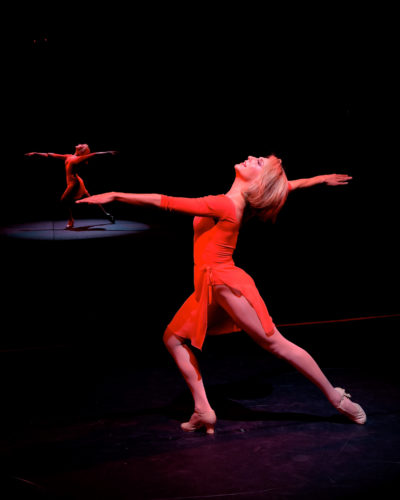
Erica Mansfield (as Cassie) In A Chorus Line

Filed Under: Gotta Have Arts Tagged With: A Chorus Line, Westchester Broadway Theater

Northern Westchester Hospital Wins Gold in Patient Safe Handling Olympics

January 18, 2018 by Inside Press

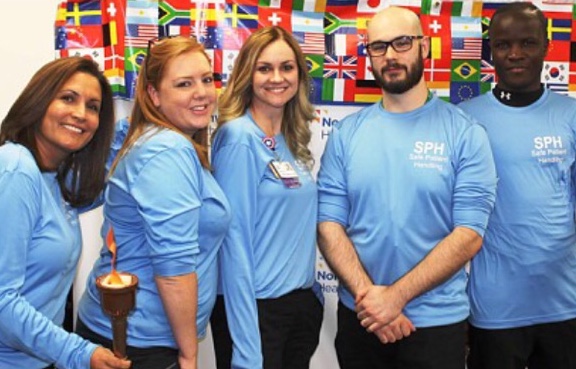
Team members from Northern Westchester Hospital who participated in the Northwell Olympics. From left to right: Lorraine Owens, RN, BSN, Administrative Supervisor, Co-Chair of Safe Patient Handling; Abigail O’Brien PCA-IV Co- Chair of Safe Patient Handling Team; Laura Longbard RN, Mixed Medical/ Oncology; Larry Reo PCA-IV, ED Tech, Co-Chair of Safe Patient Handling team; Thomas Addai PCA- IV, Mixed Medical/Oncology.

Northern Westchester Hospital brought home the gold recently as the Northwell Health Center for Learning and Innovation and Patient Safety Institute (CLI) was turned into an Olympics of sorts, pitting health system hospitals against one another in their quest for a medal in safe patient handling.

Teams from Staten Island University Hospital and Long Island Jewish Forest Hills brought home silver and bronze medals respectively.

The event in Lake Success, NY, was designed to be a fun and creative way to demonstrate safe and proper patient handling techniques that benefit both patients and healthcare workers.

“People don’t realize how dangerous it is to work in a hospital because we’re always moving patients,” said Paul M. Power, director of workforce safety for Northwell. According to statistics, one in three injuries to healthcare workers are caused by moving patients, and the majority of those injuries involve the back.

In fact, nursing staff sustains approximately 73 percent of musculoskeletal disorders (injuries that affect the human body’s movement and can involve muscles, tendons, ligaments, nerves and discs)..

“The average healthcare worker manually lifts 1.8 tons per eight-hour shift,” explained Power. “That’s equal to lifting one sedan per shift.”

To that end, hospital teams of five members competed in four events using motorized lifts and others devices to safely transition Northwell employees acting as patients in the following scenarios: laterally from a gurney to a bed; from a chair to a bed; from a bed to a chair; and off of the floor.

The teams were comprised of nurses, nurses’ assistants, occupational and physical therapists.

As the teams competed, they were judged by a nurse and occupational therapist, as well as the patient actor who scored them on their transport and interpersonal skills.

In 2014, New York State passed the Safe Patient Handling Law that requires healthcare facilities to establish safe patient handling programs. The law recognizes that safe patient handling programs can reduce the risk of injury, protect patient dignity, improve quality of care, increase patient satisfaction and enhance caregiver morale.

For Susana Dealmida, RN, BSN, MHA, assistant director of inpatient services at Northern Westchester Hospital and a nurse there, the Olympics is the perfect way to showcase the importance of proper body mechanics and using technology for safety sake.

“Northern Westchester was able to take home the gold because our front-line staff is used to being engaged as unit champions,” said Ms. Dealmida. “This has created a culture that promotes peer-to-peer accountability to practice safety protocols. A simple action, such as relocating the lift equipment from equipment rooms onto units, has improved accessibility and increased usage of the equipment.

Filed Under: New Castle Releases Tagged With: #Patient safety, Northern Westchester Hospital, NWH

“Why Did They Have to Die?”

January 15, 2018 by Inside Press

Peter Somogyi, a survivor of Auschwitz-Birkenau and victim of Nazi experiments on twins, still grieves as he bears witness to the unimaginable.

Story and Photos by Grace Bennett

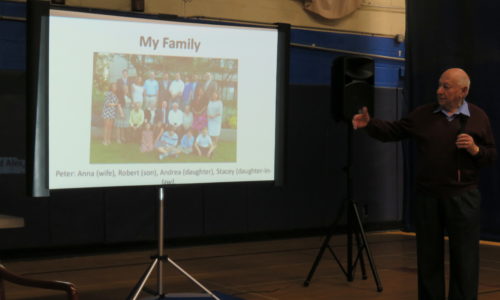
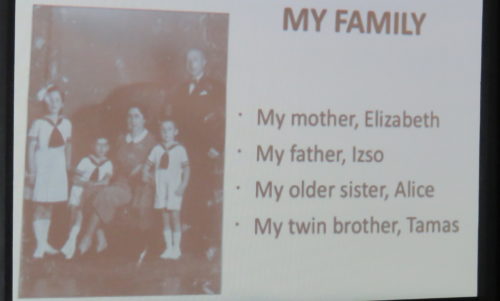
Mount Kisco–Peter Somogyi , a survivor of Auschwitz-Birkenau, was 11-years-old when he and his twin brother Tamas were ‘selected’ and imprisoned as concentration camp victims and subject to the horrific ‘human experiments’ performed by the notorious Josef Mengele (“the Angel of Death”) and others. Somogyi, now 85 years old, said he would not talk about his imprisonment or experiences for decades.
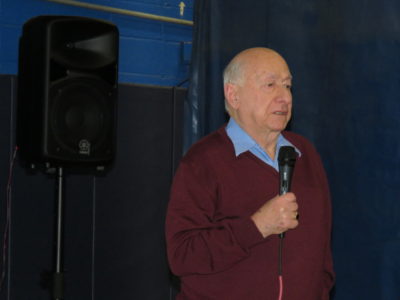
But at the Boys and Girls Club of Northern Westchester BGCNW on January 7, Somogyi, a member of the Speaker’s Bureau for the Holocaust and Human Rights Education Center for the last four years, relayed his memories to attendees.

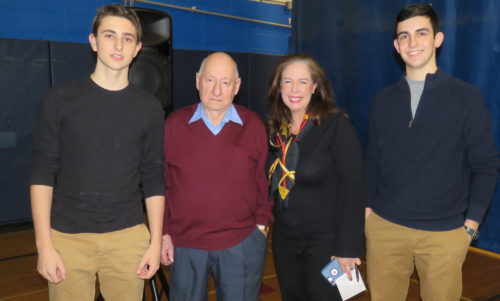
Jason Fine, Peter Somogyi, Alyzza Ozer and Aaron Notis

Opening the program, Alyzza Ozer, BGCNW’s executive director, said that Somogyi’s talk was the Club’s first in a Civic Advocacy speaker series within ‘Youth for Unity,’ a program launched at BGCNW, which serves 500-800 kids a day, ages 3-18 (nationwide, some 4.2 to 4.3 million). The Club’s mission, she said, is to inspire and enable all youth to be best they can be and advocate on behalf of the community.

Introducing Somogyi were Aaron Notis and Jason Fine, Horace Greeley High School juniors who are volunteering with the HHREC to bring lectures about the Holocaust and genocide to wider audiences. They said they got involved due to a scourge of modern day anti-Semitism and bigotry. They noted that 900 hate incidents were reported across the U.S. in the 10 days following the 2016 election. Those attacks included vandals drawing swastikas on a synagogue, schools, cars and driveways. They pointed out the now infamous march of white supremacists in Charlottesville last October and their anti-Semitic chant. They also expressed concern over a growing, so called BDS movement that veers into anti-Semitism.

Finally, they cited reasons why people of every race and religion need to be aware of exactly what happened during the Holocaust. “In Germany in the 1930’s, the Nuremberg laws institutionalized the racial theories commonly held by Nazis. The laws excluded German Jews from Reich citizenship and prohibited them from marrying or getting involved with persons of “German or related blood.” Jews were stripped of their German citizenship. They could not own businesses or do business with non-Jews. Jewish children could no longer attend their schools. Jewish doctors could no longer treat non-Jews, and Jews could no longer go to non-Jewish doctors. And this was just the beginning of the prejudices and horrors that Jews encountered.”

 Somogyi’s Journey

 “Somogyi’s Journey” began on March 14, 1944, when the Nazis invaded Hungary. Within two weeks, he recalled the required wearing of yellow stars and people being beaten up on the streets. The Jews were pushed into a ghetto with families living in single rooms confused and beset with fear. Shortly after, roundups began for deportation. “We were told to take only what we can from the ghetto. They gave us some bread but no water whatsoever. It was chaos. Children were crying. All of us…we didn’t know what was happening. On arrival at Auschwitz, exhausted and terrified, anyone ‘able bodied’ was ordered to one side, he explained, and older people and children to the other. “Then along came Mengele asking for twins… they grabbed us. We never had a chance to say goodbye.”

He remembered that his sister Alice was “forced to undress naked” and led with others into a room that was “supposed to be a shower,” he said of the infamous gas chamber, the largest room of the crematorium at Auschwitz, in which hundreds of thousands of Jewish men, women, children and political prisoners perished. “No one knew that in ten minutes they would all be dead.,” said Somogyi. Some were lucky and died instantly.” He explained how “those who had climbed to the top of bodies in a kind of pyramid, took longer. Within ten minutes, they all died.”

While Alice and his mother Elizabeth and hundreds of others were murdered following that single ‘selection,’ those chosen to ‘work’ were forcibly ‘tattooed’ and told their new identities would be a number. Somoygi showed and recited his own: A74454455. Inside the barracks, the prisoners were assigned six to “a bed” made of tiers of wood planks. There, that night, he learned of his sister’s fate and of the genocide taking place. “We smelled the stench of burning bodies, the flames going up 10-15 feet out of the chimney. The persons who worked at the crematoriums were replaced every two to three months, and gassed themselves, so there would be no eyewitnesses.”

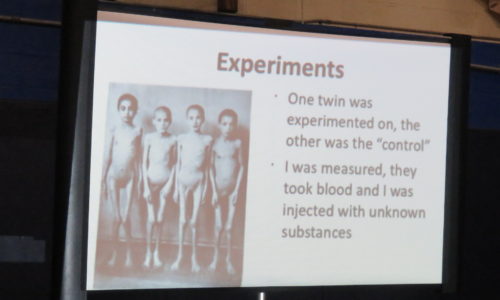
The so called ‘experiments’ began. Mengele was in fact one of dozens of ‘physicians’ participating in this torture. “They were taking blood all the time and measuring everything.” (A slide indicated the victims were injected with unknown substances; a second slide pointed to an experiment which intended to determine how long someone can survive without eating.) “I remember one dwarf (another segment of the population the Nazis targeted for experimentation) “got really, really sick. One morning I had a cold body next to me. Every day, there were six to ten people who died and they lined the bodies up like cinder sticks…”

Somogyi said that the twins considered their horrible situation ironically life saving (“although I hate to call it that,” he said) in that they were of some “use” and despite that the twins and others chosen to be experimented on lived in abject fear “wondering when Mengele would decide he didn’t need us anymore.” They knew that “any moment, any time, we could go to the gas chamber like the others.’  In addition, many of those subject to the experimentation died as a consequence of them; others were murdered in order to facilitate post-mortem examination, according to a document from the United States Holocaust Memorial Museum.

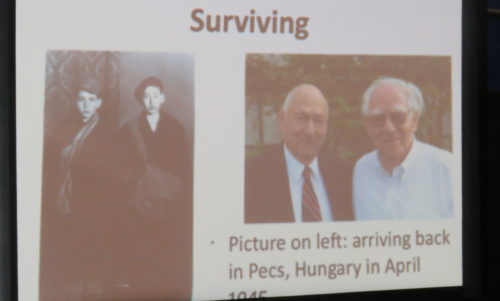
By January, 1945, the Nazis had already lost the war on many fronts. “On January 27, we saw our first Russian soldier,” Somogyi said. “Imagine an 11-year-old thinking, when is my time to die? And then, finally, I am free. You don’t know what kind of feeling that is.”  His brother Tamas survived as well. In time, he discovered that his father Izso had survived Dachau.

He described a journey back first to Budapest (he and Tamas were reunited with their father with a neighbor’s aid in Hungrary) and then to Israel (where he became an officer in the army), from where he left to England, and finally, to the United States.

Somogyi expressed his grief over lost family and friends, stating:  “Why did they have to die? We were persecuted only because we were Jewish.”

Many of the survivors, he explained, could not talk to anyone about what happened for a very long time. As a young man, “a blind date asked me about my number. I asked her never to ask me again.” 

Like many survivors, Somogyi found the inner strength to reinvent his life. He has been married for 56 years to Anna with two children and grandchildren. On one post-war trip in 1990 back to his hometown Pecs in Hungary, he said, “It felt so strange. And I was happy to get away.” “Today,” he offered, “there are people who say this never happened. In 10-15 years, there will be no survivors. I’m here to tell the world that it DID happen, and it’s very lucky I survived.”

At the end of his talk, Shantae Artis, BGCNW’s Community Volunteer Coordinator, commended Somogyi for his openness. “We need to bear witness,” she told the crowd who came out in single digit temperatures to hear him. “Empathy and compassion are tools we need to have to prevent future tragedies so that we never ever have to bear witness again like this.” 


Bearing witness continues when the BGCNW on March 4th at 7 p.m. welcomes guest speaker Rita Kabali Wagener, a survivor under the regime of Idi Amin in Uganda. Do mark your calendar.

Grace Bennett is publisher and editor in chief of the Inside Press, and the 2017 recipient of the Holocaust and Human Rights Education Center’s Bernard Rosenshein ‘Courage to Care’ award. For more information and membership info about the Boys and Girls Club of Northern Westchester, please visit bgcnw.com, and for same at the HHREC, please visit hhrecny.org.

Filed Under: New Castle News Tagged With: Auschwitz, Auschwitz-Birkenau, Boys and Girls Club of Northern Westchester, Civic Advocacy, HHREC Speaker's Bureau, Holocaust and Human Rights Education Center, Holocaust education, Josef Mengele, Nazi Twin Experiments, Youth for Unity

  • « Go to Previous Page
  • Page 1
  • Interim pages omitted …
  • Page 60
  • Page 61
  • Page 62
  • Page 63
  • Page 64
  • Interim pages omitted …
  • Page 175
  • Go to Next Page »

Primary Sidebar

Please Visit

White Plains Hospital
William Raveis – Armonk
William Raveis – Chappaqua
Northwell Hospital
Houlihan Lawrence – Chappaqua
Houlihan Lawrence – Armonk
Houlihan Lawrence – Briarcliff
NYOMIS – Dr. Andrew Horowitz
Westchester Table Tennis Center
Spavia
Compass: Miller Goldenberg Harris Team
Lipari & Mangiameli Dentistry
Raveis: Lisa Koh and Allison Coviello
Bristal Assisted Living
Maid Brigade
Kevin Roberts Painting & Design
Zwilling J. A. Henckels
Meagher & Meagher Attorneys at Law
Compass: Aurora Banaszek
Dr. Briones Medical Weight Loss Center
Roamfurther Athletics
Fleetwood Pastry Shop
Play Nice Together
World Cup Gymnastics
Home Grown Gardens
Houlihan: Tara Siegel
Joseph Richard Florals
Pinsky Studio

Follow our Social Media

The Inside Press

Our Latest Issues

For a full reading of our current edition, or to obtain a copy or subscription, please contact us.

Inside Pleasantville and Briarcliff Manor Inside Chappaqua and Millwood Inside Armonk

Join Our Mailing List


Search Inside Press

Links

  • Advertise
  • Contact Us
  • Digital Subscription
  • Print Subscription

Publisher’s Note Regarding Our Valued Sponsors

Inside Press is not responsible for and does not necessarily endorse or not endorse any advertisers, products or resources referenced in either sponsor-driven stories or in advertisements appearing in this publication. The Inside Press shall not be liable to any party as a result of any information, services or resources made available through this publication.The Inside Press is published in good faith and cannot be held responsible for any inaccuracies in advertising or sponsor driven stories that appear in this publication. The views of advertisers and contributors are not necessarily those of the publisher’s.

Opinions and information presented in all Inside Press articles, such as in the arena of health and medicine, strictly reflect the experiences, expertise and/or views of those interviewed, and are not necessarily recommended or endorsed by the Inside Press. Please consult your own doctor for diagnosis and/or treatment.

Footer

Support The Inside Press

Advertising

Print Subscription

Digital Subscription

Categories

Archives

Subscribe

Did you know you can subscribe anytime to our print editions?

Voluntary subscriptions are most welcome, if you've moved outside the area, or a subscription is a great present idea for an elderly parent, for a neighbor who is moving or for your graduating high school student or any college student who may enjoy keeping up with hometown stories.

Subscribe Today

Copyright © 2026 The Inside Press, Inc. · Log in