New Law Follows One Month After State Comptroller Finds Significant Non-Compliance with Leandra’s Law
As New Yorkers look forward to celebrating the upcoming holiday season in a safe and responsible fashion, Governor Andrew Cuomo has signed into law legislation to reduce drunk driving among repeat violators of state law. The bill’s sponsor, Assemblyman David Buchwald (D-Westchester) introduced the legislation (bill number A.6222) earlier this year to close a loophole that allows repeat DWI offenders under probation to potentially operate a motor vehicle while intoxicated, despite the generally mandated use of an ignition interlock device (IID) under what is known as Leandra’s Law.
An IID is an apparatus that is similar to a breathalyzer and is often attached to the ignition system of a motor vehicle as a condition of probation stemming from traffic-related infractions. The vehicle can only be started if the driver blows into the ignition interlock and his or her blood alcohol content (BAC) is below the legal limit of .08 BAC. Assemblyman Buchwald’s legislation, sponsored by Senator Michael Nozzolio (R-Seneca Falls) in the State Senate, strengthens part of Leandra’s Law, which was signed in 2009 and named after 11-year-old Leandra Rosado, who was killed in a motor vehicle operated by a drunk driver.
Last month, State Comptroller Thomas DiNapoli published an audit of drunk drivers who were ordered to install IIDs in New York City between 2012 and 2014. The audit found that of over 53,000 IIDs ordered by the courts, only 13,810 drivers, or just 25 percent, were compliant.1 For those who violated their probation or conditional discharge, the requirement to use an IID could not be extended to make up for the missed time on probation during which the violation occurred. The new law grants the courts the ability to extend the sentence of mandated use of an ignition interlock device if a DWI offender violates his or her probation or conditional discharge. Buchwald’s bill, which was recommended by New York’s Office of Court Administration, provides judges the ability to extend the period in which the use of an IID is mandated in the vehicle of a DWI offender who violates his or her probation.
“Over the years we’ve seen senseless accidents and tragedies as a result of drunk driving in every corner of the state,” New York State Comptroller Thomas P. DiNapoli said. “Ignition interlocks, coupled with aggressive monitoring of DWI offenders, are an effective way to prevent intoxicated drivers from getting behind the wheel and endangering the welfare of pedestrians and motorists. I commend Assemblyman Buchwald, as well as Senator Nozzolio, for their efforts to strengthen Leandra’s Law and thank Gov. Cuomo for signing this much needed measure into law.”
“Leandra Rosado’s story reminds us that life is precious, and in her memory New York State has taken steps to reduce the tragic loss of life due to drunk driving,” said Assemblyman Buchwald. “Ignition interlock devices save lives, and by granting our courts the ability to extend the period of mandated time these devices are required for repeat offenders, we will increase the chance of preventing further tragedies like Leandra’s from happening in the future. I am thankful that Governor Cuomo signed into law this initiative to reduce drunken driving and keep repeat offenders off the roadways. I wish all New Yorkers a happy and safe holiday season.”
“Mothers Against Drunk Driving thanks Assemblyman David Buchwald for working to pass A.6222, and Governor Andrew Cuomo for signing this bill into law, that will increase the use of interlocks by individuals that have been found guilty of driving drunk in New York State,” states Rich Mallow, State Executive Director, Mothers Against Drunk Driving.
According to the Centers for Disease Control, 20 percent of all children who are killed in traffic-related accidents perish as the direct result of a drunk driver.2 In addition, over 22,000 DWI offenders in New York State are repeat violators, according to the National Highway Traffic Safety Administration.3 The new law helps prevent this unnecessary loss of life by requiring that probationary terms remain in effect after a declaration of delinquency, and allowing the court the ability to extend the end date of the oversight and utilization of the IID.
Assemblyman Buchwald’s legislation passed unanimously in both the State Assembly and the State Senate.
______________________________________________________________________________
1 New York State Office of the State Comptroller; “Oversight of Persons Convicted of Driving While Intoxicated” (http://www.osc.state.ny.us/audits/allaudits/093016/14n4.pdf) October, 2015.
2Centers for Disease Control and Prevention; “Injury Prevention and Control: Motor Vehicle Safety: Impaired Driving” (http://www.cdc.gov/MotorVehicleSafety/Impaired_Driving/impaired-drv_factsheet.html) January, 2015.
3National Highway Traffic Safety Administration; “DWI Recidivism in the United States: An Examination of State-Level Driver Data and the Effect of Look-Back Periods on Recidivism Prevalence.” (www-nrd.nhtsa.dot.gov/CATS/index.aspx) Nathan Warren-Kigenyi and Heidi Coleman. March 2014.
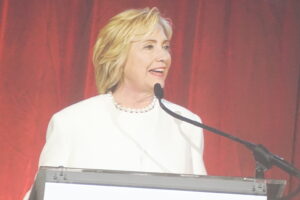 Could the pendulum finally be swinging in favor of passing major new gun violence prevention laws? Words of optimism and encouragement by Brady Center honorees Sec. Clinton and Sen. Chuck Schumer, and from Governor Andrew Cuomo, along with Brady campaign president Dan Gross, suggested that major change again could indeed finally be in the cards.
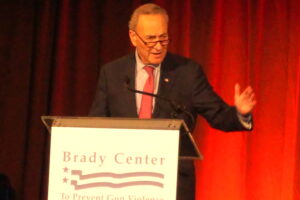 #Enough was the hashtag for an evening defined by both elegance–with various celebrity guests lending star support — and everyone treated to recording star Ingrid Michaelson’s poignant hit, Take Me as I Am–and the speakers’ defiant eloquence.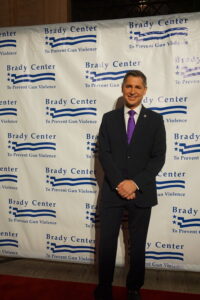
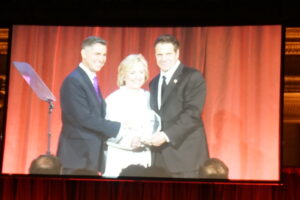 “We don’t care if you are red, blue or purple. If you don’t do right by the American people, we will hold you accountable,” offered Dan Gross, president of the Brady Campaign to End Gun Violence before introducing Governor Andrew Cuomo to present the inaugural Mario M. Cuomo Visionary Award to Sec. Clinton. Senator Schumer received the annual Jim and Sarah Brady Award.
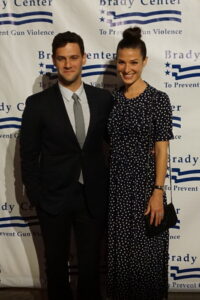
 The Brady Center “Bear Awards” honor the efforts of individuals who have distinguished themselves in their dedication to Sarah and Jim’s vision of a nation without gun violence and who embody their remarkable spirit, strength and perseverance, to the extent that anyone else can!
 “A patient might need to move back and forth between the inpatient and residential programs. That Silver Hill has both makes the difficult healing process easier for the patient and their family,” she says. Patients will also have the benefit of the Silver Hill Recovery and Support Follow-up Service “Thirty million people suffer from eating disorders in the U.S., yet only 35% seek care at facilities that specialize in treating them. With the highly skilled staff we have assembled and our outstanding facilities, we have an exceptional program that will help patients lead healthy, productive lives.”