• Skip to primary navigation
  • Skip to main content
  • Skip to primary sidebar
  • Skip to footer

The Inside Press

Magazines serving the communities of Northern Westchester

  • Home
  • Cover Stories
  • Features
    • Portraits and Profiles
  • Advertorials
    • Lifestyles with our Sponsors
    • Sponsor News!
  • Wellness
  • Happenings
  • Advertise
    • Advertise in One or All of our Magazines–And/Or Subscribe
    • Advertising Payment Form
  • Contact Us
  • Search

Benjamin Cheever

About Benjamin Cheever

Ben Cheever edited The Letters of John Cheever and has published four novels (The Plagiarist, The Partisan, Famous After Death and The Good Nanny). He wrote two nonfiction books – Selling Ben Cheever and Strides. He has freelanced for The New Yorker and The New York Times and lives in Pleasantville with his Labrador/Golden mix, Fifi.

Still Running after all those Years

February 27, 2025 by Benjamin Cheever

Jen Cheever, Ben Cheever, and John Cheever running the Pocantico Half Marathon.

This was 1980 if you can believe that time goes back that far. No email. Manhattan was the center of the world, and this temperate zone still had an annual event called winter. The gusts that came off the Hudson were so nasty that you could buy a coat called the Riverside Drive.

I had just spent a heavenly night not sleeping in bed with the woman who – against terrible odds – would become the love of my life. Snow was whipping outside her casement window. I woke first and by the time she had reached consciousness, I was tying my New Balance shoes.

Propped prettily against the headboard she was holding a quilt across her front in that endearing way some women will do, even though you’ve touched what’s commonly concealed.

“Aren’t you forgetting something?” she asked. “Was it okay? Didn’t you like what we did? Come back to bed.”

“I liked it very much,” I said. “Much much better than okay. But here’s the deal; I loved what we did.”

“But I can always run.”

The marriage lasted 40 years. We have two splendid sons older now than I was on that morning. All our parents died. I gave the eulogy for her beloved father.

Strides (Rodale 2007) was my last book. I rewrote the ending so that a history of running was also a love letter.

Ben Cheever and his son, Andrew, at the Bronx Zoo 5K

I guess she had as much trouble remembering 1980 as you do, because we are now divorced.

I may be taller at 76 than I was at 32, although it could just be the Hokas, which are the equivalent of two-inch heels.

I go out with the Rivertown Runners. A Todd Ruppel brainchild, we start at 8 a.m. on Saturday and Sunday from the parking lot at the Sleepy Hollow High School. I once wrote an article about that parking lot for Runner’s World. Maybe I’m having a good day, or maybe my younger companions are slowing up so we can talk, but often one of them will complain about a colleague who refuses to retire. “Even though she’s seventy.”

“Seventy-six,” is what I say. “Seventy-six and passing on the right.”

Running, we all know, is good for mood. It’s good for the heart and for the brain. But yes, I’ve gotten slower. I was delighted to win my age category in this Halloween’s Sleepy Hollow 10k running 9.16-minute miles. But then I’m the same guy who ran 7:10’s in Iraq and came in first over fifty.

I came in 47th out of 760.

It’s crucial here to make one point: Unlike our beloved nation, running is a meritocracy. What you want – what you need – is to leave it all on the road. The word “personal” is more important than the word “best.” If you’re eighty or you ate too much and you run 15-minute miles, then 15-minute miles are still your Personal Best.

Because he was gorgeous and because he died young, the Oregon’s Steve Prefontaine is the Christ figure of American running. Prefontaine said that he wasn’t a fast runner, but a man who could tolerate more pain on the track than any other man alive.

You may not be built for speed, but all of us are built for pain. The trick is in knowing that Pain is a message sent out long in advance. You run through pain. Be careful. Stretch and take that week off. Do remember that your body is a liar.

I don’t want to live forever. Amby Burfoot who won the Boston Marathon in 1968 is still running. If Prefontaine was Christ, then Amby Burfoot is our slender Buddha. He coined a phrase that bitten runners oft repeat. “I don’t run to add years to my life. I run to add life to my years.”

Time to mention running’s ugly sister. Cross training can be fun, but often cross training is running’s ugly sister.

Swimming laps is great for my running. Swimming laps is hell for me.

I gasp and splash. I fight the water until what seems like an hour has passed. Hanging on the edge of the pool I look at my Garmin. Time spent swimming: Three minutes and 16 seconds.

The Elliptical, the ski and rowing machines are easier to take.

Bicycling is another way to cross train. Bicycling doesn’t just seem deadly, though. Bicycling is deadly.

I’ve swum (ugh). I’ve ridden a bicycle (Eek!). I’ve struggled with machines. My friend John Nonna (also 76) has a similar basement. On weekends we go out together for a run.

A dozen doctors told me not to run. I have been diagnosed with a bad back and – much more frightening – a bad heart.

But still I run.

My son, John, and Jen, his precious wife, ran the Pocantico half marathon with me last (this) year.

Forty-five years later and reeling from a broken heart there’s just one truth of which I’m certain. I was right back then. I was right to go out running before climbing back into that lovely bed.

Filed Under: Cover Stories Tagged With: Ben Cheever, fitness after 60, health benefits to running, Physical Fitness, running, stretching after running

Go to the Woods

August 16, 2024 by Benjamin Cheever

PHOTOS BY JON CUNNINGHAM

Henry David Thoreau went to the woods because he “wished to live deliberately, to front only the essential facts of life…”

Most of us came to Westchester for the schools. Sometimes the longing for a yard and a dog to despoil it helped send us up the Hudson, but it’s easy to forget how precious and essential it is for children – and their parents – to come into frequent contact with what now passes for the wild.

Ever notice how stepping outside will raise your mood? Stay outside and your blood pressure will begin to drop. You will also lower your risk of diabetes, heart disease and cancer.

When we fell trees or pave meadows, we are thinking of utility, convenience, profit. We forget that when we diminish nature, we are diminishing ourselves as well. We didn’t come down from Mars to ride the planet like a wild bronco, break it to our will. This planet is our home, the out of doors was our nursery and school.

Separating humans from nature is like separating Siamese twins. Sharp knives will be required and one of the patients often dies.

Next time you step outside, look closely and you will be shocked by the beauty you see there, but also ancient pleasures and even older fears. Children understand their place in nature without even making up their minds to do so. When he was a toddler, my son Andrew used to go behind the pool house and dig in the dead leaves until he found a gigantic worm. He’d spread his wriggling treasure – with a little clump of leaves and dirt – on the white fabric of his mother’s lounge chair. She didn’t mind. I didn’t understand.

I must have been bored, because I picked up one of the worms at just the right moment, and I saw the creature’s face. Commonly hidden in a closed tube – that visage – when you glance at it – is both ancient and familiar. It might – I guessed – resemble the faces of reptiles that once hunted mammals.

Andrew cherishes the beauty of the great out of doors, but he also likes the power. Godzilla was his first love. Godzilla – in case you’ve forgotten – is a gigantic monster brought to life by the bombs dropped on Hiroshima and Nagasaki. Nor does the big guy pass out soup and bandages. He stomps Tokyo and he roars.

After Godzilla, Andrew fell in love with great white sharks. He got posted to South Africa, so he could study great white sharks up close. He works now with dolphins, but you wouldn’t want to tempt him with a great white, or a killer whale either for that matter.

He doesn’t want to kill these creatures, or even catch them. He only wants to be around them. I never asked him, but I think I know why. He wants to be close to nature, cheek by jowl. If possible, he’d like to work with an animal that once had Homo sapiens for breakfast.

The secondary result of this passion is that – like his father – like his entire family, Andrew would rather be outside.

Archipelago Films (featured recently in the Inside Press) is at work on a movie showing all the proven benefits of contact with nature.

Like Andrew my love of being out under the sky is more instinctive than intellectual. I run a lot. I’ve run in Africa, Bulgaria and Rome, but most of where I run is on the trails of The Rockefeller State Park Preserve.

Here’s the part where I may lose you: I like nature as much as I like art.

I used to take the train to Manhattan to see Marc Chagall’s Cow, which once looked down the stairs at me at the Museum of Modern Art. At night the Union Church in Pocantico Hills will sometimes light up Marc Chagall’s stained-glass window, a piece he titled The Good Samaritan. This is a spectacle to behold.

And yet despite the tens of thousands of dollars my parents spent on education, I have yet to see a work of art that I thought could match the majesty of a single maple leaf in autumn.

This is not a decision I made, it is a position that grew in me and long before I even knew how to spell the word aesthetic.

The children and dogs of my generation were shooed out the screen door in the morning and not expected home again except for meals.

We formed cliques, built forts, pelted one another with snowballs. I don’t recall for sure if I ever ate an earth worm, but it was done, though usually on a bet for baseball cards.

I’ve been a church-going Christian and an ardent Buddhist, but really – and at my heart of hearts – I’m a pantheist. I worship nature, even though I know she bites.

The dogs I have loved are descended from the wolves, who once made nightfall terrible, pulled babies from their cradles, picked off stragglers in a march.

Two guardian dogs, let loose by accident, attacked a walker not that long ago and killed her poodle. I like poodles, and I like walkers too, but I like the guardian dogs as well.

They’re bigger and tougher than is my own dog, Fifi, but still the same species. Missing nature, all I need to do is take the time to look Fifi in the face. I can see myself reflected in her eyes. She’s a dog and dogs were wolves, and wolves were with us before we were became what we now consider human.


We’re all afraid now, and I don’t know why exactly, but it’s true. Instead of going outside, we stay indoors and look at screens.

Parents are afraid to let their kids out of the house. I understand. I’m frightened too, but this is something I’ve got to get over, don’t you think?

Fear is nothing new, though we have more of it these days. We have more fear and less danger, which seems odd, but then the truth is often odd.

My father wrote about fear on the last page of his first novel, The Wapshot Chronicle. “Fear tastes like a rusty knife,” he wrote. “Do not let her into your home. Courage tastes of blood.”

PHOTO BY JON CUNNINGHAM

Filed Under: Cover Stories Tagged With: Back to Nature, Benjamin Cheever, Henry David Thoreau, John Cheever, Kids and Nature, outside, Rockefeller State Park Preserve

The Call of the Wild

April 17, 2024 by Benjamin Cheever

Inside the World Trotting, Courageous Adventures of the Award-Winning Archipelago Films Documentary Team: Susan Todd and Andrew Young

PHOTO BY DONNA MUELLER

Not overlooking the Hudson, or even Fitzgerald’s “great wet barnyard,” a landlocked, Pleasantville is easy to ignore. The Readers’ Digest came but went away and then went bankrupt.

The streets are crammed with Babbits, we assume, sheltering in what my father called “happily-ever-after architecture.”

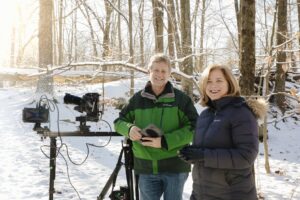
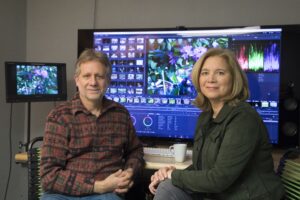
Courage is not the word that comes to mind, though Pleasantville is home to Andrew Young. He’s an Emmy Award-winning, Academy Award-nominated Director, Cinematographer, Writer, and Producer, who with Susan Todd founded Archipelago Films, Inc. Their 2018 documentary Backyard Wilderness won every award it could. What’s shocking though is the courage required to make a documentary.

Let’s start with Andrew on one of his first outings.
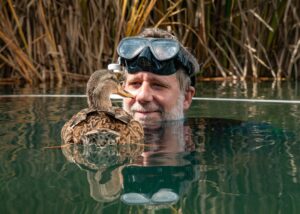
The temperature was 110 degrees, so sweat was pouring inside the hazmat suit. Goggles fogged and breathing through a respirator, “I felt that I was walking into the belly of the beast,” he recalls. “Literally walking into the heart of the earth. You looked at what you thought was the wall, but it wasn’t the wall; it was solid bats…. You wear boots that go up to your shin. If you do get stuck, what’s left will be a skeleton, beautifully cleaned by the flesh-eating dermestid beetles,” he said, and chuckled. Predicaments that would terrify a civilian set Andrew Young to chuckling.

Snakes – which can imbed in the wall of the cave –are among the predators that dine on any bat foolish enough to think himself/herself safe after a night of hunting and now so close to home and sleep.

It was the majesty of nature, not the risks, that drew Andrew Young and Susan Todd to the profession in which they have succeeded magnificently. Andrew’s father, Robert M. Young, was a legendary film maker, so there’s a tradition to grow into.

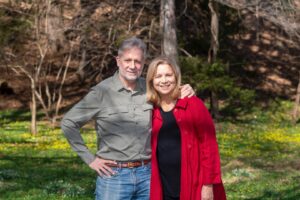
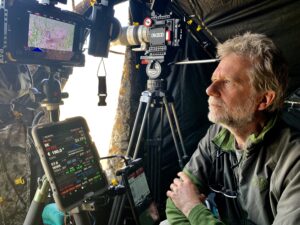
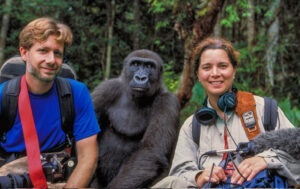
Pictured with this article is a beaming Lowland gorilla flanked by Andrew and Susan.

Susan explained that cute baby gorillas harvested – mostly by the pet trade – are given up when they get too big to snuggle. The Congo Center they are pictured at works to re-habituate them to the wild.
The Lowland Gorilla to Susan’s left looked big enough for JV football. Susan says she “was never frightened. He followed us around. He wasn’t all that big,” she said, ignoring the enormous strength gorillas have whatever size they come in.

“Looks big to me,” I said.

“Little for a gorilla is still big,” Andrew explained. Susan admitted that she was at first put off by the Silverbacks. Instead of a simple “Hello there,” or ‘Hot enough for you?” a Silverback will make a noise that sounds as if you crossed a diesel engine with a pitbull and then broke the dog’s leg.

“We were told to respond, in a similar vein, but at a slightly lower register,” Andrew said demonstrating a gutteral ahhem, ahhem, ahhem ahhem.
This was simple civility Andrew was told though he couldn’t entirely shake the suspicion that what the patriarch meant to say was “I’m about to tear you to shreds,” which a 600-pound gorilla could easily do and on a whim.

“The biggest trouble we had with the gorillas was the babies, because they would steal the lenses out of our bags,” Susan explained.

“And how much were those lenses worth?” I asked.

“I don’t know,” she said. “Five, maybe 10,00 dollars.”
The film makers were instructed to act as if they didn’t mind at all, “because if they sense you care,” Andrew said, “it was a win. They’d take the lens and climb a tree.”

“What you had to do,” Susan said, “was just to wait them out. Wait until they got bored.”

Andrew will acknowledge that he was uneasy filming buffalo in rutt. The cows were curious about the man with the camera,
the bulls were curious about the cows.
The bulls are big. With terrible eyesight.

Brown Bear Encounter

It was filming Bears in Southwestern Alaska near Admiralty Island that he had a session that still turns my own bowels to water.

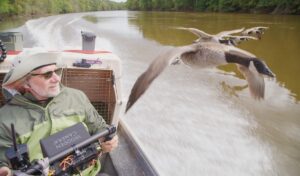
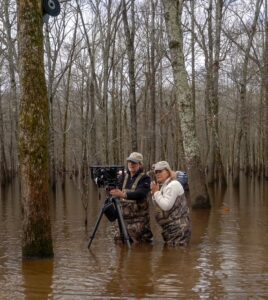
Glowering skies and persistent rain were ruining the video of the annual salmon massacre. Noticing an Alaskan Brown Bear who favored a particular pool and hoping for better lighting below the surface, Andrew dove into the water to arrange a camera trap.
He was maneuvering equipment in extremely cold water, when his assistant called out in alarm: The bear was coming back. “We had no place to go,” Andrew told me, “So we just kinda flattened ourselves out on the shore. We lay very still.”

Blissfully uninterested in his 15 minutes of fame, the gigantic omnivore ambled past the supine documentary makers and went fishing. Larger than their more notorious relative the Grizzlies (Ursus arctos horribilis), an Alaska Brown Bear (Ursus arctos) comes with what Wikipedia calls “well developed dentition and claws.”

“I could hear him breathing,” Andrew recalls. Peering out of one almost closed eye, he saw the giant splash about for what might have seemed an hour but was probably 15 minutes.

Bear gone, Andrew was in the pool and trying to finish the job when his assistant gave the alarm a second time.

Back on shore and trying to appear as dead as one of Mathew Brady’s civil war soldiers, Andrew could “hear the bear breathing. I could see his head,” Andrew told me, holding his hands three feet apart to give an indication of one of the largest skulls of any land-based mammal.

Bored, or sated, the bear headed off a second time. Into the water went Andrew – his fingers stiff with cold – and managed to finish the camera set up.

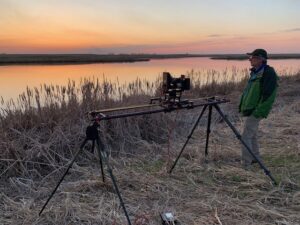
Once the stage was set, the bear was gone, apparently done with the pool. Andrew built a stand in a tree. There he sat for days. Cold, frustrated and a feast for mosquitos, that’s where he stayed, his boredom only slightly ameliorated by the observation that the mother bear who settled with three cubs at the bottom of his tree showed little interest in the frustrated herbivore above.

Finally, though, the bear came back. “The shot was terrific,” Andrew recalls. First seen fishing, the picturesque walk-in spotted the camera. There is video of the Alaskan Brown Bear reaching out for the lens with one gigantic claw.
It was almost certainly Andrew’s courage that kept him alive. Surprised by a hungry Brown Bear, your correspondent would have raced screaming away, quite possibly raising an idle question in the mind of the giant omnivore: “Nothing but fish all week. Maybe today I’ll try a something different. Something that tastes like chicken.” Though an Alaskan Brown bear weighs more than 1,000 pounds, he can go 35 miles an hour, which is much faster than I can go, and this despite a lifetime of training.

Danger and discomfort can team up to make the job harder. The dry side of Madagascar was scorchingly hot. Hot and dry, Susan and Andrew doused themselves in the relative comfort of a large, muddy pool. The luxury of this makeshift jacuzzi was only slightly marred by an enormous bug, a two-inch long boatman, who liked to skate the surface.

“Did he bite or sting?” I asked.

“I don’t know,” Susan said. “I don’t think so.”

They’d brought a portable pharmacopia, but Andrew still got so sick that Susan needed to help him back to their rat-infested shelter for several days of recuperation.

“People see the movies and they think we had an exotic vacation,” Susan says. Vacation it was not, though both consider it an honor to have been so close to nature however red in tooth and claw. Right before the interview, Andrew had gone to Mexico to photograph the Monarch butterflies.

Home Sweet Home

If life is having to go a long way out of the way to come back a short distance correctly, Archipelago Films exactly enacts that truth. After photographing exotic animals in exotic places, Susan and Andrew were drawn to their own back yard.

Parents who had grown up playing outside, they were alarmed with the devices that seem to have kept so many younger people indoors, fascinated by imaginary, addictive, and highly manipulative worlds on their private screens. “We thought local animals could be ambassadors to the wild,” Andrew said.
When a beaver family used the stern of a rowboat flipped and pulled up on the shore near their house, Andrew inserted cameras, and his audience got a chance to observe an apartment that everybody else – beavers included – had to dive underwater to visit. There were frogs inside and even a snake. My own son Andrew helped with some of the manual labor, and I remember him telling me that many wild animals share their houses – and not just at dinner parties.

The most spectacular scene in the movie which changed its name from Pondominium to Backyard Wilderness, filmed a clutch of wood ducks nesting in a knot hole.

Which brings me to another quality exhibited by the film team but not necessarily noticed by the audience. Susan and Andrew are brave, but they are also imaginative. And – above all – persistent.

Say you suspect wood ducks have nested high in a tree near your house? Would you wonder how to get a camera up there, and – without disturbing the ducks – take video of the eggs hatching?

“What if,” is a phrase Andrew likes to use. Sometimes the projects fail, but when they succeed, the resulting footage is astonishing. I’ve been in movies audiences ensorcelled by a private world – a biosphere right outside their windows. Racoons of course and squirrels, mice in the walls but also coy wolves and white-tailed deer.

We held our breath when the fledgling wood ducks – not yet equipped to fly – jumped like so many Icaruses out of their nest and fell awkwardly down into the world.

My favorite scene was of a beaver who – having spotted the infrared from a camera in the family living room – picked up a clot of mud and leaves and blocked half the lenses. When he picked up another clot of mud and leaves, the screen went black.

Backyard Wilderness was shot in 2D. Two to three million people have already seen it in 3D, and it will soon be released in 4D. Netflix plans to air it on August 15.

Projects in the wings, include a movie about the lowland gorillas in Rwanda where a profitable tourist trade has led to the preservation of natural habitat. “A good news story,” Andrew said.

Next up, and clearly central is a project titled Hardwired, which shows that the great outdoors is not an aesthetic to be enjoyed when the real work of the world is done.

This is a truth we must feel in our bones, since visits to the Rockefeller State Park Preserve reached an unprecedented 600,000 during Covid.

Writing in the Preserve Observer, Susan Todd makes the case that preserving nature is necessary if we intend to survive.

“There is nothing better for the human soul than to recognize that there is something bigger and mightier than us,” says writer and theologian Dr. Belden, she wrote. “But while people have long intuited that nature is good for us, only recently have scientists begun to demonstrate its health benefits empirically.” The Japanese speak of the need for vitamin N, by which they mean exposure to nature.

“Trees are definitely cheaper than health care,” Andrew told me, citing a study in Toronto that found that 10 more trees on a city block improved health outcomes for residents comparable to a $10,000 increase in annual salary, or an increase in lifespan of seven years.”

Parents of 11th graders eager to pay somebody else to write the college essay may also be interested to learn that students in a wilderness setting get grades 50 percent higher on intelligence tests.

“We are all at our best in nature,” Andrew said.

Filed Under: Cover Stories Tagged With: Archipelago Films, Documentaries, Documentary Makers, Pleasantville, Susan Todd and Andrew Young

Primary Sidebar

Please Visit

White Plains Hospital
William Raveis – Armonk
William Raveis – Chappaqua
Northwell Hospital
Houlihan Lawrence – Chappaqua
Houlihan Lawrence – Armonk
Houlihan Lawrence – Briarcliff
NYOMIS – Dr. Andrew Horowitz
Westchester Table Tennis Center
Spavia
Compass: Miller Goldenberg Harris Team
Lipari & Mangiameli Dentistry
Raveis: Lisa Koh and Allison Coviello
Bristal Assisted Living
Maid Brigade
Kevin Roberts Painting & Design
Zwilling J. A. Henckels
Meagher & Meagher Attorneys at Law
Compass: Aurora Banaszek
Dr. Briones Medical Weight Loss Center
Decicco and Sons
Elliman: Pam Akin
Terra Tile & Marble
Chocolate Chalet
Home Grown Gardens
Houlihan: Tara Siegel
Saltbox Sash
Joseph Richard Florals

Follow our Social Media

The Inside Press

Our Latest Issues

For a full reading of our current edition, or to obtain a copy or subscription, please contact us.

Inside Pleasantville and Briarcliff Manor Inside Chappaqua and Millwood Inside Armonk

Join Our Mailing List


Search Inside Press

Links

  • Advertise
  • Contact Us
  • Digital Subscription
  • Print Subscription

Publisher’s Note Regarding Our Valued Sponsors

Inside Press is not responsible for and does not necessarily endorse or not endorse any advertisers, products or resources referenced in either sponsor-driven stories or in advertisements appearing in this publication. The Inside Press shall not be liable to any party as a result of any information, services or resources made available through this publication.The Inside Press is published in good faith and cannot be held responsible for any inaccuracies in advertising or sponsor driven stories that appear in this publication. The views of advertisers and contributors are not necessarily those of the publisher’s.

Opinions and information presented in all Inside Press articles, such as in the arena of health and medicine, strictly reflect the experiences, expertise and/or views of those interviewed, and are not necessarily recommended or endorsed by the Inside Press. Please consult your own doctor for diagnosis and/or treatment.

Footer

Support The Inside Press

Advertising

Print Subscription

Digital Subscription

Categories

Archives

Subscribe

Did you know you can subscribe anytime to our print editions?

Voluntary subscriptions are most welcome, if you've moved outside the area, or a subscription is a great present idea for an elderly parent, for a neighbor who is moving or for your graduating high school student or any college student who may enjoy keeping up with hometown stories.

Subscribe Today

Copyright © 2026 The Inside Press, Inc. · Log in