Though Rich Hanlon spent his childhood painting flames on model cars for his friends in the orphanage and redrawing every issue of MAD Magazine, he never believed he would be an artist. Throughout his life, he enrolled in the army, serving as an Army Ranger for almost 15 years, attended college, and worked at UPS. He continued to paint, but he never pursued art full time. However, “one thing expands into another and another and another,” he says, and life takes us by surprise.
In October 2022, Hanlon retired from his job at UPS to commit to painting as a career, and his business has only grown from there.
 Now, as Hanlon embarks on an art study throughout Pleasantville, where he has resided since 2011, his work is displayed in stores across town such as The Black Cow, Pubstreet, Dolphin South Trattoria, Jacob Burns Film Center, and more.
Hanlon often paints seascapes and landscapes, but his work for Pleasantville storefronts has taken a different form. He captures local shops and restaurants from a unique perspective that highlights the warmth, ambiance, and energy they bring to the community. And he never knows when inspiration may strike.
After eating at Pubstreet late one night, Hanlon stepped outside to see the lights on in The Black Cow illuminated against the darkness. Reminded of Edward Hopper’s painting Nighthawks, he took a picture and began painting the next morning. His work is now displayed in The Black Cow for customers to enjoy as they sip their morning coffee. Though this type of work is different than Hanlon is used to, he thoroughly enjoys it: “I like the challenge,” he says.
 Even as the focus of Hanlon’s paintings shifts, the heavy texture, depth, and brilliant colors that define his work remain. Completely self-taught, Hanlon learns and grows with each painting:
“I immediately look at the painting I just finished, and I know I could’ve done better… so you grow with every painting,” he shares.
Whether in regard to his creative process, a new commission, or the direction of his career as a whole, Hanlon is simply “letting it free flow and seeing where it goes.” After all, he never thought his art would be so successful in the first place. “I’m actually surprised,” he says. “Everybody says you can’t make a living doing art, to get a real job and keep that as a hobby, but it’s actually really been growing… and it’s surprisingly fun.”
 Rather than putting energy into a rigid plan that will likely change, we can learn from Hanlon to put our energy into where we are now and take a chance. He is giving his all to each new painting and opportunity, allowing life to surprise him, and enjoying it along the way.
Hanlon is able to see his hard work pay off as he walks around Pleasantville to see his art displayed. “It makes me just melt,” he shares. “I just want my art to be on other people’ walls.” As his art hangs in homes and local shops, Hanlon hopes that the joy his paintings have brought him can be shared and enjoyed by others.

 The Do Something Club at Byram Hills High School undertakes simple projects to make a substantial difference. Started last year by Zoe Harris, a current junior at Byram, the club has already conducted numerous campaigns that spread smiles, increase climate awareness, connect the school community, and more. The club is part of the national organization, DoSomething.org, that is committed to “fueling young people to change the world.”
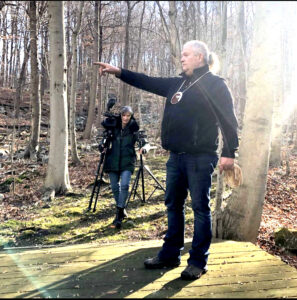
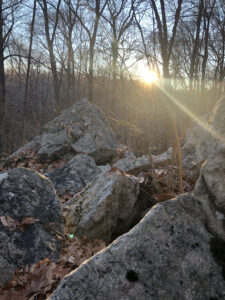 Buttonhook forest is home to thousands of creatures such as bobcats, foxes, coyotes, flying squirrels, box turtles, bats, many species of amphibians, hawks, owls, and migratory birds that would all lose their habitat if the forest is destroyed. “We have to help the animals that can’t talk for themselves,” Rubin adds.
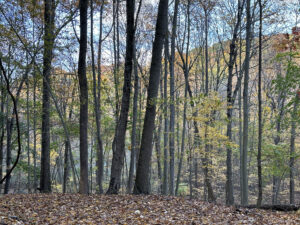 The Ramapough Lunaape Nation stated in a letter sent to the New Castle Town Board and Council that “Prayers and intention set years ago will be broken, if even one stone is moved.” Our community has been given a momentous opportunity to right our history’s wrongs, and to set a local example of how to respect and teach about indigenous culture and history. Tracey Bilski, leader of FoBF, reflected upon the minimal information she was taught about who lived here in the past, and how her journey has served as a learning process for her: “we can use this as a case-study,” she shares.