• Skip to primary navigation
  • Skip to main content
  • Skip to primary sidebar
  • Skip to footer

The Inside Press

Magazines serving the communities of Northern Westchester

  • Home
  • Cover Stories
  • Features
    • Portraits and Profiles
  • Advertorials
    • Lifestyles with our Sponsors
    • Sponsor News!
  • Wellness
  • Happenings
  • Advertise
    • Advertise in One or All of our Magazines–And/Or Subscribe
    • Advertising Payment Form
  • Contact Us
  • Search

Janie Rosman

Journey to Healing: A Bereaved Father finds Solace through Blogging

June 3, 2017 by Janie Rosman

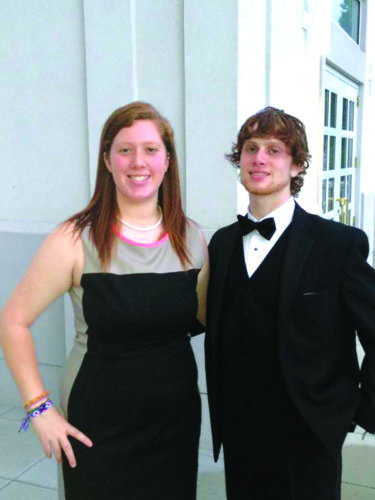
“Andrew and his sister Nicole truly were very close. This is the last picture of them together taken, at a family affair. She missed her brother, her only sibling, a lot, and writes to him on Facebook and elsewhere often.”

Andrew Grosser and his sister Nicole were splashing in the family pool, while his dad, Perry, sat talking with my brother and me. Years later, I saw him again, when he and his sister were shopping for school supplies in a local store. While I didn’t know him well, I’ve come to learn much about this sensitive, intelligent, soft-spoken young man through his father’s blog, “Never Forget Andrew.”

This ongoing tribute to Dorothy and Perry Grosser’s son and his untimely passing on August 26, 2013–the first day of his senior year at the University of Colorado at Boulder–is a way for Grosser to heal, to memorialize events in his son’s life, and to introduce readers to Andrew’s essence and spirit, yet it has become a great deal more.

Having lost my dad more than three years ago, I can relate to some of the posts, like part of the January 22, 2015, entry:

Moving. What a broad subject. Not moving on, or moving up, or moving others with your words. Just moving. Sometimes we move for work, or for a larger place, or for downsizing. But where I am now, my mental and emotional place in life, moving has different meanings. Moving becomes emotional.

Grosser finds solace for his grief through sharing whatever’s on his mind at any particular time and aims to publish his writings in a book. “Sometimes I feel I want to organize it into chapters according to a particular time or date or event, and then I change my mind,” Grosser said. “Organizing my writings would change the natural flow of the healing process because memories of Andrew come to me in different ways. Putting them in order would change the spontaneity.”

Nicole Grosser feels the blog is a great platform. “It gives everyone a chance to learn more about Andrew,” she said. “It’s usually a trip down memory lane for some memories that I was too young to remember, and a strive to keep Andrew alive with us.” Grieving over the loss of a child is an individualized process, Samantha Schnell LHMC, a licensed psychotherapist in Chappaqua, explained. “Writing is also a singular process and gives a person an opportunity to grieve at his or her own pace.”

It self-soothes as well, Schnell said. “If you feel like you can’t help yourself, then helping someone else, can give you a sense or purpose and help you feel better as you navigate your own grief and connect with people going through the same thing.”

Readership, while varied, has increased steadily. “Each blog produces another 20 to 30 new subscribers,” Grosser said. “When I post a blog, I get about 5,000 to 8,000 hits within a few days, and on average, about 100 to 200 hits per day between posts.” Sometimes people are stuck with thoughts or ideas in their head, he noted, “and the blog lets me verbalize and put into writing how I feel,” Grosser said. “That lets me move past a specific thought, to keep my feet moving forward albeit one step at a time.”

Losing a child challenges the natural expectation that your child will out live you, Schnell said, and while speaking with friends is helpful, some people are uncomfortable discussing death.
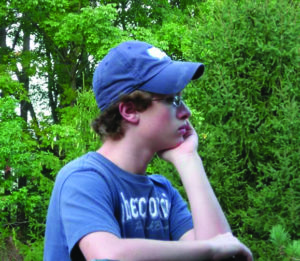
“Andrew would stare out and think. I often write about what I was hoping he was thinking about, or questioning what he was thinking so intensely about.”

It takes away the future and reverses things, and while speaking with friends is helpful, some people are uncomfortable discussing death. “Feelings of grief can be triggered at anytime,” Schnell said. “As time passes, you learn to hold grief in one hand and joy in the other. A parent never wants their child to be forgotten and writing can be a very therapeutic way to honor their memory. A specific conversation or thought can develop into an idea.

“Many times it is what I hear at a group meeting or hear from friend or other bereaved parent,” Grosser said. “Then I sit and write the blog, which helps me get thoughts and ideas off my chest.”

Most of his early readers and subscribers were other bereaved parents, (and) he wrote for that audience. Then, “more and more non-bereaved parents subscribed,” he said. Posts changed “from targeting and talking about bereaved parents to advice and commentary on how others can/should interact with us, what to say and not to say, what we can use help with, and how we feel that others might not understand.”
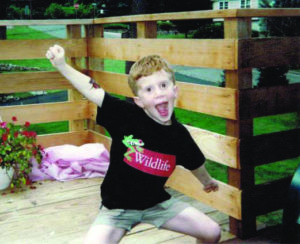
“One of our favorite pictures of Andrew. He would do anything to make someone smile. Even at this young age, he could strike a pose and you would have to laugh and smile.”

Thoughts others have and don’t know or think about, Grosser puts into words, including what others said to bereaved parents, the paradox of healing, and Father’s Day. “Other parents tell me I have a putting into words and onto paper what they have in their heads but can’t get out to others,” he said. “Other times posts are for non-bereaved parents: what to say, how to react, how to act.”

Schnell acknowledges that bringing up memories and writing about them can be helpful, noting speaking with a therapist is also important for the healing process. “I like to write about my son; years from now, someone will read about Andrew and learn about him,” Grosser said. “People will know about his love of hockey, his humorous manner, and his ability to be a therapist to so many of his friends. This is usually not the case with most people who have passed.”

To read his poignant writings visit www.neverforgetandrew.com and join the Facebook page Never Forget Andrew.

PHOTOS BY PERRY GROSSER

Filed Under: Cover Stories Tagged With: Andrew Glosser, Bereavement, Blog, Healing through blogging, Perry Glosser, Solace

Byram Hills HS Students Learn a Valuable Lesson Amid Bridge Project Date

June 3, 2017 by Janie Rosman

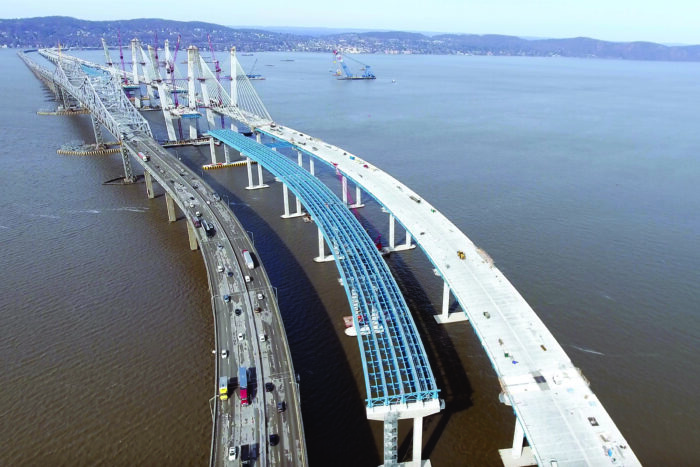
Aerial view of the new bridge’s westbound span stay cables

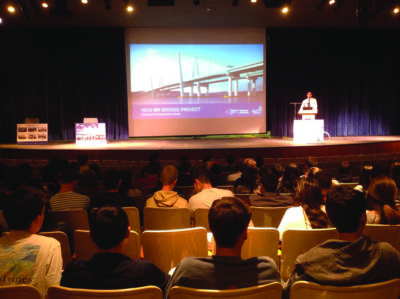
Eleventh and 12th grade physics classes at Byram Hills High School got a peek into the state’s largest infrastructure project when the New NY Bridge educational outreach team came to their school this academic year. “We asked them to focus on the engineering aspects of it although some science students were there,” BHHS teacher Paul Beeken said.

The presentation included the politics of getting a megaproject started. “One fascinating concept for us (students) was how to get a project like this in place,” Beeken said.

This year one of BHHS’s classes built a truss build from balsa wood and was challenged to see how much it can carry versus the weight of the bridge itself. “With this in mind, they have an understanding it’s a tradeoff: cost of materials and how heavy is the bridge versus how much can it carry,” he said.

Outreach educator Dan Marcy addressing students at Byram Hills High School

Beeken requested the presentation focus on engineering and the stress factors: what goes into building the roadway, the technologies needed to lift roadway and how the super crane was able to lift the weights it did as he’d finished a unit on forces including weights and pulleys.

When the kids asked Marcy where he got his degree, he told them he’s not an engineer and explained his background. “That was very valuable,” Beeken said, “because the kids could see someone who wasn’t an engineer but who was still very articulate about all the different facets of the project.”

Engineering is only one part of the project, he noted. “While maybe one-tenth of the class will become engineers, it’s important to have a basic literacy to more easily navigate the subject.”

Precast concrete panels atop structural steel girders

Months after the new bridge’s eight iconic towers were completed (in December) the super crane resumed setting structural steel on the eastbound span utilizing a different process. Assemblies lifted from the northern side of the westbound were moved to a floating barge between the two new spans and then fitted across the eastbound span’s concrete piers.

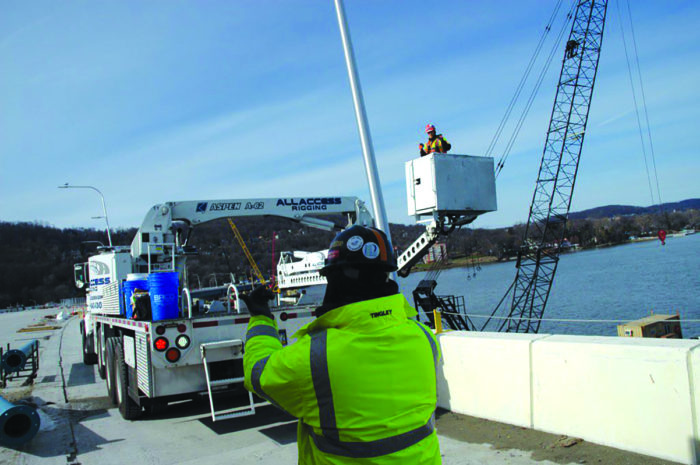
Anti-climb tensile mesh fencing will line both sides of both spans and the walking/bicycle path; steel mesh safety netting will be below each of the six belvederes. Earlier this year, an aesthetic LED (light emitting diodes) hour-long system test set more than 20 piers on the westbound Rockland awash in bright colors.

Crews anchoring a stay cable to the roadway

When fully installed, the 2,700 color lights and 500 white lights from Philips Lighting, the same company that brightens Madison Square Garden, will also illuminate the eight iconic towers and stay cables. With a predicted 100,000-hour lifespan (three times that of conventional lamps), the lights will use roughly 75 percent less energy.

As of a mid-April, date, all 96 stay cables–ranging from 190 to 623 feet long–for the westbound span and one-third (32) for the eastbound span are attached to their respective towers and tensioned to structural steel. More than 120 girder assemblies have been installed on both spans. Ongoing work includes installing concrete noise barrier panels along the northbound Thruway in South Nyack this week and installing transparent acrylite noise barriers on the Rockland approach on the soon-to-open westbound span and installing overhead gantries with electronic signage about lane use, exits and other helpful information.

Bucket trucks used to install LED system

“Before the (Tappan Zee) bridge was built there was nothing there, so no one had any expectations about what a bridge would do,” Beeken said. “Now (building a bridge today) is 10 times more difficult because people need that bridge and depend upon it. You want to build a new one, so the logistics of being able to build a new bridge without ever shutting down the old one presents challenges.”

Two-way traffic will temporarily switch to the new westbound span’s eight lanes by spring/summer. Crews will then dismantle the current bridge so the eastbound span can be completed and attached to the Westchester and Rockland landings.

The full bridge and its walking/bicycle path is expected to open in 2018.

PHOTOS CREDIT NYSTA

Filed Under: Armonk Cover Stories Tagged With: Bridge, Byram Hills High School, construction, Infrastructure, New, New NY Bridge, Tappan Zee Bridge

A Journey of Faith and Hope

April 24, 2017 by Janie Rosman

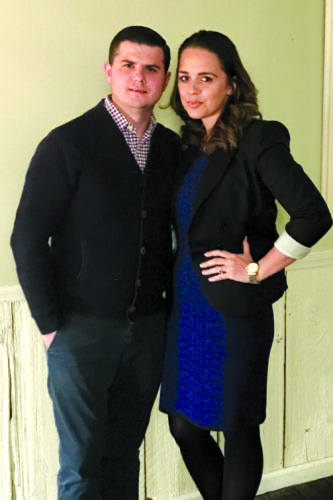
Lavdie Maqedonci-Krasniq with her husband Besian Krasniqi
PHOTO BY KELLY LEONARD

Fourteen-year-old Lavdie Maqedonci-Krasniqi and her parents were on the second plane of refugees departing Kosovo for a new life away from war and terror. “We got to JFK at four o’clock in the morning,” Maqedonci-Krasniqi, 32, said in a soft voice, remembering her first glimpse of the United States. “It’s hard to say because I never had to speak it. As a kid, there’s a part of it that you put away. This (talking about it) is a memory lane I haven’t walked.”

Her experiences remained alive within her until her involvement with the Chappaqua Rotary prompted a speaking engagement. “A group of people came to hear my story!” Club president Dave Shields said Maqedonci-Krasniqi “became active, bringing her kids to Community Day, and is now on the board.”

Born in Prishtina, capital of Kosovo, in 1985–Yugoslavia started to break down–Maqedonci-Krasniqi’s early teenage years were fraught with worry. The regime wanted to assimilate as a nation, “and wanted us to lose our identity, language and traditions. From 1990 to 1997, we were oppressed: the economy crashed, and bank accounts were frozen. Universities, schools and hospitals were closed or controlled by Serbian military.”

Those who needed medical assistance were forced to bribe doctors with money or seek help at a private family Albanian doctor. “When I was about 10 or 11, I injured my leg while playing and needed stitches,” she said. “It was getting late, and at that time we were not allowed to be outside our homes after 6 p.m. because of the imposed State of Emergency.”

Unable to take her to a hospital, Maqedonci-Krasniqi’s father brought her to a family/friend doctor, who stitched her leg without anesthesia at his home. “I remember my mom holding me tightly while I was biting on a pillow from the pain,” she said. Albanian families in Kosovo converted their homes to schools; teachers went from house to house with different subject studies. Her grandfather’s house became a daily classroom for 35 Albanian children from 8 a.m. to 2 p.m. On March 5, 1998, the small town of Prekaz was attacked, an attempt to eliminate Kosovo Liberation Army leader Adem Jashari and his brother Hamëz Jashari.

After that day Kosovo was never the same, the war had fully began, the Serbian military was all over our country,” Maqedonci-Krasniqi said. “By March 18, 1999, we knew NATO was starting to bomb,” she said,” and by April 1, 1999, they forced us out of our homes.”

Nearly one week later on March 24, President Bill Clinton announced U.S. armed forces were joining NATO allies in airstrikes against Serbians. “I owe my life, and my family owes our freedom, to President Clinton,” she said, eyes watering at horrific memories not known to teenagers. “It was about five o’clock in the morning when we reached there, and they asked us to walk in the middle of the train tracks–kids and adults and older people–because if you stepped out of the train tracks there were active mines,” she said.

After hours of walking came to a camp–“a strip of land next to Macedonia”–filled with people from her Kosovo. “You saw people dying, older people and kids with colds, Maqedonci-Krasniqi said, and while UNICEF and the RED CROSS arrived a few days later, “little kids and older people were not handling the cold well, some didn’t even make it.”

Those who were lucky and strong caught the pieces of bread thrown to the estimated 150,000 refugees struggling to survive more than two months at the camp; people not as fortunate waited until the next round.

Maqedonci-Krasniqi’s parents chose the United States because her mother had a sister living in Elmhurst (Queens). She began high school, took ESL classes, and got an afternoon job at Burger King (where) at age 15 to help her parents and send money to Kosovo to rebuild their home.

“It was hard,” she said quietly. “My dad didn’t want to leave our house. He told us, ‘We decided to live in U.S. even after the war ended. Let’s make sure we do not regret it, let’s make sure you finish college and work hard so when you look back, I hope you can say, Dad thank you for deciding to stay.’”

Sixteen years later, the college graduate and mother of two sons (five and seven) is humble and grateful and a successful mortgage officer living in Mt. Kisco. “It is very meaningful, and we are honored that Lavdie is the most recent member of the Chappaqua Rotary Club, and of Rotary International,” Program Director Sandy Bueti said. Maqedonci-Krasniqi presented Horace Greeley High School senior Ellie Loigman with the Student Community Service Award at the Rotary’s Annual Charter Night Celebration and Dinner on March 4.

“We bought our first home, and we still continue to work hard and try to create the best possible life for our children,” she said. “We learned to never lose hope and as long as we have the freedom to follow our dreams, everything else is possible.” Still, Maqedonci-Krasniqi admitted, “there’s a part you don’t think about, yet when May 26 comes, I know I got on a plane to come to this country.”

“I am a refugee, and I am an immigrant,” she emphasized. “The only thing given to me was the freedom to come to this country. My grandmother used to say, ‘Hard work and a good heart.’ Lavdie is also a Muslim, another reason she felt compelled to share her story. “Don’t look at people a certain way,” she advised. “You may think you know them, and you don’t.”

Filed Under: Cover Stories Tagged With: Kosovo, President Bill Clinton, refugee, Rotary Club, Rotary Club of Chappaqua

  • « Go to Previous Page
  • Page 1
  • Page 2

Primary Sidebar

Please Visit

White Plains Hospital
William Raveis – Armonk
William Raveis – Chappaqua
Northwell Hospital
Houlihan Lawrence – Chappaqua
Houlihan Lawrence – Armonk
Houlihan Lawrence – Briarcliff
NYOMIS – Dr. Andrew Horowitz
Westchester Table Tennis Center
Spavia
Compass: Miller Goldenberg Harris Team
Lipari & Mangiameli Dentistry
Raveis: Lisa Koh and Allison Coviello
Bristal Assisted Living
Maid Brigade
Kevin Roberts Painting & Design
Zwilling J. A. Henckels
Meagher & Meagher Attorneys at Law
Compass: Aurora Banaszek
Dr. Briones Medical Weight Loss Center
Caramoor
Play Nice Together
World Cup Gymnastics
Decicco and Sons
Beascakes Bakery
Carolyn Simpson (Doublevision Photographers)
Wags & Whiskers Dog Grooming
Pinsky Studio

Follow our Social Media

The Inside Press

Our Latest Issues

For a full reading of our current edition, or to obtain a copy or subscription, please contact us.

Inside Pleasantville and Briarcliff Manor Inside Chappaqua and Millwood Inside Armonk

Join Our Mailing List


Search Inside Press

Links

  • Advertise
  • Contact Us
  • Digital Subscription
  • Print Subscription

Publisher’s Note Regarding Our Valued Sponsors

Inside Press is not responsible for and does not necessarily endorse or not endorse any advertisers, products or resources referenced in either sponsor-driven stories or in advertisements appearing in this publication. The Inside Press shall not be liable to any party as a result of any information, services or resources made available through this publication.The Inside Press is published in good faith and cannot be held responsible for any inaccuracies in advertising or sponsor driven stories that appear in this publication. The views of advertisers and contributors are not necessarily those of the publisher’s.

Opinions and information presented in all Inside Press articles, such as in the arena of health and medicine, strictly reflect the experiences, expertise and/or views of those interviewed, and are not necessarily recommended or endorsed by the Inside Press. Please consult your own doctor for diagnosis and/or treatment.

Footer

Support The Inside Press

Advertising

Print Subscription

Digital Subscription

Categories

Archives

Subscribe

Did you know you can subscribe anytime to our print editions?

Voluntary subscriptions are most welcome, if you've moved outside the area, or a subscription is a great present idea for an elderly parent, for a neighbor who is moving or for your graduating high school student or any college student who may enjoy keeping up with hometown stories.

Subscribe Today

Copyright © 2026 The Inside Press, Inc. · Log in