• Skip to primary navigation
  • Skip to main content
  • Skip to primary sidebar
  • Skip to footer

The Inside Press

Magazines serving the communities of Northern Westchester

  • Home
  • Cover Stories
  • Features
    • Portraits and Profiles
  • Advertorials
    • Lifestyles with our Sponsors
    • Sponsor News!
  • Wellness
  • Happenings
  • Advertise
    • Advertise in One or All of our Magazines–And/Or Subscribe
    • Advertising Payment Form
  • Contact Us
  • Search

The Inside Press

Tackling Bullying A Greeley High School “Senior Experience” Report

August 16, 2014 by The Inside Press

By Liora Fishman

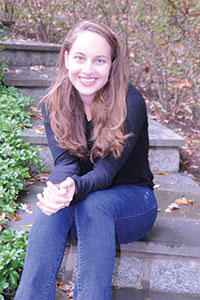
Editor’s Note: Contributor Liora Fishman, pictured here, used her “Senior Experience” at Horace Greeley High School to explore the Chappaqua School District’s viewpoints and policies surrounding the topic of bullying, and to explore what to do about bullying in general. Inside Chappaqua was thrilled to pick up Liora’s report for our “Safety First” edition.

When I was in the ninth grade, I went to an assembly. It was early in the year, and I was beginning to settle into the looping hallways and brick exterior of Horace Greeley High School. At the assembly, students were shown a movie that was supposed to be a moving and empowering testament to the dangers of bullying and the power of kindness, but all I remembered as I walked out of the gym where these school-wide assemblies took place were bodies of students splayed across a library floor and students trampling each other to clear a crowded cafeteria as gunshots rung through the air. At this assembly, we were shown footage of the infamous 1999 school shooting, the Columbine High School Massacre.

There must have been some message, some powerful meaning to the showing of this movie. But I missed it completely. I am lucky because Greeley was, and still is, one of the places I feel the safest at. As I’ve ascended through Chappaqua schools, I have been treated with nothing but kindness from my classmates and teachers. But what did I take away from this film? Be nice to people who are different from you. They could be dangerous. I understood–then and now–how inadequate this message was, and that in all likelihood, the filmmakers had a different point that I could not see: after all, the footage of Columbine was only part of the movie, not the whole film. It shouldn’t have to be this way. Students should not have to be “scared straight,” terrified into acting kindly towards one another.

The Limits of “Scared Straight”

Our country’s media coverage of events like these is relentlessly the same, and often in such situations, this “scared straight” method seems like the only way to get the message across. It goes without saying that reactions to bullying have evolved in unimaginable, horrific ways; shootings and suicides have been triggered by such events. But the media rarely asks pertinent questions: What was the school doing to prevent this in the first place? What can we do? Thus, for many, bullying has become a bit of a cliché, and after a while, anti bullying campaigns fail to resonate with the target audience: kids. Assistant Superintendent for Leadership Development and Human Resources Andrew Selesnick states that it is “challenging for students to understand how serious [bullying] can really be.”

Nonetheless, regardless of its prevalence in the community, “this is not a perfect world and schools need to be proactive in this area,” explained Seven Bridges Principal Mike Kirsch. It is important to be united against this issue, have a protocol to follow, and a definition of bullying so that we can properly identify and react to it. And that we do.

According to the district’s “Harassment, Bullying and Discrimination Prevention and Intervention Policy,” bullying has the “same meaning as harassment.” Harassment involves the maltreatment of a student for a host of difference reasons: gender, sex, race, and weight, to name a few. If this treatment creates a hostile environment in which the student does not feel safe at school, it meets the district definition of bullying. Principal Martin Fitzgerald, of Robert E. Bell Middle School cites “persistence, exclusion, and power imbalance” as common keywords or factors in definitions of the term. “Conflict is not the same as bullying, nor should it be treated that way…sometimes, if it is treated in this manner, it can even exacerbate the conflict,” said Fitzgerald, but he notes that exceptions are made for “egregious issues or situations.”

Although harassment is often thought as persistent offensive behavior, the district amends this definition for non-traditional situations. “Bullying is something that is generally done repeatedly, but it is also true that one serious event can be considered bullying too,” said Selesnick.

The policy also includes that these acts of bullying can be both verbal and non-verbal. “Exclusion is often the most powerful form of bullying,” added Selesnick.

In addition to his daily responsibilities, Selesnick is also the Dignity for All Students Act District Coordinator.The Dignity for All Students Act (DASA) is state law enacted in 2012 that provides a uniform protocol when taking action against or in prevention of bullying. It was created to make schools a safer place for everyone–faculty, students, and visitors–because the ramifications of bullying have proved to impact not only the victim and the bully but entire communities. Students have taken their lives, or taken the lives of others–naturally, the state was inclined to act. “It is a preventative measure,” explained Selesnick, “in reaction to some tragedies throughout the state. We have to do something to make sure that everyone is doing what they can to create a safe environment.”

When Aiming for Dignity
BoyHuggingKneesHC1104_X_300_C_YDASA assigns Dignity Act Coordinators to each school. In the Chappaqua School System, these Coordinators are the assistant principals at each school. These administrators go through a training process to ensure the implementation of this policy according to state requirements, and have responsibilities that include investigation and handling of the complaint process. “Every building has a DASA coordinator, and if a student does not know anyone they can go to, that’s the person who will help them and investigate further regarding the situation.”

Yet, bullying has evolved from its stereotypical meaning of physical or verbal intimidation. The most common form of bullying seen today is called “relational bullying. It is a type of intimidation that often includes passive-aggression, spreading rumors, or exclusion. It is a type of bullying that most people experience at points in their lives, and even the type of bullying that people exercise. It is less blatant, and more discreet, and even ingrained in social codes and cues.

With the advent of technology like smart phones, relational bullying is easier to engage in because “the ability to communicate verbally has become minimal. We are missing eye contact, body language, and voice intonation,” said Amy Valentin, a Horace Greeley High School social worker.

This often creates a more complex understanding of the issue, and greater obstacles in tackling the global problem. More often, we have opportunities to write things we would not say to someone in person. Even more pressing is that more often, victims of bullying cannot escape the situation–it follows them home too.

The Impact of a Cyber World

“The Internet creates a world where the students can feel totally unsupervised,” said Selesnick. Yet, contrary to popular belief, the school can get involved in these cyberbullying cases. “If this bullying that takes place on the Internet begins to interfere with life at school, when a student is uncomfortable being in school, and it interferes with the school day…that is an opportunity for school involvement.”

However, for all the grief the “cyber world” has brought upon students and adults in terms of intimidation and bullying, it has had its benefits, as well. The Internet has propelled bullying into a spotlight, and as a result, has driven actions against bullying, and increased consciousness of it. “We’re a lot more aware of [bullying],” said Fitzgerald. “Much of that came through the power of the Internet–obviously, not in the way one might hope it would, but now we can see the documentation of these encounters.”

Such awareness has spurred student run anti-bullying campaigns around Westchester County schools. At Croton Harmon High School, the students launched a campaign called “Words Last Forever”–a program that encourages students to think before speaking, and to avoid judging others before taking the time to talk to them. Similarly, at Harrison High School, students were shown award-winning movie Bully and launched a fundraiser, the first annual “Upstanders Walk,” to benefit the American Foundation for Suicide Prevention and Pacer’s National Bullying Prevention Center.

Yet, in spite of all the buzz surrounding the issue, there is only so much the school district can do to combat it. Fundraisers and campaigns can only go so far, especially with its overpowering presence in the media. “Meanness exists in our culture. We go to the movies and see people being made fun of,” said Selesnick. “In addition, meanness also exists in the media. How do we minimize something that is so prevalent in our culture?”

The Tie to Human Rights
BoyBulliesHC1309_X_300_C_Y“How do we teach empathy?” posed Amy Valentin. It seems like an impossible feat especially to older students. This is precisely what organizations like the White Plains-based Holocaust and Human Rights Education Center addresses. Through annual events for high schoolers, the HHREC holds small-group workshops that discuss injustices such as bullying–but from a different perspective.

“We talk to kids about bullying through larger topics such as prejudice, genocide, and hunger,” said Millie Jasper, Executive Director of the HHREC. “We then approach it from a lot of different angles.”

Although much of this change lies in the hand of the students, Jasper considers administrators and teachers of equal, or even greater importance when attempting to minimize bullying. “If the administration and teachers do not buy into an anti-bullying campaign, it won’t happen,” said Jasper.

I believe in Chappaqua that teachers and administrators are universally united against bullying, and have taken preventative measures and actions to minimize risk. Fitzgerald cites “the climate and culture of a school, the ideals, such as trying to be a community, being more accepting, understanding, tolerant” as attributes integral to a safe, comfortable school environment where bullying can be reduced. These attributes are emphasized in the classroom, where we promote collaboration, and help kids find their place in our school.”

“The Bell 4Core” Unifying Students

Although this teaching style has become increasingly the norm across many classrooms and schools, Bell takes it further with its regular assemblies coordinated by Fitzgerald which emphasize kindness and compassion, and the “Bell 4Core.” It is a mission statement of sorts that underscores four ideals that the school values and promotes. These “core” values unify the students: empathy, self regulation, respect, and perseverance. A visitor can see signs hanging throughout the building and in classrooms in which these characteristics are inscribed. With the Bell 4Core to help, 
Fitzgerald hopes to “get away from the pessimism of bullying and focus more closely on amplifying community, collaboration, and dialogue.”

Similarly, in Seven Bridges Middle School, there are organized advisory-curriculums and assemblies that address the issue. Furthermore, through peer-leadership positions, students are able to assume a critically important role of responsibility in the community.

“We have an advisory program that meets twice monthly to address issues of civility and to develop a sense of community,” said Kirsch. “Our students raise awareness by making posters that are displayed in the school. Eighth graders, as peer leaders, speak with all students about civility and appropriate treatment of others.”

Evolving Attitudes

These awareness and action-oriented programs have undoubtedly made an impact on students. Despite the constant changes within bullying culture–from physical violence, to cyberbullying and implicit exclusion–students’ attitudes have evolved, too. “I find students today are considerably more tolerant and sensitive than they have been in the past. Differences are more frequently celebrated than scorned,” said Kirsch.

However, the only way we can truly minimize bullying culture in schools is to practice kindness and compassion in our everyday life. This is not limited to the playground or the classroom, but to the home, as well.

Bullying does not necessarily stop when we leave school property: if we allow it, it will follow victims throughout their lives, leaving a burden no one should have to bear. Although these vehement anti-bullying campaigns feel relatively new, administrators emphasize that this type of education is here to stay.

“This will be the work that we do for as long as we work in schools. We are always going to be working on compassion and kindness,” said Selesnick, “But this is also about the whole community and culture being aware…it is not an issue where the school stands alone. This is a joint mission.”

Liora Fishman is a 2014 Greeley graduate who will be attending Barnard College in New York City this fall. As one of the 2013-2014 editor-in-chiefs of The Horace Greeley Tribune, she cultivated a love for writing and journalism that has led her to write for local publications such as Inside Chappaqua and The Examiner.
Filed Under: Cover Stories Tagged With: Bullying

Questions do Save Lives – ASK Yours!

August 16, 2014 by The Inside Press

Nicholas Naumkin, for whom the proposed Nicholas’ Bill is named.
Nicholas Naumkin, for whom the proposed Nicholas’ Bill is named, but years later, still not passed.

By Dawn Evans Greenberg

When local mom Anna* routinely dropped her toddler at a sitter’s home, it never occurred to her to ask about guns. The sitter came highly recommended, had been diligent about discussing food allergies and even kept her pets in a separate area of the home. Only when Anna read about an accidental shooting between two toddlers in North Carolina did it occur to her to approach the sitter and ask whether there were any firearms in the house. Expecting to be reassured that guns were not an issue, Anna was shocked when the sitter readily admitted that three guns were in the home but “put away where the children couldn’t get to them.” After a few sleepless nights, and well aware that, had she not asked, there’d be no changes to her or her toddler’s routine, Anna decided to find a new sitter for her child. As the saying goes, better safe than sorry.

Stories like Anna’s aren’t often widely shared first-hand. They’re the heard-from-a-friend-of-a-friend anecdotes that moms and dads tell one another when they meet for coffee, head to the park or stand on the sidelines at soccer games. When these cautionary tales ARE shared more directly, it’s too often because something unimaginable, something that should never have happened actually did.

That is why, over the last three years, as mass shootings have stunned and frightened the public, many gun safety groups have come together to address a related problem that is sometimes overlooked: the accidental shootings of children, often in their own homes.

According to the National Centers for Disease Control and Prevention, there were at least 140 unintentional firearm deaths for people aged 0-19 in 2011. However, the actual numbers appear to be much higher. A New York Times report from September 2013 revealed that accidental shootings are seriously under-reported: “The undercount stems from the peculiarities by which medical examiners and coroners make their ‘manner of death’ rulings. Choosing among five options–homicide, accidental, suicide, natural or undetermined–most medical examiners and coroners simply call any death in which one person shoots another a homicide. These rulings can be wildly inconsistent…Even self-inflicted shootings that are clearly accidental…can wind up classified as homicides.”

NYAGVSaratoga Springs resident Oksana Naumkin knows all too well the nightmare of losing a child to accidental gunfire. On December 22nd of 2010, her 12-year-old son Nicholas was visiting a friend when the unimaginable occurred– said friend accidentally shot Nicholas in the head while playing with his father’s unlocked and loaded handgun. Following this preventable tragedy, Oksana started to advocate for a law that would require the safe storage of guns in the home; the proposed law, Nicholas’ Bill (S.7822/A.8293), is named for her son.

Twenty-eight states plus the District of Columbia have some form of safe storage law, but, as of press-time, New York State does not. We are fortunate in that Westchester County (along with New York City) does have safe storage laws. Still, we would all benefit from a state-wide passage of Nicholas’ Bill. The New York State Coalition for the Prevention of Child Access to Guns is comprised of over forty organizations around the state that have joined Oksana in advocating for Nicholas’ Bill.

There is something else concerned parents can do right now: ASK. The ASK campaign–Asking Saves Kids–offers a very simple solution to a tricky social situation.

Basically, and per its acronym, ASK suggests that all parents sending their children to another person’s home for a play date (or anywhere one may have concerns or questions) simply ask if guns are on premises and whether (if they are) they are securely stored. If the answer makes anyone uncomfortable, the play date should then be renegotiated so that all parties feel comfortably satisfied.

A Chappaqua dad who keeps several guns for sport explained that his weapons are stored in a gun safe anchored both to the floor and wall with ammunition stored separately. He added that he believes the majority of gun owners in our area keep their guns locked and stored carefully too. However, he thinks there are those who may not readily admit they have guns for fear other parents may not allow their children over for play dates. As he noted, “People feel that they have second amendment rights but they have a fear of expressing it, at least in our area, particularly after the tragedy at Newtown.”

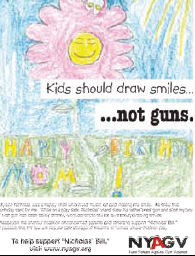
askPutting political views aside for the sake of all our children should be something we, as a community, should be able to accomplish. Adopting ASK helps make that easier; with more parents ASKing, the “gun” question becomes less fraught and more part of everyone’s comfort zone when play date-planning. Let’s ask, not judge. Strategize not stigmatize. Anna asked. Now it’s our turn to ASK. And to contact state representatives in support of Nicholas’ Bill (S.7822/A.8293). With everyone’s help, our children will enjoy drawing pictures (not guns) happily ever after.

*Names and defining characteristics have been changed.

Dawn Greenberg is an eight-year Chappaqua resident and the Executive Director and founder of the Chappaqua Children’s Book Festival. She’s a member of Million Mom 
March/Northern Westchester chapter. She always asks about guns where her eight and 11-year-old boys play.  

Filed Under: Cover Stories Tagged With: accidental shootings, Firearms, Guns, Nicholas' Bill

Making A Difference, One Trip At A Time How Hands Up For Haiti is Changing Lives

August 16, 2014 by The Inside Press

by Lindsay Hand

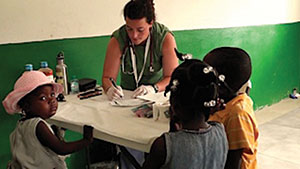
Dr. Jane Alyce Hunt sees patients at Open Door Clinic.

Formed shortly after the 2010 earthquake, Hands Up For Haiti (HUFH) has made extraordinary progress in bringing much-needed medical supplies and help to the devastated country, as well as teaching natives important life-saving concepts.

The non-profit organization is a self-proclaimed “medical humanitarian organization committed to improving the quality and sustainability of health care in northern Haiti.” Initially founded by Mount Kisco Medical Group doctor and now organization president Jill Ratner along with several others from Northern Westchester, the group wanted to be on the ground to help after the January 12, 2010 earthquake ravaged the developing nation.

Ratner was tireless, contacting colleagues through the American Academy of Pediatrics, and with support from both the local community and MKMG, she organized a team to travel to northern Haiti. After that trip, their goals became clearer and the organization incorporated and gained non-profit status. According to Ratner, “we recognized that our goals were to facilitate clinical trips, incorporate teaching and new technologies to be shared with Haitian doctors and nurses, and to bring much needed equipment to facilities on the ground.”

Through the continued efforts of doctors, nurses, students, and volunteers, the organization has made a huge difference in one of the most medically challenged countries in the world. As Ratner explained, “When you work in Haiti, you are given the gift to see your own life in different terms. All people deserve an equal opportunity to lead fulfilling and healthy lives. It is our goal to try to right the inequality that exists, one person at a time, through promoting improvement in ongoing care.”

Almost 200 people are now involved, most of whom have traveled to Haiti as volunteers numerous times. In the past four years alone, HUFH has facilitated 29 trips to the country and treated over 6,000 patients. In June 2014, HUFH sent 17 people, its largest group ever. Their destinations included Cap Haitien, Bwa de Lance, and Bord de Limonade. The volunteers “worked nonstop,” said Ratner. “They were triaging patients, starting IVs, assisting the doctors, and distributing and administering medication.”

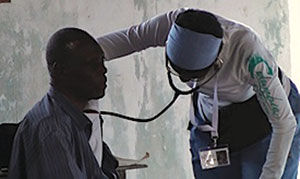
Dr. Josette Romain at Bod de Limonade outreach.

None of this is easy, as for the most part patients are seen and treated in deserted churches and cramped clinics without electricity and running water. In addition, the volunteers prepared and delivered “community lectures” for and to the people waiting outside.

Riley de Jong, a Hunter College nursing student and Lewisboro Volunteer Ambulance Corp. EMT who recently went on her first trip with HUFH, recalled a poignant day when she made the important decision to bring an extremely malnourished three-year-old boy directly to one of the doctors. “That day it really didn’t feel like much of an accomplishment,” she said. “I felt a little helpless, seeing this little boy suffering right in front of my eyes from severe malnutrition. It just seemed so unfair. However, looking back now, I wouldn’t trade it for anything. Our team provided him with more assistance than he would have ever seen.”

While the organization’s efforts are greatly appreciated by the Haitians, the effect of these trips on the HUFH volunteers is profound. “This work is a labor of love and each person involved has felt that they gain more than they give. It crystalizes for myself and others why we went into health care in the first place, and the satisfaction that it brings to help another human being,” said Ratner. De Jong couldn’t agree more. “Haiti is one of the most beautiful countries you will find, full of beautiful people, beautiful mountains and beautiful smiles. Once you go, you too will fall in love with the country and its people–it is inevitable!”

Hands Up For Haiti will no doubt continue to do unparalleled work in the country. As Ratner explained, “Once you have been to Haiti, you cannot walk away. It stays with you every day of your life. It is the people who have nothing and yet are so grateful for anything you can do for them that keep you constantly engaged. It is the camaraderie of working with so many people who are like-minded and determined, and willing to spend their time just trying to make things better.”

For more information visit 
www.handsupforhaiti.org.

Two-time Inside Chappaqua Guest Editor Lindsay Hand is an incoming freshman at Cornell University.

Filed Under: Cover Stories Tagged With: Haiti, Hands Up For Haiti, medical supplies

Why We Kvell* About Living Here

August 16, 2014 by The Inside Press

scrollCelebrating the Jewish New Year and Religious Tolerance
By Deborah Notis

For many, fall is a time of renewal. This is certainly true for Jewish people, as they welcome the New Year, celebrate the harvest, and begin a new cycle of reading the sacred Torah in the fall. It’s also a time to recognize and appreciate the town of Chappaqua, where everyone can worship as they please without great prejudice.

Ten days after Rosh Hashanah is Yom Kippur, the Day of Atonement and the most somber day on the Jewish calendar. Rabbi Jonathan Jaffe, the new senior Rabbi of Temple Beth El in Chappaqua, emphasizes that religious tolerance is something that’s inherent in Judaism. “The Torah does not begin with the story of the Jewish people but rather with all humanity.” Judaism, at its roots, teaches religious tolerance and

Rabbi Mark Sameth of Pleasantville Community Synagogue offers a broad perspective too regarding our community’s tolerant attitude about religion, stating, “Maybe it has to do with that fact that people…wherever they are in terms of religion, they still have spiritual longings, a need for community, a sense of purpose.” Ultimately, whatever the motivation for this spirit of acceptance, it’s another reason to feel fortunate and count our blessings this holiday season.

The Jewish “Reset Button”

The Jewish Holidays season is “like a reset button that gives us a new chance to access a renewed sense of hope and a way to deepen one’s gratitude,” states Rav Shoshana Mitrani-Knapp, who offers High Holiday services to Jews without shuls. Rosh Hashanah, the Jewish New Year, marks a time of renewal and is considered a symbol of hope within the Jewish community.

With the blowing of the Shofar at the end of the holiday, Jewish people are calling the Messiah, hoping that he will arrive in the New Year.

Sukkot, which follows Yom Kippur and lasts seven days, is one of the most festive Jewish holidays. With large feasts and celebrations under the traditional ‘Sukkah,’ or shelter, built and decorated with poles, tree branches, and bamboo reeds, dried corn and gourds, Jewish people pray for a bountiful harvest.

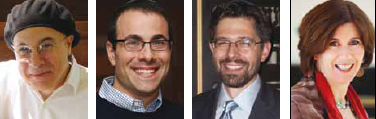
(L-R) Rabbi Mark Sameth, Rabbi Jonathan Jaffe, Rabbi Aaron Brusso and Rav Shoshanna Mitrani-Knapp.

Sukkot is followed by Simchat Torah, during which Jewish people rejoice in completing another year reading the Torah. Simchat Torah celebrations are like a huge, celebratory party, complete with singing, dancing and bountiful feasts. All in all, these holidays “provide the Jewish people with an opportunity to reconnect with one another and as a community with G-d,” notes Rabbi Jaffe.

While Jews in our area can celebrate the holidays in relative peace, nationwide anti-Semitism is still an all-to-frequent occurrence. The Anti-Defamation League noted that incidents of violent anti-Semitic assaults increased in 2013. In April 2014, before the Jewish holiday of Passover, a 73-year-old white supremacist with a long resume of anti-Semitic acts opened fire outside Jewish centers around Kansas City. Closer to home, Greenburgh Fire Chief Anthony LoGiudice was accused of making anti-Semitic slurs about the town supervisor, Paul J. Feiner.

And while Chappaqua has not been immune to acts of anti-Semitism (an incident at Seven Bridges gave us all pause), it still remains largely safe for practicing Jews. As Rabbi Jason Nevarez of Bedford Temple Shaaray Tefilah tells us, “This area is a wonderful place to raise a Jewish family.”

Part of what makes this area such a great place to practice Judaism is the openness and respect that our community has for all religions. Many houses of worship team together for interfaith events and open their doors to the community as a whole. Temple Beth El takes part in numerous interfaith activities throughout the year, including an annual interfaith Thanksgiving dinner so popular throughout the community. This year, Rabbi Nevarez leads the Northern Westchester Interfaith Council.

Bearing Witness

Rabbi Aaron Brusso of Mt. Kisco’s Bet Torah Synagogue teams up with Catholic leaders every summer to participate in the Anti-Defamation League’s Bearing Witness program. According to Rabbi Brusso, this program has helped him to develop an even deeper “respect for and understanding of Catholicism.” Ultimately, an increasing familiarity with different religions enables people to achieve a greater level of respect for diverse religious and spiritual beliefs.

Overall, Americans are “benefitting from a marked increase in religious tolerance,” says Rabbi Sameth. He cites a 2013 study by Rice University that “showed a ‘substantial jump in the proportion of Americans who view all religions with equal respect.’” Plus, as Rabbi Nevarez and Rabbi Sameth point out, in our communities, Jews live in proximity to others with similar identities, and many non-Jews have ties to Judaism through friends, neighbors, and relatives. These factors contribute to making this a safe place for people to practice Judaism.

Religious tolerance is very much about looking inside too; that looking and “checking” are what reside at the heart of New Year services.

According to Rabbi Maura Linzer of Temple Beth El, from Rosh Hashanah through Yom Kippur “the Jewish people are obligated to engage in the process of Chesbon Nefesh, which literally translates as a checking of the soul or self. We look back upon our thoughts and deeds, asking where we missed the mark of being our best self.”

Deborah Notis is a writer and a co-founder of gamechanger, LLC. She lives in Westchester with her husband and four sons.

*to be extraordinarily proud; to rejoice

Filed Under: Cover Stories

The Bus Stops Here!

August 16, 2014 by The Inside Press

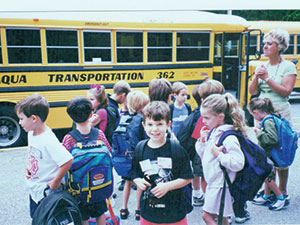
All aboard after a day of Kindergarten at Roaring Brook School.

Or how I Learned to Just Say Go

By Dan Levitz

I remember driving my son, our first-born child, home from the hospital.  My wife and I were a nervous parental cliché personified–hazards on the whole way, our usual five minute drive across East 86th Street took 20 instead.

Old habits die hard. Charlie was starting first grade when we moved here, and my wife and I were far more nervous than he was about taking the bus to school. My recollection of the bus at his age was something akin to Lord of the Flies; complete anarchy, survival of the strongest. Charlie was a robust little snapper but, at six, did he have the stuff to weather this oncoming daily storm?

Of course, to our extreme relief, it was obvious that my boy felt safe. And, in the rare case where there was a behavior issue on the bus, we learned that Roaring Brook School had (and has) an effective response. Bus Safety Coordinator Bill Woolard is a well-liked and respected Physical Education teacher who has been the bus safety czar at RBS for 12 years. I asked him about his training for this role and he cited his decade’s long experience with at-risk youths, special needs kids and here in Chappaqua. Bill describes himself as “large, ugly and loud” which may be needlessly self-deprecating but certainly gets the kids’ attention. Bill sits when talking to a student about RBS’s “three strike” bus safety policy so his formidable stature isn’t overly intimidating; first strike is a conversation with Bill, second a Bus Behavior Worksheet and third is a suspension for repeated disallowed behavior. Notably, three strike offenders are extremely rare.

Our bus transport nervousness only re-emerged in rare instances like the mini-rogue-tornado we had one spring. Long story short, headed home, the bus couldn’t proceed due a sudden and intense storm which brought trees down on 120. The bus driver wisely pulled over, kids exited safely and kind neighbors harbored our children until the storm, literally, passed. School was canceled the next day and Charlie was interviewed on News 12. Perhaps the greatest day of his life to that point.

As Charlie moved on to Bell, and now Greeley, it occurs to me that we rarely ever think about the details of his daily bus rides. It’s just a fact of his routine. This confidence comes from knowing that Chappaqua Transportation Company operates with our children’s safety as priority number one.

I met with longtime CTC owner Joan Corwin who emphasized, “We are doing all we can to insure the children’s safety.” She pointed out that drivers and monitors are extensively trained in bus safety, taking both required courses and physical performance tests. This passionate woman noted that, early on, her authoritative command garnered the nickname The Godmother. Now, however, she’s mostly called Mom by bus drivers, monitors and employees who have worked for her as long as 30 years. Joan told me that she’d be unable to count the number of hugs she’s given nervous Moms over the years because there’ve just been so many. The message I received from our conversation was a strong feeling of empathy with the parents and a professionalism that never strays from the bottom line of safety ahead everything else.

My daughter Bella came along five years after Charlie, and was a baby when we moved here. Bella, a Special Ed student, has generally traveled on the smaller van-type buses. I’ll never forget when, as a 2 1/2 year old, Bella got on one of those little busses, with its wonderful mix of children, and headed away from us for the first time. It was difficult for us as parents but Bella seemed happy to be leaving her nervous folks behind. Since then, she’s studied at several schools in Westchester, riding as far as Bronxville on a daily basis. The thought of this long trip, on highways, was nervous-making. However, once we met the wonderful bus driver and monitor we felt confident and relieved that she was in good hands.

I sat down at Lange’s Deli with Tiffany Thomas who has been my daughter’s Bus Monitor going back at least five years. The distinct message that came across from our conversation is that the children’s safety is the number one concern for these professionals. They are required to take two safety classes per year and, in working with Special Needs children, go out of their way to make the bus feel safe and friendly. Tiffany noted, “On the bus I treat Bella and the other kids as if they are my own.” Tiffany also described situations where her bus role requires flexibility, saying, “some kids you sit with if they need it,” which she is happy to provide.

Both of my kids have had very positive experiences taking the bus to school mostly due to the fine professionals who transport them every day. 
I wish I could say that all school transport nervousness has been eliminated, but I don’t see any way a bus-driver or monitor can help with the next parental anxiety filled milestone.

Charlie will be driving himself to school next year. Yikes!

Dan has lived in Chappaqua for 10 years and is an art dealer and writer with a blog on The Huffington Post.

Filed Under: Cover Stories Tagged With: School bus

  • « Go to Previous Page
  • Page 1
  • Interim pages omitted …
  • Page 33
  • Page 34
  • Page 35
  • Page 36
  • Page 37
  • Interim pages omitted …
  • Page 238
  • Go to Next Page »

Primary Sidebar

Please Visit

White Plains Hospital
William Raveis – Armonk
William Raveis – Chappaqua
Northwell Hospital
Houlihan Lawrence – Chappaqua
Houlihan Lawrence – Armonk
Houlihan Lawrence – Briarcliff
NYOMIS – Dr. Andrew Horowitz
Westchester Table Tennis Center
Spavia
Compass: Miller Goldenberg Harris Team
Lipari & Mangiameli Dentistry
Raveis: Lisa Koh and Allison Coviello
Bristal Assisted Living
Maid Brigade
Kevin Roberts Painting & Design
Zwilling J. A. Henckels
Meagher & Meagher Attorneys at Law
Compass: Aurora Banaszek
Dr. Briones Medical Weight Loss Center
Roamfurther Athletics
Elliman: Team Ad
Whitaker’s Garage Door Store
CPW Vein & Aesthetic Center
Beascakes Bakery
Houlihan: Tara Siegel
Wags & Whiskers Dog Grooming
Donna Mueller

Follow our Social Media

The Inside Press

Our Latest Issues

For a full reading of our current edition, or to obtain a copy or subscription, please contact us.

Inside Pleasantville and Briarcliff Manor Inside Chappaqua and Millwood Inside Armonk

Join Our Mailing List


Search Inside Press

Links

  • Advertise
  • Contact Us
  • Digital Subscription
  • Print Subscription

Publisher’s Note Regarding Our Valued Sponsors

Inside Press is not responsible for and does not necessarily endorse or not endorse any advertisers, products or resources referenced in either sponsor-driven stories or in advertisements appearing in this publication. The Inside Press shall not be liable to any party as a result of any information, services or resources made available through this publication.The Inside Press is published in good faith and cannot be held responsible for any inaccuracies in advertising or sponsor driven stories that appear in this publication. The views of advertisers and contributors are not necessarily those of the publisher’s.

Opinions and information presented in all Inside Press articles, such as in the arena of health and medicine, strictly reflect the experiences, expertise and/or views of those interviewed, and are not necessarily recommended or endorsed by the Inside Press. Please consult your own doctor for diagnosis and/or treatment.

Footer

Support The Inside Press

Advertising

Print Subscription

Digital Subscription

Categories

Archives

Subscribe

Did you know you can subscribe anytime to our print editions?

Voluntary subscriptions are most welcome, if you've moved outside the area, or a subscription is a great present idea for an elderly parent, for a neighbor who is moving or for your graduating high school student or any college student who may enjoy keeping up with hometown stories.

Subscribe Today

Copyright © 2026 The Inside Press, Inc. · Log in