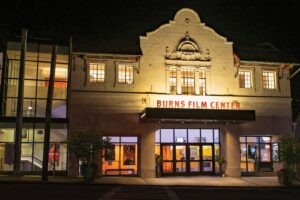
Today the Jacob Burns Film Center in Pleasantville is widely recognized as one of the most successful suburban art house cinemas in the United States. Every year, some 200,000 people flock to the Burns from around and outside Westchester County for its state-of-the-art, five-screen theater presenting over 400 independent, documentary, and foreign films annually. It is also renowned for its film discussions with celebrity actors, filmmakers, screenwriters, and critics. In addition, some 7,000 local students walk through the Burns’ doors every year, mostly free of charge.
But it wasn’t always that way. In the late 1990s, founders Stephen and Lisa Apkon and Sabrina Coughlin, brought together a group of community members, including Brian Ackerman (Founding Programming Director), to help bring their dream of a nonprofit cultural arts and education center to life. The group’s focus was on reviving the 1925 Rome Theater, a beautiful Spanish mission–style historic landmark that was a working cinema until 1987.
According to Stephen Apkon, who is also former executive director (2001-2014) and a board member of the Burns, “The project grew through a series of informal coffees, dinners, and gatherings where community members embraced the vision and helped launch fundraising efforts.”
The group (originally known as Friends of the Rome Theater) soon launched a $5 million capital campaign to build the Burns. Early on, the campaign received a $1.5 million grant from the Jacob Burns Foundation, and the film center was named in honor of this leadership gift. The Burns broke ground in May 2000 and opened in June 2001, with three movie screens and the first year’s attendance totaling approximately 3,000 guests.
As far as big names in the film business who have heIped the Burns, Apkon said, “I’d have to start with three great Burns film center board members and filmmakers, Ron Howard, Jonathan Demme, and Steven Spielberg. Also, somebody who’s been very important from the beginning is Janet Maslin. A former New York Times chief film critic, Maslin has served as the long-standing president of the film center’s board of directors and regularly moderates high-profile Q&As with renowned directors and actors. In addition, the Burns has hosted major filmmakers and celebrities, including Tom Cruise, Meryl Streep, Alicia Silverstone, Brendan Fraser, Barry Jenkins, and Martin Scorsese.
Since its inception the Burns was always envisioned as a film and education institution. Brandon Shenkman, the Burns’s director of education, said, “It’s truly wonderful because education was not an afterthought, rather it’s been built into the DNA from the very beginning.”
“Our goal is to turn people from passive scrollers into active viewers,” said Shenkman, adding that students learn both critical viewing skills and the tools to tell their own stories through visual media.
A key milestone for educational programming at the Burns was the $20 million Campaign for 21st Century Education that allowed the Burns to build the Media Arts Lab across the street from its theater. Launched in November 2006, the campaign was successfully completed in December 2008, and the Media Arts Lab opened in January 2009.
Shenkman said, “The vision for the Media Arts Lab was to have this hugely beautiful professional space that was built as a playground for people who wanted to learn anything and everything about filmmaking and visual arts.” The lab has a recording studio, sound stage, screening room, and a huge editing bay of computers.
The Burns champions the notion that media literacy should be something that’s accessible to everyone and works hard to help the 80 local schools it serves every year to overcome any economic barriers that might prevent them from participating in educational field trips.
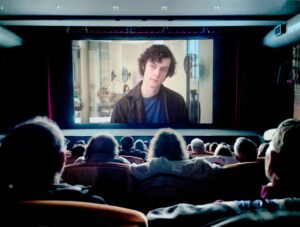
“Over 70 percent of the students we work with each year come from underserved schools. The children participate free of charge, including bus transportation to and from the Burns,” said Shenkman.
School-based programming begins in third grade and extends through high school, using film and media projects to strengthen writing, critical-thinking, and visual literacy skills. “Our programs work with both school curricula and Common Core standards,” said Shenkman. Programs are designed to complement classroom learning and cover subjects ranging from environmental science to civics and government.
At the pinnacle of education offerings are the “Director’s Cut” programs, which focus on narrative filmmaking, documentaries, and screenwriting. The – free of cost, immersive, pre-collegiate filmmaking fellowships are offered in partnership with the New York University (NYU) Tisch School of the Arts. Designed for high school students, these highly selective groups receive mentorship, access to industry-standard equipment, and a stipend. The program culminates in a table read by professional actors of student work (screenwriting fellowship), and the documentary program is incollaboration with Imagine Entertainment, Ron Howard’s production company
The Burns’ educational offerings also expand to public programs, including afterschool and adult education. “Courses range from filmmaking to cinema studies and screenwriting – basically anything that is a film adjacent discipline,” said Shenkman. The Burns also has a filmmaking summer camp for fourth through twelfth graders that covers the whole filmmaking process from pre-production filming to editing.
Many students at the Burns have gone to top colleges, including Harvard, Brown, Rhode Island School of Design (RISD), and NYU. “Beyond that, I get at least three or four emails a month from people who say that they made a film with us 10, 15, or 20 years ago, and are now out there in the field,” said Shenkman. “In addition, there are a lot of former students who work for us as instructors.”
Another important growth opportunity for the Burns came when the nonprofit purchased a home adjacent to the Media Arts Lab. Called the Artist Residency, it is the third building on the Burns campus. Since its opening in 2009, it has hosted dozens of artists-in-residence from over 20 countries, ranging from emerging voices to internationally renowned filmmakers (such as Academy Award winner Bong Joon-ho of “Parasite” fame).
“A lot of the people that stay with us are not famous, but they’re doing amazing, really important projects. It’s always been part of our mission to highlight voices that don’t always get the chance to be on screen,” says Shenkman.
In March 2015, in direct response to appeals from the community, the Jacob Burns Film Center began the next step in its evolution by opening two new theaters on the third floor of the theater complex along with an updated gallery space. Most recently, the Take 3 Wine Bar and Café opened in 2024, a perfect place for pre- or post-film conversation.
According to Chris Holliday, the Burns’ director of Special Programs and Strategic Partnerships, the “secret sauce” behind the film center’s success is that “nothing beats that communal experience of being in a movie theater.”
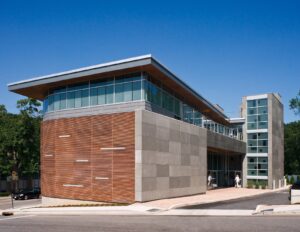
PHOTO COURTESY OF JACOB BURNS FILM CENTER
Apkon agreed, adding, “Since the beginning we wanted the experience not to end when the credits come on the screen, but to really begin. And the way that’s happened is through conversations with filmmakers, actors, set designers, and screenwriters, really covering all of the different facets of storytelling. I think that that is something very special about the Burns. There’s both a conversation with the featured guests and a conversation that’s created within the audience.”
Apkon said, “People want to come together and have shared experiences, especially now. At a time where a lot of media is contributing to us being more and more polarized, I believe that there is a need and a very strong desire for people to come together in places like the Burns.”
For readers wondering how the movies get chosen at the Burns, the film center has a team of three full-time programmers who travel all over the world to scout titles and talent. “We go to film festivals, like Sundance in the U.S., the Berlinale in Germany, Cannes in France, and BFI Flare, which is the LGBTQ+ film festival in London,” said Holliday.
“We truly watch a lot of movies and want to be able to bring in a variety of films that appeal to everyone. And that means trying to get that balance between something like “The Devil Wears Prada” with a documentary from director and producer Maite Alberdi,” said Holliday. (Alberdi is a rising star in the film world who is the first Chilean woman to be nominated at the Oscars.)
He noted that he wants not only to inspire people and educate people, but also to challenge audiences by presenting a film they may never have thought to see unless it’s programmed at the Burns. “Hopefully these films open peoples’ eyes and broaden their horizons,” said Holliday.
The amazing range of film series and festivals at the Burns, spans from the annual Jewish Film Festival (celebrating its 24th season this past March) to “Out There,” a new monthly series that celebrates Queer stories through a diverse selection of films from around the globe. The Burns also has an international documentary film series called “Docs Without Borders” and a series of family-friendly films called “All Ages,” which screens everything from “The Wizard of Oz” to “Shrek”.
“In addition, we have a program called Community Matters where we partner with nonprofit organizations across Westchester doing phenomenal work,” said Holliday. “I think that’s what makes the Burns so special is we show films from all over the world, but we also bring together groups in the community to have conversations and experiences together.”
Twenty-fifth anniversary programming in 2026 has included the first- ever retrospective of Ron Howard’s work, from “The Courtship of Eddie’s Father” (1963) to his Academy award-winning movies “Apollo 13” and “A Beautiful Mind”. The “Founder’s Series” featured some of Apkon’s favorite films, and “Time Capsule 2001” which showcased films from the Burn’s opening year. (See the side bar for upcoming 25th anniversary programming.)
When asked if he ever imagined if the Burns would be become such a cultural cornerstone in Pleasantville and beyond, Apkon said, “We believed that it could be the key to redeveloping the commercial area in Pleasantville, and we thought we could have an impact on the area around us. However, it so quickly exceeded our expectations. We are so grateful to be a part of this community.”
Apkon marveled at the shops and restaurants that have opened and at how Pleasantville has become a bustling downtown. “When we opened 25 years ago, there were numerous vacancies and lots of turnover. Now, there’s not only thriving businesses, but also a lot of residential units that have been built. One of the fun things to see is when the real estate agents are advertising in their ads that a home is ‘walking distance to the Jacob Burns Film Center’,” he said. Apkon pointed out that the Burns is also a destination location for people from all over the Greater New York Metropolitan area.
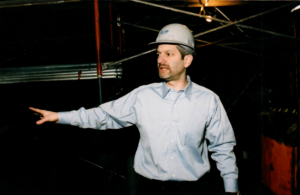
PHOTO COURTESY OF JACOB BURNS FILM CENTER
Looking at the history and future of the Burns, Apkon commented on how film has changed in the past quarter century: “The way a movie is delivered, whether it’s 35mm film or digital, at the core it’s still about the story. And the stories reflect not only our cultures, but they reflect the times and the things we as humanity are dealing with at the moment,” he said.
Apkon predicted that the programming will continue to evolve and to reflect the world around us. “Right now, we are at a very big crossroads for the humanities as it relates to communications, and that is around AI in terms of both the discernment and creation of images,” he said.
“I believe that literacy will continue to evolve and shift and needs to reflect the new modes of content creation and distribution. And I believe that the Jacob Burns Film Center should be and will be at the center of that very important conversation. I think that the ongoing challenge is always to stay new and to stay relevant to audiences as the community and the world changes.”