• Skip to primary navigation
  • Skip to main content
  • Skip to primary sidebar
  • Skip to footer

The Inside Press

Magazines serving the communities of Northern Westchester

  • Home
  • Cover Stories
  • Features
    • Portraits and Profiles
  • Advertorials
    • Lifestyles with our Sponsors
    • Sponsor News!
  • Wellness
  • Happenings
  • Advertise
    • Advertise in One or All of our Magazines–And/Or Subscribe
    • Advertising Payment Form
  • Contact Us
  • Search

autism

Local Boys Develop An Emotion-Recognition App For Children On The Autism Spectrum

May 28, 2015 by The Inside Press

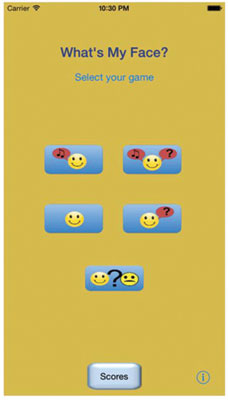
Screenshot of the engaging opening page for the free Robobenders iPhone App. Robobenders Photo
Screenshot of the engaging opening page for the free Robobenders iPhone App.
Robobenders Photo

By Beth Besen

Every parent knows the inexpressible and all-consuming love felt when embracing their newborns for the first time. It would seem there’d be nothing better, nothing deeper. But, then, miraculously, there’s more; the babies start to respond to us, they recognize our voices, they follow us with their eyes, they smile for the first time and smile back at us. Without words, we start to communicate our feelings.

Now imagine a different scenario. Your baby seems locked in his or her own world and doesn’t respond; doesn’t seem to hear let alone recognize your voice, and looks fixedly into space, inward, or everywhere but at your face and into your eyes. It’s heartbreaking, but it’s the reality experienced by many parents of children diagnosed with autism.

Autism, currently identified in one out of every 68 children,* is recognized as a spectrum disorder. This means that there’s a great range and diversity of disability. The hallmark of the disorder, however, is social impairment. And regardless of intellectual and other abilities, most of those diagnosed with Autistic Spectrum Disorder (ASD) will be mildly to severely impaired with regards to social skills development and will score so on any measurement thereof.

Enter five brilliant, thoughtful, energetic and motivated young men from Chappaqua and Armonk. Chirag Kumar, Daniel Shih and twin brothers Zachary and Nicky Eichenberger are 8th grade Bell students, and Tyler Harp is an 8th grade H.G. Crittenden student. Together, the boys are the Robobenders, and, with their innovative new App, What’s My Face, plus international recognition following their Semi-Finalist placement (one of only 20 teams chosen out of 527 entries) in the annual FIRST® LEGO® League (FLL®) Global Innovation competition, they are changing the ASD world for the better.
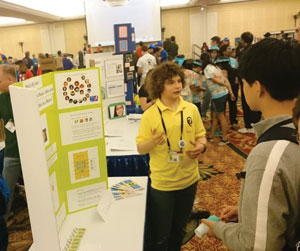
Zachary Eichenberger explains the team’s app to interested convention goers. Leslie Shih Photo

How the Team Got Started

“Friendship definitely came first,” laughs Chirag, while the others chime in with whole-hearted agreement. The boys are often in the same classes and, additionally, their families are all friends. According to Alexandre Eichenberger, who is not only the twins’ father, but also a self-described IBM “nerd” and mentor to the Robobender team, the boys came together three years ago. They were drawn to FLL®’s cooperative philosophy which, explains Alexandre, “is the equivalent of team sports applied to STEM study.”

While true that the boys met regularly that first year together, moms Christina Lee and Regina Eichenberger explain that the group really grew into something special a year later during Superstorm Sandy. The Eichenberger house was the only one with electricity and, says Regina, “food and laundry were very bonding.” There are smiles all around as parents and boys fondly remember the variety (it’s a multi-ethnic group, after all) and fun of their shared meals. Then, with an impish grin, Chirag adds, “the greatest advantage was so many days without school, and having plenty of time to brainstorm ideas and work them out.”

The Brainstorm that Led to Development of the App
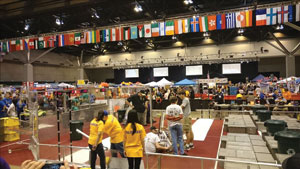
The international event attracted thousands of people.

The FLL® competition themes are specified annually, but, overall, the mandate is to develop “innovative solutions to real-world problems.” This year’s real-world problem topic: the future of learning. The boys came together last August to begin thinking about their project for the year, and brainstormed for about a month. They each have a specific area of specialized interest and talent. For Chirag, it’s research; for Tyler, content; for Zachary, outreach; for Nicky, programming and for Daniel, design. The final decision? That was inspired by Daniel’s brother, Martin, who was born severely autistic. The Chappaqua boys also had a classmate at Grafflin and Bell schools with ASD. Says Nicky, “Improving the way someone with autism learns” appealed to each of them. With that idea uniformly settled and agreed upon, the boys began their work in earnest.

Alexandre describes a disciplined schedule, “They met for the entire FLL season (Oct-April) for a couple of hours per week, and as the competition drew near, many weekends were spent on the project and the robot. In addition, Nicky and Zachary used the Xmas break to learn the Swift programming language to program an iPhone. They learned a lot of skills; teamwork to achieve a common goal, focus and dedication to reach this goal, robotic and mechanical skills to build a competitive robot (they won the robot performance in their first competition)and programming skills.”
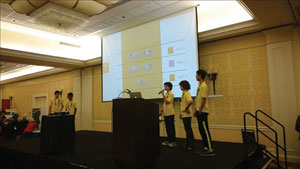
All five team members on stage for the formal presentation. Leslie Shih Photo

It’s a Family Affair

Everyone participated in the project, kids and parents alike. The boys realized early on that music was going to be a key part of their invention. Says Regina, “Music stimulates the whole brain.” Nicky explains further, “Stimulating the whole brain creates a deeper understanding of the whole emotion. Video-modeling leads to raw memorization, but music goes further. You’d think it would just affect auditory processing but it actually evokes emotion.” Daniel and Christina attest to the fact that music had and continues to have a dramatic impact on Martin, changing his life, and therefore the entire family’s life too, for the better. The boys spoke and worked with Martin’s Chappaqua music therapist, Barbara Yahr, as well as the UK organization Music for Autism, as they developed and integrated music as an important component of their App.

With a Ph.D in Cognitive Psychology and current work in the area of decision-making, Chirag’s mom Poonam Arora, was also a valuable source for the boys, particularly in their research and development period. She worked with the team, helping them hone the critical neuroscience questions that led them to find and refine their answers. To this end, they exchanged emails and spoke with neuroscientists at Columbia and IBM. In fact, crafting emails to professionals and hearing back from them “de-alienated these famous researchers for us. It made them less imposing,” says Zachary on behalf of the team.

Even their eye-catching yellow polo shirts are an in-house team effort. Tyler designed the bold graphics, and Christina had the shirts stenciled; in fact, she shares that the shirts were still wet from the screening process as she packed them for travel to the FLL® Global Innovation Award Semi-Finalist competition in St. Louis. And, yes, every Robobender attended with at least one parent.
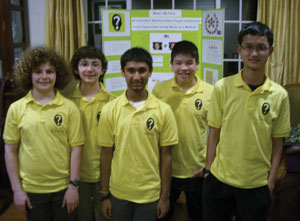
Returning heroes (L-R): Zachary Eichenberger, Nicky Eichenberger, Chirag Kumar, Tyler Harp and Daniel Shih

So, How Does the App Work?

One of the biggest surprises and a motivation for the boys’ work was the realization that autistic people can actually feel emotions very strongly, often even more strongly than do neurotypical people. With this in mind, Nicky explains that WHAT’S MY FACE was developed to help medium-to-higher functioning ASD school-aged children recognize and identify the four “most basic and necessary feelings: Happy, Sad, Angry, Scared.” It’s an easy-to-use Iphone App that connects the dots of music, gaming, social skills, computer interface and autism. At first, a player hears music associated with one of the four emotions. Slowly, with a deliberate delay built in so that the music has time to make the Associative Learning connection, a face takes form on screen and the emotion is clearly identified and spelled out. As the game progresses and points are awarded and accumulated, the player is slowly weaned off the music and better prepared to identify emotion in real life as well as in the game.

Win-Win

The boys and their families are still flying high after their return from the Semi-Finals in St. Louis. While they did not make it to the final three, they are proud of themselves and of their contribution. Regina reminds the boys that theirs was the only fully developed App, up and running at presentation time. Nicky remembers and shares that other participants came over to express interest in What’s My Face for people they know with ASD. The parents recognize what a great life and learning experience this year has been. In addition to all the technical work and hours of research and development, Alexandre speaks for them all when he says that the boys also learned, among many things, how to contact and present work to professionals in various fields, how to take constructive criticism and how to work truly collaboratively as a team.
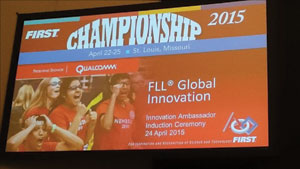
The Championship 2015 poster. Leslie Shih Photo

And the best part of the whole experience from the boys’ points of view? Zachary puts it in perspective saying theirs is one step in the march of a million steps towards a cure for Autism. Chirag nods and suggests, “We’re 13 years-old, but we can still have an impact.” And Daniel adds, “We’re helping people like my brother so the world can be more meaningful.” Nicky points out they’re not actually finished because there are always ways to improve and update the App. And, while Tyler agrees with his teammates that “the best thing was being able to help and have an impact,” he then pauses for a brief moment, before adding one final thought, “oh, yeah, and hanging out with friends. That was the best too.”

*Estimate per the CDC’s Autism and Developmental Disabilities Monitoring Network

What’s My Face logo, designed by Tyler Harp. Robobenders Photo

Familiar with the disappointments that can play all too frequent a part in the ASD world, Beth Besen was thrilled to meet the Robobenders, and share their story with Inside Chappaqua and Inside Armonk readers.
Filed Under: Cover Stories Tagged With: autism, Iphone App, Robobender, WHAT’S MY FACE

The Impact of Girl AGain Empowering Young Women With Autism

April 17, 2015 by The Inside Press

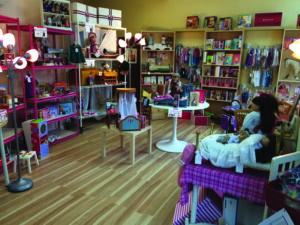
The White Plains store overflows with gently used American Girl doll merchandise.

By Gillian Hand

At first glance, it might appear like any other store. Colorful merchandise, carefully handled and placed, lines the walls, and enthusiastic and knowledgeable workers greet you with a smile. You feel welcomed, and in the hands of experts.

But this is more than just a store. It is Yes She Can Inc.’s Girl AGain American Girl © resale boutique–a center of learning, progression and happiness for young women on the autism spectrum.

Preparing for the Workforce of the Future

Yes She Can Inc., founded by former corporate marketer Marjorie Madfis, provides these women with the training and education of business skills transferable to the competitive work world. Girl AGain taps into their passion for and expertise with American Girl products while creating a safe working environment, training them in the skills that will enable them to acquire and sustain employment.

Madfis found inspiration for Girl AGain in her daughter Isabelle, a teenage girl with autism. Though a fan of, and expert on, all things American Girl, the store in Manhattan posed the threat of sensory overload*. “What if I could create a mini version of the store?” Madfis thought, and Girl AGain was born. Alongside Chappaqua resident and psychologist Sheri Baron, Madfis opened the White Plains store in February 2014. The program provides coaching and support in the development of retail-related business skills, along with a nurturing place where their expertise is needed, 
appreciated, and valued.

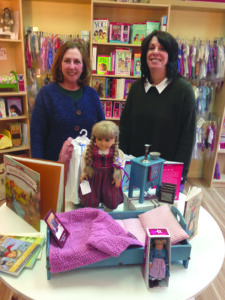
Girl AGain co-owners Marjorie Madfis (L) and Sheri Baron (R)

Twelve young women–high school students and graduates in their teens to early twenties–currently work in the boutique, receiving experience in all aspects of the business. Most work approximately two days per week, and get trained “end-to-end” in the variety of skills needed both in Girl AGain and in the work world. This includes preparing donated products for resale, researching and determining appropriate prices, and performing business transactions with customers. They solve problems, collaborate with colleagues and make decisions, all while learning how to deal with uncertainty. By sharing and justifying their ideas, the young women develop the ability to debate and compromise–skills that are crucial in any work environment. Madfis and Baron are aware that this program isn’t for everyone; the participants must be willing to put in effort, cooperate with others, and have motivation to pursue a career.

“There is such an insecurity to give answers and trust their own instincts,” says Baron regarding the training. “They have not yet been given the opportunity to use their own judgment.” Girl AGain’s non-profit mission confronts both this insecurity and the attention, sensory and emotional problems associated with autism disorders. Madfis describes the store as “a safe place to learn new skills without worrying about possible consequences of errors.”

Real World Training Working at Girl AGain has allowed the young women to discover their own strengths and weaknesses. The workers must learn to interact with customers, adjust to distractions, understand the levels of authority, and manage situations they have not anticipated. These experiences teach them the expectations and responsibilities of competitive business –but if they ever feel overwhelmed, they can “chill” in the boutique’s “Cozy Corner” and take a break from the hustle of 
the workplace.

To develop social communication skills, the young women lead special events at Girl AGain where they demonstrate their knowledge and interact with members of the community. Whether it is American Girl doll “Hair Do’s and Don’ts” or a special book reading, these “workshops” provide the women with leadership experience. In addition, weekly business meetings feature the exchange of strategies and ideas followed by a group pizza dinner, both of which are important in the social development of these otherwise isolated young women. Interacting with peers, especially those who share their interests, creates a comfortable social environment where they can stretch in areas that are difficult for them and build their confidence around others.

Madfis and Baron describe the program as an “incubator” where the young women receive the experience they need before progressing to a paid job or additional training. Girl AGain is their first step toward finding success in the competitive workforce, world they hope will discover the potential and capability of workers with autism.

Helping the Mission

Girl AGain’s eager customer base–both young American Girl enthusiasts and older collectors of the brand –happily support the program for its mission of educating the young women as well as its constantly evolving inventory of reasonably priced merchandise. These customers act as part of the training, presenting social and professional interaction opportunities. Girl AGain is grateful for any donations, as they excite the workers, enrich the training, and expand the store’s offerings.

Girl AGain is the first venture of Yes She Can Inc., but certainly not the last. Madfis and Baron continue to develop the program and increase the learning and employment opportunities for girls on the autism spectrum. There is no doubt at all that these young women will develop the vital life skills necessary to live, work, and prosper on their own, bringing their unique talents to whatever they chose to pursue. 
Yes She Can, indeed.

For more info, visit: www.yesshecaninc.org or www.girlagain.com or contact Sheri Baron at sbaron2001@aol.com

*Editor’s note: Sensory overload occurs when one or more of the body’s senses experiences over stimulation from the environment; many people with autism are acutely, uncomfortably and/or overly sensitive to various sensory stimuli–a large, bustlingly crowded store such as American Girl in Manhattan would present a significant challenge.

Gillian Hand is a sophomore at Horace Greeley High School and a frequent contributor to Inside Chappaqua Magazine. She was thrilled to be able to donate her old American Girl products to Girl AGain.

Filed Under: Cover Stories Tagged With: autism

Protecting Our Autistic Children

May 1, 2012 by Sarah Ellen Rindsberg

All parents shudder at the thought of a missing child.  For those whose offspring are autistic, the fear is particularly prevalent.  In recognition of the need to protect this segment of the community, the New Castle Police Department has become an active participant in a novel venture entitled:  Kind Find.

Officer James Dumser, program manager for Kind Find in the town of New Castle learned about the program recently when he attended a seminar called “first responders and individuals with autism; averting crises and preventing disastrous consequences” on March 27.  The mission of Kind Find is to have all parents with children on the autistic spectrum register their children with the police department.  This will insure that when the department receives a call regarding a certain child or residence, information will instantly appear on their screen, advising them of where the person falls on the spectrum of autism.  This knowledge will in turn inform the manner in which the department approaches the individual.  “Kind Find will help us out immensely,” Dumser observed.

The program is mutually beneficial for families and the police department.  According to Dumser, the interpretation of responses from an autistic individual are not always self-evident.  Sometimes, “We think the person is trying to harm us when they are not,” he related.  Officers are trained to understand that one-word answers are not always the result of a negative attitude.  Instead, they may be the dominant way in which a person communicates.

Information on triggers; actions that set off an autistic individual such as approaching too closely or touching, are especially helpful.  Additionally, any insight into what the child responds best to such as trains or video games, will facilitate the department’s efforts to assist.

Registration forms are available at the police department and at ncpd.info/forms.  Extensive information on the program is at kind-find.com.  Officer Dumser may be reached at 238-4422 or jdumser@town.new-castle.ny.us.

Filed Under: New Castle News Tagged With: autism, child, kind find

  • « Go to Previous Page
  • Page 1
  • Page 2

Primary Sidebar

Please Visit

White Plains Hospital
William Raveis – Armonk
William Raveis – Chappaqua
Northwell Hospital
Houlihan Lawrence – Chappaqua
Houlihan Lawrence – Armonk
Houlihan Lawrence – Briarcliff
NYOMIS – Dr. Andrew Horowitz
Westchester Table Tennis Center
Spavia
Compass: Miller Goldenberg Harris Team
Lipari & Mangiameli Dentistry
Raveis: Lisa Koh and Allison Coviello
Bristal Assisted Living
Maid Brigade
Kevin Roberts Painting & Design
Zwilling J. A. Henckels
Meagher & Meagher Attorneys at Law
Compass: Aurora Banaszek
Dr. Briones Medical Weight Loss Center
Decicco and Sons
Beecher Flooks Funeral Home
World Cup Gymnastics
EyeGallery
Beascakes Bakery
Houlihan: Tara Siegel
Joseph Richard Florals
Breathe Pilates and Yoga

Follow our Social Media

The Inside Press

Our Latest Issues

For a full reading of our current edition, or to obtain a copy or subscription, please contact us.

Inside Pleasantville and Briarcliff Manor Inside Chappaqua and Millwood Inside Armonk

Join Our Mailing List


Search Inside Press

Links

  • Advertise
  • Contact Us
  • Digital Subscription
  • Print Subscription

Publisher’s Note Regarding Our Valued Sponsors

Inside Press is not responsible for and does not necessarily endorse or not endorse any advertisers, products or resources referenced in either sponsor-driven stories or in advertisements appearing in this publication. The Inside Press shall not be liable to any party as a result of any information, services or resources made available through this publication.The Inside Press is published in good faith and cannot be held responsible for any inaccuracies in advertising or sponsor driven stories that appear in this publication. The views of advertisers and contributors are not necessarily those of the publisher’s.

Opinions and information presented in all Inside Press articles, such as in the arena of health and medicine, strictly reflect the experiences, expertise and/or views of those interviewed, and are not necessarily recommended or endorsed by the Inside Press. Please consult your own doctor for diagnosis and/or treatment.

Footer

Support The Inside Press

Advertising

Print Subscription

Digital Subscription

Categories

Archives

Subscribe

Did you know you can subscribe anytime to our print editions?

Voluntary subscriptions are most welcome, if you've moved outside the area, or a subscription is a great present idea for an elderly parent, for a neighbor who is moving or for your graduating high school student or any college student who may enjoy keeping up with hometown stories.

Subscribe Today

Copyright © 2026 The Inside Press, Inc. · Log in