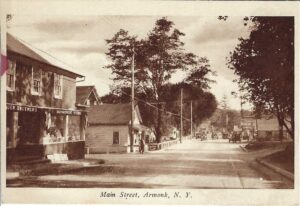
The building on the left survives today at the corner of Maple Avenue and Main Street. By the early 1900s the building was Lander Brothers Store and Post Office. The view is looking up NYS Route 128 – Main Street, Armonk, towards today’s Bedford Road and Kent Place and farther up the hill towards NYS Route 22. Out of the image to the right, across from Lander Brothers Store and Post Office, would become today’s Citibank.
PHOTO COURTESY OF NORTH CASTLE HISTORICAL SOCIETY
As we celebrate the 250th anniversary of the United States, the Town of North Castle is marking the semiquincentennial as well. Commemorating 250 years of American independence and the town’s integral role in the Revolutionary War, Armonk has held a special place in the hearts of those who call it home. Three longtime residents; Sharon Tomback, Bud Schultz and Susan Shimer share their fond memories of life in this idyllic town and what the future holds for it as we celebrate this tremendous milestone.
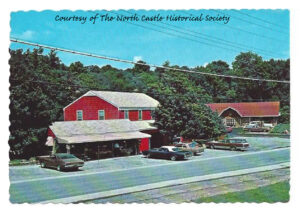
First, let’s take things back to the 1950’s when Armonk’s downtown was more pastoral with roadside farm stands rather than today’s boutique shops and chic restaurants. Bud Schultz, long time Armonk Fire Department volunteer, along with his family started the beloved Schultz’s Cider Mill in 1951, buying the property from Cornelius Rae Agnew. Over the next three years, his father and uncle built out the building where they sold fresh cider and apples. The family moved in in 1954 and added a coffee shop selling their famous apple cider doughnuts.
Sharon Tomback, a resident since 1985 shares her own special memories of Schultz’s, “We went after church on Sundays for coffee and donuts. Forget about lunch! We watched our donuts come down the long hot oil fryer, pass into the powdered sugar and go into a bag imprinted with ‘Leave the Bag Open’. We took home fresh vegetables in the summer and pressed on-the-spot apple cider in the fall.” Sue Shimer, who served as North Castle Town Justice for many years and has lived in Armonk since 1966, also echos the importance of Schultz’s to the community. ”For many of us it was the real heart of Armonk. The always friendly Schultz family made the cider and donuts that attracted people from all over. Bud Schultz would drive to the produce market in the Bronx or to the Hudson Valley early in the morning to bring fresh produce to the Cider Mill. Whenever I went there, Mr. and Mrs. Schultz were at the stands, keeping me and the other customers happy.”
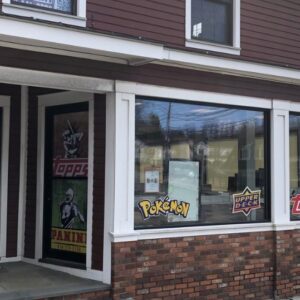
PHOTO COURTESY OF NORTH CASTLE HISTORICAL SOCIETY
Life in Armonk was slower (in a good way) back then and everyone knew and looked out for everyone else – which is still a common theme persistent today. Shimer remembers downtown Armonk spanning only one block and everyone saying “hello” as you passed them. Armonk Pharmacy was run by John DiGiacintio, “We all called him Johnny Di”, says Shimer. “To me, the pharmacy and particularly Johnny Di was very special – can you imagine, when my toddler was ill, Johnny Di brought the prescribed medicine to my car. Next door was a small liquor shop, operated by one of Johnny Di’s sons, John Jr. The small-town feeling was amplified at all the businesses.” One of Schultz’s favorite memories also involves the pharmacy – “Walking to Johnny Di’s for a cherry coke served by Anna Mae Brown.”
Although the pharmacy may be gone, the small town feeling still persists. When asked what endures about Armonk despite its growth, Schutlz is quick to say, “People’s ongoing generosity and willingness to help.” Tomback agrees, hoping Armonk never loses its value for traditions and appreciation for those who “came into the wilderness and built a lovely community at ‘the fishing spot between the hills’ – the traditional meaning of the Indian word Armonk.”
It’s easy to see why so many places in Armonk hold such a special place in people’s hearts. Sadly, many establishments are now just fond memories but fortunately others still remain. One staple that’s been around for many years and still going strong is Hickory & Tweed, Main Street’s stop for all things biking and skiing. Originally owned and run by Jimmy and Roberta Ross from 1961 to 1985, it was bought by Skip Betzel, who worked there through high school and college and now continues running it with his son. It’s wonderful to see Main Street filled with both long-time and newer establishments. Some stores of the past that will always be considered the heart of Armonk include Ox Yoke Restaurant, Green’s Stationery, Schultz’s, Armonk Pharmacy and Village Prime Meats.
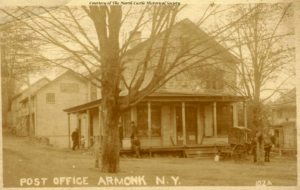
This building, with porch enclosed, survives today at the corner of Maple Avenue and NYS Route 128 (Main Street). The view is NYS Route 128 on the left and Maple Avenue at the bottom of the image.
PHOTO COURTESY OF NORTH CASTLE HISTORICAL SOCIETY
One business of the past remembered with nostalgia by all is the Log Cabin Restaurant. Located on Route 22, it opened in 1916 as a roadside farm stand and in 1921, a log cabin was built where people would come to buy fruits and vegetables, cider, doughnuts, pies and more. In 1929 owner Webster Schmaling sold it to August Hussar who built a large dining room and dance floor. In its heyday, the Log Cabin could hold over 1,000 patrons, who would come to dine and dance to live music. The Log Cabin tragically burned to the ground in 1965 but lives on for so many who share wonderful memories of its place in Armonk.
Shimer remembers “The North Castle News” (1963-1986), which was a publication started by Edith Hahn. “The North Castle News” was a weekly and vital source of information about Town. It covered Town Board meetings, local Court proceedings, and other local news”, she says. Shimer herself is a longtime town advocate and volunteer, having served in part as Past Chair of North Castle Landmarks Preservation Committee and Past Chair of North Castle Historical Society. She currently serves as President of Town of North Castle Ethics Board.
Tomback was inspired by Dick Lander, who at the time served as the Commissioner of Jurors for Westchester County as well as the North Castle Historian, to move to Armonk. “Lander learned that I was a history lover and steered me towards joining The North Castle Historical Society. I fell in love with everyone involved. The Historical Society is an all-volunteer, membership-based 501(c)(C3) charity chartered by the Regents of the University of the State of New York. We enjoy each other’s company and accomplish some great things for our community.”
What becomes clear to see through these conversations is that one of the most enduring resources in Armonk is the people who live there. In the past Schultz says, “Families got together to play cards, go bowling and have parties. They supported local activities like the Memorial Day Parade.” Today, many of the special events and organizations in town are supported and run by volunteers. Events such as the Fol-de-Rol each Spring and the sentimental Frosty Day in November – which bring large crowds to Armonk and stir up an abundance of nostalgic feelings.
Despite its rapid growth since the 1960’s, Armonk still holds onto the charm of its small-town feeling. Two of the biggest changes in the town’s recent history were the creation of the Byram Hills School District as well as the induction of IBM’s world headquarters. These two events coincided with each other in 1964. Shimer says, “IBM brought many people to Armonk who had no family connection. Until the opening of Byram Hills, children needed to travel to Pleasantville to go to high school. Byram Hills created more of a community among our teens and also made more people willing to raise their families in Armonk.”
PHOTO COURTESY OF NORTH CASTLE HISTORICAL SOCIETY
As for the future of Armonk – the common sentiment is that it boils down to one thing – its people. The residents who uphold the values of the town are what make it everlasting as Armonk embarks on the next 250 years.
Schultz summaries the celebrations succinctly. “I’m looking forward to the anniversary. This town has great history, and we need to celebrate our part in it.” As for what he hopes never changes about Armonk? Probably something most people who live here can agree on: “I hope that Armonk will always keep its small-town feeling.”